

 |
 |
 |
 |
 |
 |
 |
 |
 |
 |
 |
 |
 |

January 31, 2006
Peace be unto those who brand the networks of Messrs DeSkilling
The first badwilled one I accidentally started mapping began in 1998:
Case 3 Mr Maxwell
Ironically for a mathematician, whose only work is to try to help people and organsiations value deep trust and action learnings multipiers for sustaining human progress -peoples economics mapped through the exponential wealth our open human collaborations can compound and network, my worst ever career move began in 1988-1989. This was when:-
I joined a big 5 accountant because foolishly I believed they want to build on my experience of modelling local markets worldwide, the leadership (future history ) scenarios of networking and globalisation models that my father and I co-authored on a 1984 future history to 2020, and the entrreneurial revolution circles we have been hosting, 2006 being the 30th birthday party circles of my dad's publication of Entrepreneurial Revolution in The Economist.
I had left a company I loved working for doing deep market modelling work in over 30 countries the day Robert Maxwell bought a controlling share in it. A few weeks earlier after the youthful exuberance 8 years of working night and day on jobs that at the timed seemed to be about helping to innovate stuff people urgently needed, I had been promoted as a director of the company I left but I was unaware that French law permitted 2 boards one of whome did the Maxwell deal before I even heard of it. So I needed a new job and innocently assumed that globalsiation accounting for markets might be important for mathematical transparency especillay knowing how revolutionary service and network economy scenarios looked liked being. I was about my fifth day in this Big 5 accountant as senior consultant for valuing intangibles of brand amd markets, that I got a very ominous signal. I had been invited as part of my first 10 days initiation to have a cup of tea with the senior partner of our division. There jutting out of the front of his desk was a framed letter from Robert Maxwell: I recommmend Big 5 firm XXX because they always do exactly what I tell them to do.
Of course at the time, all I knew I disliked was the sort of ruin of deeply contextual market research (which needed a lot of iteratuive human questioning and not just number crunching to get at any expoentail dynamic more interactive than linera separation). This ruin of the mathematics of hi-trust market relationship info was coming in because collecting more and more data was the big money spinner the more the data collection companies and computer salesfolk teamed up. A couple of years later Max jumped off his yacht when it was found that he had doubly gambled - both doing a sort of CEO's Nick Leeson or covering one bad bet with another over a compound period of time and by playing with the company's pension funds. It amazes me that given such a clear early warning case of what can go wrong with global auditing when it is subservient to the big boss client, that for almost a decade and a half now pensioners rights haven got better in most democratic countries, nor has governance of intangibles valuation judged by transparent mathematical maps of what future exponentials global market sectors are compounding. But then Macs like I are just humble mathematicians -seeking to value space, resolve conflicts befopre they destroy trust and deeply purposeful relationship systems, and empower people who have a deep passion for contextual knowledge and helping others to web a difference around it can ask open questions without fear or favour - not a smart Max
I guess this is not just my cv but archetypal of any transparency mapmaker: if you know of project work for Macs not Max, our webs and networks love to hear from you at wcbn007@easynet.co.uk
Chris Macrae , World Class Business/Brand Networks permalink


The Unseen Wealth Crises of such badwill-led empires as Enron and Anderson have not yet been fixed. However what has happened is recognition that the world needs a new organisational typology - citizen orgs (or some such synonym). Before everyone jumps on the co-brandwagon or rebrands themselves as an organisation all citizens can trust, we have an opportunity to charter or certify how true citizen orgs are uniquely governed to transparency compound the interests of all they make service promises to or whose societal resources they use. Join us here http:/civil-society.blogspot.com These are exciting times if you connect this with the 6 transparency and Beyond leaders and their 16 dvds which you can sample here or find out more about at CS-blog. The DVDs include what World Social Forum founder's lifelong interest is - Beyond Corporate Social Responsibility, and how the world's leading transparency network is fighting corruption in 80 countries. Meanwhile, I am exploring with anyone who wishes to sail into a perfect storm how to go beyond economics. I will be surveying shareholders of The Economist (where my dad Norman Macrae worked through his lifetime as economics and future systems editor) to see if anyone still wants to live up to Scottish founder James Wilson's 1840s mission for The Economist and the truth school of economic journalism he developed as one of the 19th C world champions for social entrepreneurship. Do contact us if you have a collaboration idea to map on how to explore Beyond Economics
C.M.Macrae.72@cantab.net (CM1) and N.A.Macrae.42@cantab.net (NM1) ... aSIN: association Sustainability Investment Networks http://www.bbc.co.uk/dna/actionnetwork/A4205819

Let's list some of the achievements of badwill branding's greatest executional mix:
Sustainability of our species depends on goodwill networks winning out the war over badwill networks. Enron's branding's crimes were so vast (but in his time so praised) that thousands of CEOs have been infected, through a plague of global consultants who never had any idea of beyond branding's exponentially real consequences
so we greenwash corporate responsibility tables - Enron had PR'd its way to near the top to the day before its reputation died
so we write up inspiring values and vision statements and laugh at the suckers who thought we ever intended to do anything but the exact opposite
so we compound through 80 quarters of spreadsheet mischief from a small company to a top 20 economy in the world, and 7th largest US corporate economy; we destroy every assumption of truth on which free market economics is based. We pervert capitalism until it rivals extreme communism in its dumbing down control of a nation by a few.
The branded hate propagated by Kenny Boy (and those boardrooms admiring his image) started the tailspin in the external value of the nation brand USA to be worth much less than half what it was in 1990. Who abroad knows where trust begins and ends with anything big and American any longer? This is exactly the opposite faith to what made so much of the world grateful to America for the rest of its 20th Century. It is as if Enron's cancerously fictitious values have now infected America's biggset organisational values worldwide. That's quite a chnage in fortune for one man to preside over, but it is just one more signal of how everything is becoming interconnected in the way we choose to design globalsiation.
Enron's fictitious example of compound growth gets honest CEOS in other companies sacked for not performing up to our numbers; along the way we pervert almost every type of profession
we sell billion dollar projects in developing countries by boasting that US aid is conditional and will be withdrawn if you do not buy enron; many of these projects have now become white elephants; billion dollar waste projects concering poor countries' utilities cost many thousands of lives; if anyone does not see Enron as one of the primary root causes of tensions between East and West, they need to have their analytical heads examined
What the world needs now is to turn the corner; to have zero tolerance for another Lay in any of the baordrooms of the Global 5000 corporations. Even as irreversible loss of sustainability of our species is inconveniently within sight, the world's largest governments have done nothing to resolve the Unseen Wealth accounting crisis. In an interview with the EU's number 1 funder of Unseen Wealth research in 2003, he gave me his brutally frank assessment- Chris it would take 3 Enrons in one year to wake the EU's politicians up because this is a technical subject that is not on the radar of public discontent. 23 years into opening spaces for man's greatest communications crisis, it has boils down to this.
Still you who read this are, I presume, a practitioner or opinion leader on branding. The loss of sustainability due to Unseen Wealth and the mathematical errors compounded by brand valuation are on the same storyboard. As Arthur Andersen found out if only leaders had known that risks to goodwill are multiplicative they'd proactively take different actions. They would not serially abuse transparency, let alone human sustainability. If AA had understood that billions of dollars of business stakeholder value but zero social value results in a future of billions times 0 =0 then they would probably be alive today, and Enron would never have helped bring the sustainability of people into question
In pursuit of Her Majesty's question at the end of 2005 : is (globalsiation) turning humanity on itself? She/We should pick up the phone to Tony Blair and tell him to phone Mr Bush. Now that all your old energy advisers are no more GW, who actually advises you on energy? WE demand to know from every corner of this earth http://www.motherjones.com/news/special_reports/mojo_400/76_lay.html
Readers of BB will know that when it comes to Brand Transparency I have written more, provided more validated frameworks for brand valuation and conflict resolution than anyone in the branding world. But I am not the number 1 transparency expert in the world. He says that we (whatever our profession, design or leadership facilitation method) have one last 2 year window of opportunity to get globalisation starting to spin transparency. Read his lips on this 6 minute video http://video.google.com/videoplay?docid=-3407997752764644269 and if after that you want to join a network of 50 brand experts who write to ask Peter Eigen how can we help with transparency international write me at chris.macrae@yahoo.co.uk
May our gods be with us in these perilous times - never have so many been owed so much by so few.
Billanthropy is The Economist's brand of Bill Gate's Microsoft2.0 -the intended antidote to spreadsheeting the world into boxes, where the poorest always get to be the human remnants (a label I dislike that a personnel director of a Big 5 accounting firm used in presentations of how HR's main competence was firing the most innovative, because innovators take more than 90 days to pay back which doesnt match CEO's rewards any longer)
Its just that Billanthropy could end up being a bit top down unless civic society ensures it open sources - a business model Bill may not be world's most experienced at, though actually I am confident he will be. so what's the first step in Bill Squared?
I think I have innovated a way forward to get any deeply concerned virtual community to debate which Change The World (CTW) methods it values most, or even wholly knows of
if you have a minute to test browse, click here
I can't recall if you have to register before it will let you see; this is the community space where nearly 15000 people interested in exploring microfinace communicate thanks to the gracious hosting of Piere and Pam Omidyar
Naturally since they are among the most innovative CTW resources of 2006, this is also a no-cost marketing format that aims to get people to have a look at Ashoka's 16 global academy videos -or any other entrepreneurially revolutionary methods - and debate how they can be related to other significant happenings like how civil society can influence Billanthropy - the world's biggest philanthropist's web, or getting Blair's people's judges on the G8's promises to Africa connected everywhere humanitarians chatter. The latter is particularly urgent if we are to succeed in furthering Grajew's 2 aims on Africa as I understand them:
*make the world social forum in Kenya in January more exciting for economic reform than the world economic forum; not too difficult if we remember to politely ask schwab to collaborate
*up the annual ante for global corporates who do or dont join benchmarking syndicates on sustainability valuation
------
note: of course what can be laid out is constrained by the lowest common denominator of what virtual community software permits- so I realise the format isn't the prettiest in the world- but a question for you- what other virtual communities should this conversation format be tested in next?
cheers
chris macrae
301 881 1655
January 30, 2006
Brainjams & Web2.1
Web2.1 -if I understand it correctly - is the people striking back- everything the web could have been communalised to do if dotcoms hadn't been misdirected by people whose greed toppled love of sustainably real communal application. If you know my dad and I's 1984 future history on networks - see eg http://deathofdistance.blogspot.com - you'll know how we don't much care for people who messed up the greatest people's learning media ever. The summary of what the web can do is well chartered here http://ninenow.blogspot.com/1999/12/learning-networks-open-mentors.html
So why Brainjams? I know there are all sorts of blogwalks, but they tend to be the hi-tech talking to the hi-tech, or the conventional blogger to blogger. Brainjams specifically tries to bridge the hi-tech and those with a communal need who are not hi-tech (not knowing of a blog is cool). Unlike other West coast open space events, its planning to take the Californian belief in Web2.1 to chalenging places - in choopsing an East Coast coordinate it started today with Washington DC!
http://www.brainjams.org/docs/BrainJamsJournal30Jan2006.pdf
Brainjams will also collaborate with just about any movement that believes in web2.1 - so what have we people got to lose? permalink
New Year, new Beyond Branding Blog
In mid-2005, Johnnie Moore, who deserves credit for setting up and continuing this blog in its early days, planned to close the BBB down. Most of us had gone on to our own blogs (listed at right), and it was only the industriousness of Chris Macrae (who, incidentally, also has his own blogs, from those who will have been following his posts) that kept this one current.
And then I stepped in. I had actually begun coming here in the early days—August 2003—posting maybe one item a quarter. But from last May, I became a regular. I look back and call it “my turn”, and through that period saw this blog rise in popularity. It is in the top 10 in Google for the search branding. It also rose incredibly at Blogshares with the number of incoming and outgoing links—a sign that something was right here. Unwittingly, I frustrated Johnnie’s plans.
However, as regular readers know, in January 2006, I asked if I should branch off on to my own blog. The responses were positive. And, after chatting to Johnnie about it, we decided that one win–win was to aggregate blogs from the BB writers you like, so you still get the best of Beyond Branding wisdom, and we don’t have to cross-post. Why not use technology to help us—provided it doesn’t hurt our brand, correct?
The archives will still be here, and this page will still be updated as long as we work on our own blogs—which means regularly. And come on, we know you’ve missed the regular posts of Johnnie Moore and Tim Kitchin. We also know you’ve taken the time to go to their sites—so by putting them all together in a feed, you will now get your dose of all the Beyond Branding co-authors who have agreed to be part of the revised blog.
We won’t switch off the juice right now. I think we need a chance to say where we’ll blog regularly from now on—and most of you know where I have gone to (jackyan.com/blog). But we do hope you’ll stay with us as the changes are implemented shortly. permalink
World Class Brand Network- Open Source Resources
WCBN
I now know of World Class Brands as the last of 3 open debating networks that I have been associated with. It started with my 1991 publication of World Class Brands. I believe this was the first whole book on brands but it was also a future transformation book. As my whole professional career has been connected by an obscene fascination (Johny von Neumann's trem for what a mathematician's lifetime compass of revolution should be - his was collaborative computing as we discovered in my dad's biography of this MVP of mathematics and market games) with maps as a way of sharing connections between 2 or more people with big budgets to govern -and all who may get stuck between them -I wanted to start guiding and being guided to how different the leadership of global or corporate brand architecture practices would be from budgeting for a different brand for every country and new product. I had spent the 1980s researching how uneconomic a new brand for every new product had become for the world's largest multinational brand owners. Our database (using one of the earliest database softwares Express) connected almost every major brand owner of the 80s; and my own project work took us to 25 countries. We got to the embarassing stage of predicting that 90% of new product launches couldn't achieve what their whole NPD process had invested in becasue the company wanted double the share that crowded markets would permit, absent of a revolutionary innovation. Embarassing because before we had the databank, we were paid to manage simulated test marlet surveys, but now we knew we didnt even need to do most of them! Our market models were licensed for worldwide use outside of USA from an MIT professor.
By 1996, I now had many years of experience in how numbers spreadsheeting - learnt at one of the master of such onbfuscation of markets' voices - Coopers & Lybrand - and had taken ove true customer research. So I needed a second book Brand Chartering if any networks were to grow round brand scripts connecting learning organisation and living system. This genre proved to be quite challenging requiring as it did that both the ad agency and the leadership teams connected with all disciplines in the way they communicated service of the brand and vision for their sector's future. The world class brand trilogy has been completed by various co-authored books, one of which is Beyond-Branding.
I still use WCBN in my email but in other respects the network has branched through about 15 names. Before we called ourselves BB or Medinge , we were Chief Brand Officer Association or Brand Chartering or Marketing Electornic Learning NETwork - the latter being how I pasted up the 1996 book Brand Chartering on a web, so I could discuss almost any quiz and answer section of the book with almost any discipline. That worked well until the 3 Bradford Business School professors (including the school's head from whom I learnt about the risks of system theory) who had supported the MELNET web all left, and the web was melted over night by a new brigade
DOD
The Second Network circles I populate -let's call it DoD for "Death of Distance" - began back in 1984 (when my father from The Economist and I co-authored a future history book timelining the s altterantive states -very goodwilled or very badwwiled) of the world to 20204) or 1973 (when i worked for 3 years as a development officer in the UK's national development programme for computer assietd learning). The book was on networking economics and the societal chalenge of transparently connecting 2 million global villages before rivalries between nations or superpowerful specualtors blew us up. Neither fanciful if you understand living systems theiry nor if you understand one defintion of networks as systems*systemes, nor fanciful if you know that my father listened to leaders from more big countries or big corporations between 1950-1980s than just about anyone -including a group who wanted secnarios scripted for the 3rd world war - another one of the future histories my dad helped to wordsmith as well as map how to prevent). DOD newswires keep you up to date with personally interesting stuff such as:
-how to use email to find your best mentors through life & help others likewise
-how to correspond for a global vilage, city or country by co-editing a timeless blog format
-how we need to chnage the curriculum the world ove for 9-13 year old girls including my American daugther
-what the 2 biggest innovation challenges of 2006 in my world are - and how to play a game of snap in case you and one of my big 2 connects (the future of the world's public media sector and the future of photosynthetic energy which we have been scripting since 1984 and keeping an ey out fro who will brang it to worldiwde market safely in time -including unlucky first attempts -Kuwait was just investing in it when saddam started the first gulf war! - how time warps futures!) . Of course I am interested in surveying everyone's biggest 2 - mail me at wcbn007@easynet.co.uk if you are
ER
The third network circles I now need to populate are celebrating their 30th birthday in 1976, which was the year my dad's survey launched Entrepreneurial Revolution in The Economist. This network gives us permission to chnage economics: the main chore of 2005-2010 as predicted by network 2 and our 1984 book's summary here. In my next post in this section I will turn to an opening brief on what is 1-2-3 Entrepreneurial, Revolution, Brand Leadership. By open brief, I mean something that is 90% on target but need iteratively re-editing with you if you have a context which you passioately want to aplly these 3 terms to in oredr to see the future of your context clearly enough to faciliate goodwilled leadership decsions as well hi-trust productive and demanding relationshiops all around it. permalink
dedication: to my father in his 65th year of freelance journalism, 40 of which were also known as deputy editing The Economist.
INTRO
Here are a few bookmarks if you want a quick start in our game of everyone's a participant in the future's sustainability : For nearly 200 years of exploring (Entrepreneurial Revolution) ER - see http://er100.blogspot.com and http://EntrepreneurialRevolution.blogspot.com
The E-word (Entrepreneur) was coined in France to web-log whether egalite and fraternite were proving more sustainable for all the peoples than guillotined kings. In other words the E-word does not just apply to individuals but whether the whole of society or the world it trades it is sustaining human progress for all. Many open space futurists believe that without the transparency of the E-word its monetary partner becomes the dismal science of CONomics not the abundant value multiplying one that Scottish Economists have truly been interested in journalising
FUTURE HISTORY GAME OF ECONOMICS & HUMAN SUSTAINABILITY
Imagine an american team sports game or world entrepreneurial series but this time:
the quarters of the last two centuries involve navigating what 50-year generations exponentially compound around goodwill, and the main investment focus of economics for each next generation is the purposeful game of: how to make worldwide poverty and wars history by mapping newly productive revolutions that any human being can join in as long as they behave transparently (respecting the golden rule of relationship reciprocity as what economic sustainability needs to entrepreneurially and openly systemise)
AND
Imagine too that each quarter of the game of human sustainability starts at these datemarks
1985
1935
1885
1835
--- what scripts on the future might you play out as a social entrepreneur? (eg 1 dray1 abed1 asin1 omi1) or change the world's 1 2 omi1 systems revolutionary?
for example:1985: service economy is already taking over from machine age economy in any places compounding the most future wealth; this economics advantage is about to square with the coming of the knowledge co-workers' www -the greatest communcations revolution ever known dwarfing the invention of tv or printing press and waving through one singular generation of humanity whose engame needs refereeing by whatever are the compound global village truths of entrepreneurial sustainability of the globe and its 7 billion peoples, and whose tipping point deadlines need to be measured by the Biggest Hairy Audacious Goals (BHAG) any child can dream of; it is vital to focus on letting no place on the globe become digitally divided; the goal of this next half century most be to make poverty and wars between nations histories otherwise we will end the human race with microwar's terrorism instead of microfinancing global village network sustainability
for example 1885: the next 50 years will see the greatest innovations coming out of the USA which will scale systems and markets around electricity, telex, radio, highways of proportions quite unimaginable in other parts of the world especially the over-divided Europe which has more divided national boundaries than the US has states , and has the most hierarchical Empire in the history of the world (the male English empire) coming to terms with its own impotence while its political leaders are still incentivised to divide up world territories in ways that temporarily satisfy whichever pressure groups shout loudest
You don't have to agree with either of those ; the question the game demands you set in motion is :take one of the 4 periods; write a one-paragraph guided tour of its next 50 years world entrepreneurial revolution; provide some googles to people etc who were writing about that at your nominated time or to the period's greatest innovators of human productivity (who practise & revolutionise something that matches your future-guiding role
C.M.Macrae.72@cantab.net N.A.Macrae.42@cantab.net jargon searches on systemic constructs:
Collins' BHAG
Change the World
Transparency International
Transformation Sustainability Open
goodwill wars networks
January 29, 2006
(source The 2024 Report, a future history of becoming netwirks & integrating global locally)
CHANGING ECONOMICS 2005-2010
The introduction of the international Centrobank was the last great act of government before government grew much less important. It was not a conception of policy-making governments at all, but emerged from the first computerised town meeting of the world.
By 2005 the gap in income and expectations between the rich and poor nations was recognised to be man's most dangerous problem. Internet linked television channels in sixty-eight countries invited their viewers to participate in a computerised conference about it, in the form of a series of weekly programmes. Recommendations tapped in by viewers were tried out on a computer model of the world economy. If recommendations were shown by the model to be likely to make the world economic situation worse, they were to be discarded. If recommendations were reported by the model to make the economic situation in poor countries better, they were retained for 'ongoing computer analysis' in the next programme.
In 2024 it is easy to see this as a forerunner of the TeleComp conferences which play so large a part in our lives today, both as pastime and principal innovative device in business. But the truth of this 2005 breakthrough tends to irk the highbrow. It succeeded because it was initially a rather downmarket network television programme. About 400 million people watched the first programme, and 3 million individuals or groups tapped in suggestions. Around 99 per cent of these were rejected by the computer as likely to increase the unhappiness of mankind. It became known that the rejects included suggestions submitted by the World Council of Churches and by many other pressure groups. This still left 31,000 suggestions that were accepted by the computer as worthy of ongoing analysis. As these were honed, and details were added to the most interesting, an exciting consensus began to emerge. Later programmes were watched by nearly a billion people as it became recognised that something important was being born.
How to do this in 2006
A) London needs all media experts to argue the greatest future vision of public braodcasting so that the BBC as world's largest public broadcaset and service can provide a colaboration lead
B) Economics needs tio be reframed for 2 million global villages to openly network sustainbility around not a few superpowers to specualte with. The daft udea that open networking of 6 bilion being capability to make a difference will depress anyone apart from robber barons needs expelling. Replacing dirty energy with photosynthetic energy can do this
C) UK as world' s largest Kindgom needs to celebrate its Queens wisdom every day of the year with a different women's leadership and collaboration story supporting the Commonwealth's Future History Catalogue of : Green is the New Red, White & Blue
Please tell me at wcbn007@easynet.co.uk - subject 2006 Our Worldwide Future - what you would like to see at D) and out of which city wil we find a network village ready to Just do it?
The 2024 Report: a future history of the next 40 years" (Macrae & macrae, 1984)
It was the first book to:
provide readers with a brainstorming journey of what people in an internetworking world might do
predict that a new economy would emerge with revolutionary new productivity and social benefits enjoyed by all who interacted in a net-connected world
Our 1984 scenario of an internetworking world
Changing communications, and what makes people distant, bossy, etc
Changing national politics
Changing economics
Changing employment permalink
With 10 years to go before any loss of sustainability becomes irreversible as first forecast in our 1984 future history on Death of Distance and reconfirmed in annual sustainbility networkers meeting, IT SEEMS TIME TO START CLARIFYING THE WORLD'S FINAL BRAND VALUATION METHOD.
Most Valuable Brands in The World 2.0 -sustainability's untold story
Thanks to Al Gore’s Inconvenient Truth movie and risks knowledge sustainability investors have of another top 10 tipping point of globalization going irreversibly beyond sustainability of our species, we now have an entirely different brand valuation league table
For starters ask which of these 3 are contenders as their open source networks serving lead to another world is sustainability : Is Microfinance the most valuable brand in the world ? Or is ashokastore? Or is the world's largest citizen organisation? Or who would you nominate that the Association of Sustainability Investment Networks includes in their league tables? Is the Gates Foundation the most valuable brand in the world? Or is the Africa Progress Panel if it succeeds in filling the hole that have so far made make Poverty History and its 2005 Commission for Africa very empty vessels
Do I hear someone asking: what has this got to do with bread and butter corporate branding? Well everything. We now see macro sustainability maps applied at the global market sector levels – as this achieves global transparency over the next 2 years, customers everywhere will demand to know demand whether the sector is realising a vision that is sustaining the human species or ending it.
Every global market is a human relationship system albeit at a macro level. spiralling one or other directions- which. It is simply speaking a mathematical nonsense to value a sector’s biggest brand as compounding future value up if the whole sector is ending human sustainability. Next time you look at a corporate sustainability report, do have a look at see if there is any mention of collaborative meetings hosted with other players in the sector to agree the most global risk our sector might compound and collaborate in ensuring that the overall sector
Queen Elizabeth 2 end of 3rd millennium's first half decade (to 2005)
Is humanity turning on itself?
Christmas Day 2005 broadcast to Britain and Friends of Commonwealth permalink
What does Revolution mean?
R1 we aim to map transparently how a system whole revolves over time (around its contextual gravity or purpose) as well as interface with other wholes ; what facilitation is needed for wholes to change the way we expect. Other largely synonymous vocabulary for revolution :
Spin – virtuous or vicious
System uptilting or downtilting the future
Compounding exponential upcurve ( goodwill, positive value multiplication for all connected by system through time) or downcurve ( badwill, value destruction for all)
R2 Three fundamental patterns of system revolution:
R2.1 while the system is alive it is always spinning towards either sustainable growth or self-destruction (much of this spin can be tracked ahead of time because it depends on quality of investments in relationships already made)
R2.2 because of tensions between relationship coordinates the natural state of systems is to degrade unless they are proactively stewarded (ie audited ahead of time for next conflicts or disconnects) so that leadership interventions revolving this future potential to degrade are made just in time and thus at lowest cost to multiplying the system’s valuetrue
R 2.3 Because of R2.1 and R2.2 – true governance of wholes leads to different potential consequences than governance by parts. As economies develop, they become more systemic as well as more deeply contextually and impacted by human beings desires to make a difference. The service economy is fundamentally more systemic than the machine economy. A networked global and local economy (which means that ssytames8systemks*systems… are at least as important for sustained economic success as separate organisations. Mathematically, the most disastrous thing a 21st C democracy could do is assume that accounting by parts that was perfect as a monopoly standard at the start of the 20th Century would be suitable as the only need of quarterly governance in the 21st C. This would be as dumbing down to the future innovation potentials of human growth as insisting that relativity theory had no place alongside Newtownian mechanics. We have not yet freed ourselves from that global risk as we have seen with hundreds of corporate implosions and the troubles that transparency crises of Big 5 firms including the zeroisation of Amdersen’s value and eg recent troubles at KPMG.
E1 What does Entrepreneurial mean? Preneurial means take back assets (or change constitutional rules) in a fair way to the future’s greater advantage and development of peoples. Most of us would agree that if slavery exists somewhere , taking back the ownership of people if freeing them is essential for human progress. The same issue can apply to taking back land , natural resource, machines if we want to empower service economies or to sustain networked ones.
E2 What do Entrepreneurial Revolution leaders do:
They understand the above ideas well enough to help facilitate:
Both the transformation dynamics implied by system and entrepreneurial
Finding space for owners and deep inventors to see how much more value the higher order system can compound even as it means restructuring ownership
They work with future historians on deep context scenarios because timing is crucial. Both having the time to prepare for change of opinions and not leaving it later than is economically the most advantageous time before conflicts compound cancerously in the system making transformation ever more costly or ultimately impossible without total destruction of the old system and all the human consequences that will involve.
It is now 30 years since we have been hosting Entrepreneurial Revolution roundtables which began with Norman Macrae’s publication of the Entrepreneurial revolution survey in The Economist of 1976. This began a trilogy of meta-scenarios:
Part2 – Intrapreneurial Now, published in The Economist 1982 – applied ER to the context of all service economies
Part 3 published as a book in 5 languages in 1984-1986 (The 2024 Report or 2025,2026 depending on pu8blication date) provided a 40 year timeline for iterative revolutions of a 21st C of networks in various senses and sustaining the transparency of 2 million global villages so that all 6 billion people could harmonise productivities and demands to their hearts contents by making the most of the connections we can all serve, be and learn if we wish to engage in higher order development of humanity rather than lower. Being networked (with degrees of separation ever reducing) guarantees one future certainty that is not something that some nations can contract in or out of: there is no middle road –all cultures of the emerging 21st century will develop harmoniously or in mutual self-destruction - just as there is not system that does not revolve. This is how we timelined the challenge 2005-2010 back in 1984. To get towards harmonising 2 million global villages we need 30000 projects which all human beings can win from knowing of and selectively engaging prototyping and open sourcing.
BEL What does brand leadership mean if we accept the innovation challenges that ER puts in front of us.
Together with any other words that connect with the greatest purpose an organisational system of productive and demanding relationships can integrate such as knowledge, learning, how we measure connections as well as each other, it means wanting to see a second system of governance applied alongside tangible accounting , at the same cycling frequency but designed around the following opposites to the 20th century accounting monopoly:
Future tracking of exponentials, not historic reporting of separate quarters
While system not parts in the way that it models
Internalising externalities of a global sector requiring cooperation and transparency around greatest risks of responsibilities that a specific sector has most impact on either in terms of sustaining nature’s globe or in terms of crossing digital divides so that no community of people is marginalised
It means valuing reality-making beyond image-making. For example it cannot be economic for a global brand to budget a billion a year on image-making and nothing on reality futurising.
It means that leaders must openly animate debates on conflicts ahead of time rather than reactively deal with conflicts behind closed doors when the system is already spinning more vicious consequences to life than needs be.
You can see how trust-flow, transparency and sustainability come together in governance of this second kind here. Moreover, we can provide you with a simple means to traffic light or colour code governance systems that professional or other forum claim to be offering. In implementing such a system 2 different routes need to be played rather like great films need producers and directors. Someone needs to love the purpose so much that humility isn’t an issue- everyone is gravitated to wanting to pursue that whole purpose. The humble one is the facilitator of all the conversations that need to be had as disciplines and professions connect what the measurements had previously separated but doing this I n real time so that the organisation sustains enough cashflow to transform up through states of systemic health. In the 1980s, American companies benchmarked Total Quality when they realised their system quickly needed to go from beginner quality to much more integrated quality on physical defects from many in a billion to one in a billion. The good news ins that human relationship integrity never need to be that precise. The bad news is that thing quality is nothing to do with the human relations connectivity transparency that brands now need to live and learn if they are to sustain presence in global and local markets. Many of the 20th Century’s most famous brands have by our 30 year old monitoring standards left this transformation incredibly late. What this means is that the first wave of tomorrows company global brands should expect to collaborate and achieve extraordinary gains. It is absolutely possible to multiply 100 time shareholder returns over the next generation if societal ones are multiplied 1000 times. But many more of last century’s moist famous brands look as if they will drown in non-transparent leadership- or a muddle of never being humble about Big Hairy Audacious goals whilst always giving people time and open space top transform
REBEL, Global Change Village 1, London permalink
What does Revolution mean?
R1 we aim to map transparently how a system whole revolves over time (around its contextual gravity or purpose) as well as interface with other wholes ; what facilitation is needed for wholes to change the way we expect. Other largely synonymous vocabulary for revolution :
Spin – virtuous or vicious
System uptilting or downtilting the future
Compounding exponential upcurve ( goodwill, positive value multiplication for all connected by system through time) or downcurve ( badwill, value destruction for all)
R2 Three fundamental patterns of system revolution:
R2.1 while the system is alive it is always spinning towards either sustainable growth or self-destruction (much of this spin can be tracked ahead of time because it depends on quality of investments in relationships already made)
R2.2 because of tensions between relationship coordinates the natural state of systems is to degrade unless they are proactively stewarded (ie audited ahead of time for next conflicts or disconnects) so that leadership interventions revolving this future potential to degrade are made just in time and thus at lowest cost to multiplying the system’s valuetrue
R 2.3 Because of R2.1 and R2.2 – true governance of wholes leads to different potential consequences than governance by parts. As economies develop, they become more systemic as well as more deeply contextually and impacted by human beings desires to make a difference. The service economy is fundamentally more systemic than the machine economy. A networked global and local economy (which means that ssytames8systemks*systems… are at least as important for sustained economic success as separate organisations. Mathematically, the most disastrous thing a 21st C democracy could do is assume that accounting by parts that was perfect as a monopoly standard at the start of the 20th Century would be suitable as the only need of quarterly governance in the 21st C. This would be as dumbing down to the future innovation potentials of human growth as insisting that relativity theory had no place alongside Newtownian mechanics. We have not yet freed ourselves from that global risk as we have seen with hundreds of corporate implosions and the troubles that transparency crises of Big 5 firms including the zeroisation of Amdersen’s value and eg recent troubles at KPMG.
E1 What does Entrepreneurial mean? Preneurial means take back assets (or change constitutional rules) in a fair way to the future’s greater advantage and development of peoples. Most of us would agree that if slavery exists somewhere , taking back the ownership of people if freeing them is essential for human progress. The same issue can apply to taking back land , natural resource, machines if we want to empower service economies or to sustain networked ones.
E2 What do Entrepreneurial Revolution leaders do:
They understand the above ideas well enough to help facilitate:
Both the transformation dynamics implied by system and entrepreneurial
Finding space for owners and deep inventors to see how much more value the higher order system can compound even as it means restructuring ownership
They work with future historians on deep context scenarios because timing is crucial. Both having the time to prepare for change of opinions and not leaving it later than is economically the most advantageous time before conflicts compound cancerously in the system making transformation ever more costly or ultimately impossible without total destruction of the old system and all the human consequences that will involve.
It is now 30 years since we have been hosting Entrepreneurial Revolution roundtables which began with Norman Macrae’s publication of the Entrepreneurial revolution survey in The Economist of 1976. This began a trilogy of meta-scenarios:
Part2 – Intrapreneurial Now, published in The Economist 1982 – applied ER to the context of all service economies
Part 3 published as a book in 5 languages in 1984-1986 (The 2024 Report or 2025,2026 depending on pu8blication date) provided a 40 year timeline for iterative revolutions of a 21st C of networks in various senses and sustaining the transparency of 2 million global villages so that all 6 billion people could harmonise productivities and demands to their hearts contents by making the most of the connections we can all serve, be and learn if we wish to engage in higher order development of humanity rather than lower. Being networked (with degrees of separation ever reducing) guarantees one future certainty that is not something that some nations can contract in or out of: there is no middle road –all cultures of the emerging 21st century will develop harmoniously or in mutual self-destruction - just as there is not system that does not revolve. This is how we timelined the challenge 2005-2010 back in 1984. To get towards harmonising 2 million global villages we need 30000 projects which all human beings can win from knowing of and selectively engaging prototyping and open sourcing.
BEL What does brand leadership mean if we accept the innovation challenges that ER puts in front of us.
Together with any other words that connect with the greatest purpose an organisational system of productive and demanding relationships can integrate such as knowledge, learning, how we measure connections as well as each other, it means wanting to see a second system of governance applied alongside tangible accounting , at the same cycling frequency but designed around the following opposites to the 20th century accounting monopoly:
Future tracking of exponentials, not historic reporting of separate quarters
While system not parts in the way that it models
Internalising externalities of a global sector requiring cooperation and transparency around greatest risks of responsibilities that a specific sector has most impact on either in terms of sustaining nature’s globe or in terms of crossing digital divides so that no community of people is marginalised
It means valuing reality-making beyond image-making. For example it cannot be economic for a global brand to budget a billion a year on image-making and nothing on reality futurising.
It means that leaders must openly animate debates on conflicts ahead of time rather than reactively deal with conflicts behind closed doors when the system is already spinning more vicious consequences to life than needs be.
You can see how trust-flow, transparency and sustainability come together in governance of this second kind here. Moreover, we can provide you with a simple means to traffic light or colour code governance systems that professional or other forum claim to be offering. In implementing such a system 2 different routes need to be played rather like great films need producers and directors. Someone needs to love the purpose so much that humility isn’t an issue- everyone is gravitated to wanting to pursue that whole purpose. The humble one is the facilitator of all the conversations that need to be had as disciplines and professions connect what the measurements had previously separated but doing this I n real time so that the organisation sustains enough cashflow to transform up through states of systemic health. In the 1980s, American companies benchmarked Total Quality when they realised their system quickly needed to go from beginner quality to much more integrated quality on physical defects from many in a billion to one in a billion. The good news ins that human relationship integrity never need to be that precise. The bad news is that thing quality is nothing to do with the human relations connectivity transparency that brands now need to live and learn if they are to sustain presence in global and local markets. Many of the 20th Century’s most famous brands have by our 30 year old monitoring standards left this transformation incredibly late. What this means is that the first wave of tomorrows company global brands should expect to collaborate and achieve extraordinary gains. It is absolutely possible to multiply 100 time shareholder returns over the next generation if societal ones are multiplied 1000 times. But many more of last century’s moist famous brands look as if they will drown in non-transparent leadership- or a muddle of never being humble about Big Hairy Audacious goals whilst always giving people time and open space top transform
REBEL, Global Change Village 1, London permalink
Branding the year of 2006
OK I dont have a sexy title for wanting 2006 of be the year of transparency of economics, leadership and governance. Perhaps you can re-edit this script to be a more popular concept - as what we do know is that everyone's lifestyle interacts with planting this everywhere that people go to school - my 9 year old, the CEOs to be of the world's 1000 largest coms or govs, or anyone else whose integral power over what you have the freeom and happiness to network governs you and me and 5,999,999,998 beings. Ho! systems theory tells us we are all connected. Networked theory says we are multiplying system*system - connectivity squared, cubed...so this is rather an innovative revolution crisis. Not one for any communicator to play ostrich in the sand with or my gamebox is better than yours.
Will 2006 be seen as the year Transparency Economics Came out to Shine?
Queen Elizabeth 2 and the goodwill folks that circulate around the London village of ecosaintjames hope so. After all, the Queen used her end of 2005 tv broadcast to nation and commonwealth to ask : Is humanity globally turning on itself?
I have been re-reading 30 years of scripts that merged from publication of Entrepreneurial Revolution in The Economist of 1976 and 22 years of future history debates on the innovation revolution of networking which readers of the book I co-authored in 1984 have kindly shared with us. To this I have connected the two emerging fields of KM which appeal most simply to me as a mathematician: value exchange theory (typical coordinate Verna Allee) and transparency of corporate governance (typical coordinates Doug Macnamara and Don Tapscott )
What I get is the following one-page script for open debate. If anyone here is interested in exploring its connections systemically with everything else they believe in, please get in touch so we can work out the how’s and where’s of open sourcing. Chris Macrae wcbn007@easynet.co.uk
DEATH BY BUBBLING aka Transparency Economics : Are You Truly Interested in Value Exchange Theory (VET)?
VET maps all human enterprise, trade and institutional governance as integrating around molecules of interactive exchange. Each molecule is designed to be transparent as a system of productive and demanding human relationships spinning around core purpose (or gravitational context). The systemically tense nature of each molecule is such that its exponential trajectory can only lead by compounding growth or destruction of value multiplication for all sides through time.
Transparency of 21st Century organisational governance around a networked globe demands that we can all ask to see what the health of every molecule is. This gives leaders and people of goodwill time to intervene by curing unhealthy molecules or reconfiguring their interactions in innovative ways. The great mathematical mistake 1 2 (and destruction of transparency) is to govern any relationship molecule as if one side can win through time while others lose. That always causes bubbles which destroy economic (market) truth by costing more to put right than not have bubbled in the first place. Our history tells us that some bubbles have depressingly ruled for very long time periods like slavery, apartheids, chaining future generations after a war to a future with no fair access to resources, collapsing a once great civilisation or deep culture so peoples of a place enter into a dark age persisting over many generations.
Transparency is not just talking about codes of humanity or ethics. Market bubbles are the consequence of failing to wholly govern in a way that detects emerging conflicts before they compound. The kindest description of a bubble is that the assumptions of an economics framework were not met. In service or learning networked economies, bubbles are cancerous to people’s life work and to communities of people themselves. As we integrate a global world of societies, bubbling with life’s waves also means destabilising nature or being related to the root cause of terror and other plagues. Such loss of transparency will put the survival of our species at question - within two or three generations according to the fittest mathematicians’ models. Bubbles invest money and societies in ways that are blind to the greatest innovation gateways to higher order harmony we could all be connecting sustainability upwards such as the networking technology which is the greatest connectivity revolution the human race has ever played with. This includes future history mapping of more specific goals for each decade of century 21 such as the deep consensus of economists of the 1980s that this present decade would be the one where photosynthetic energy was born as abundant solution to the pollution of being tied only to carbon-emitting energies.
If you are not interested in the transparency of economics and simply seeing valuetrue mapping of exchange molecules, you are not interested in the future history of life in a networking world. And if too many people in power turn a blind eye to this now, it will be the tipping point of our species. The first time humanity as a whole sacrificed true learning and evolution the way nature plays. The cost of that will be more than 20th Century economists knew how to calculate or manage.
Chris Macrae wcbn007@easynet.co.ukOur economists invite you to open plan 30th birthday parties of Entreprenurial Revolution http://entrepreneurialrevolution.blogspot.com/ permalink
Why don't you guys start gathering case studies of "what it looks like when it works" for the next chapter of Beyond Branding? Martin Roll has "opened" the next chapters of his book to his readers, and I believe this is a great idea.
Robert de Quelen
January 28, 2006
should we media and mediator pundits be amazed that the average adult is no higher than at 5th grade on using email
how long has the average adult been on email
trust me, each grade's elevation of practice means doing something (to what the mass commercially (ie socially controlling) media deliberately and confusingly tends to call privacy) the opposite way round than you did it at a lower grade
as you go up the grades, you are linking email with every other way you network in real life
I'll give an example below. But with 2 big virtual communities I used to know going dark this week, let me say I see no loss. Virtual communities are pretty poisonous unless whomever owns them loves them and understands 12th grade emailing. The very few communities like that we don't talk about until we know who's who.
The rest of virtual communities - the bigger they get- reduce email competence and/or the positive relationship goodwills of all to lower common denominator levels. This still leaves the question - how the heck do we scale word of net before humanity turns on itself forever?. Perhaps only open source projects of deeply needed real impact (not just more virtual software) will prove the pudding
The following is taken on the intentionally rough how to network notes we compile at the transparency community of valuetrue.com where not knowing someone's grade can be very dangerous indeed for whole networks and not just whether they stay alive on computer screens.
Somewhere around the 8th grade (much sooner if you were in a ninenow school) , you need to start serius practice as a cafe host
A one hour cafe invites a roundtable of people to come and join in only if they are urgently concerned by the same specific challenge. Once you are at 12th grade as a cafe host, anyone famous for humanity visiting your town and relevant to your learning should be a target of your networks' and your own cafe hosting capability
It takes practice, but remember it also tests out how supportative all you co-mentoring peers and networks are. So its a practice that win-wins all around the network of 12th grader alumni
Here's an example: suppose I know the man who has done more across the South American continent than any other to share actions people can take to keep water clean and free as a human right, and that he's visiting London where my home networks happen to intersect. For example this man encouraged the Catholic Church to make 2004 the year of water in Brazil and animated water conversations through its 7000 local parishes. Or he can tell you how 80000 children of the river basins of Foz (the world's largest dam) are assembling the most interesting curriculum on water for every grade from 1 to 40!, its waves, its nature, how all health is sustained by its cleanliness, how its system knows no boundaries that men or nations set, how water networks! So I ask myself and my co-mentors and all the networks we link through who are the 10 people most interested in the future of water who might want to meet this man in a one hour cafe. We send them invitations. From those who do not reply, we find out may be they weren't that deeply interested anyhow. From those who say great but not at that hour, we say well let's connect you to our S.American friend by email. And among those who come to the cafe, we hope to find one projjevct that unites London as a premier knowledge collaboration city around the world and with Brazil in particular.
So that's what you can do if you practice 12th grade email and cafes. If this sounds interesting, I am always here to swap notes - chris macrae wcbn007@easynet.co.uk
Incidentally if you re-read the cafe description until you are confident enough to just do it your way, its very good news for the peoples economics. It puts all productivity back to the people who are closest to context. This is why our traffic light rankings for better governance models work for trust(intangibles)*transparency*sustainability by insisting that we map how people are the central value multiplier not branded corporations not top boardrooms - all people who have spent their lives getting on an experience curve that makes a difference. This has always been the service economy revolution at least in te 30 years that economists have been studying entreprenurial revolution. And if organisation's managers do not look te idea of empowering intrapreneurs then it is high time penioners to be and others whose best interest is to invest long, boot them out because they are being robbed of the 100 fold return to investment that comes if you all invest purposefully for as generation on something that truly is humanly worthwhile connecting every trusting relationship round. permalink
and now the last good news
None of these inventions saves the world by itself- but if one of them that is unknown today is known by all 6 billion people in 3 years time and is open sourced for almost at cost-of-make use, then its brand will unite peoples in wondering why isnt more stuff co-created like this; and perhaps that will enable us to see that the people's cultures are not at war with each other- the badwill war is with a few million villains (each perfect for a James B ond script) who'd make the rest of us puppets
The good news question most relevant to any Beyond-Brander is: how does one market one of these save the world products? The best idea I have heard do far comes from Barbados. Carnivalise it. (one of those 10 minutes of insight between 3 people discussing what moduoles to put into a sustainability MBA- when you learn about carnivals in Barbados at the same time as how do you restore community for kids in places where HIV has irradicated all parents, you know that mass media is a very wasteful way to communalise breakthrough stuff)
Say its coming to your town if you'll parade and co-create it; embibe in with your own cultural mages by all means; see how much people enjoy teamwork if they know they also have a permanent and open social stake in it. See what difference people make when you liberate their productivity around a transparently worthwhile revolution. See this as the most communal event staged in your place in living memory. Enjoy the collaboration. See the need being met in almost a miraculous way.
One of the 2 million global villages we see leading a wave or two: ecosaintjames is working on one such product. After London-wide networking debates across the 5 key villages of being the world's first collaboration knowledge city London 3.79 million marks out of world's 20.3 million marks we know how to carnivalise it round the four corners of the British isles. How do we find a chief carnivalising officer in other places is something we need to find out begore Mr Gore comes to London town in March. And who will watch the CCO's back in each country given the history of taking this product to market has already seen some very evil attempts to snuff it. permalink
Imagine all the people
the peoples world intends to go where Google won't eg in China; te epoples photosynthesis intends to put clean energy back where it should be for this century as measured by this economist's 1984 script
across dozens more verifiable exponential scripts of what future ups or downs will compound: the peoples economics continues the 30 year crisis investigation my family has been helping people question (see more on exponentials below),
the peoples politics at http://www.simpol.org lets anyone discuss what we as 6 billion people will never harmonise if our only political rulers are hell bent on their own 4 year terms and those within superpowered national boundaries (no much of good when networks are already the number 1 system and denying this make a Bin Laden in the mountains of Afghnaistan technically a more expert player than all the thousand most powerful leaders in Washington DC or any city you choose to name)...
however I disagree with statements like that of Jan 27's post: "in the 1990s we were all optimistic"; anyone who has spent a little while developing a systemic -wholes before parts questioning view of what networks will do over the last 25 years has known that they are the ultimate transport and communications revolution, one waving so fast that they make the industrial revolution look like a ripple; anyone who has dippen into the history on our race has seen that revolutions do not gurrantee an optimistic outcome, they put us at a crisis poing that may exponentially uptilt or downtilt. We are literally engaged in a bet that NOW involves the WHOLE of 6 billion peoples because networks are marrying all the systems that the 20th C kept separate - to the extent that only a small percentage of people are aware of this emerging crisis - of quarter of a century's brewing - is the extent to which the media -particularly public media like the BBC has failed to serve the world not because journalists have lots the wish to question but because the Blairband thinks its owns the right to dictate the BBC. Tony this is treason to the hundreds of billions of pounds all British people have invested- of whom you are only one have invested in this world service. Please admit your error and let the BBC be free to cover peoples stories from every view not some maddening one dimensional lens of left and right.
it is this generation -like it not me & you - in fact the next 5 years of me and you (give or take a blip) that is undertaking mankind's final examination as Buckmister Fuller branded it over 25 years ago. If we fail this does not mean that 2012 is the last year, but it does mean that the 21st Century is the last one to sustain billions of beings. This is the only certainty I ever want to persuade you off taking some time out to know where you are at. Everything else is a question that comes down to practice and governing 1 2 system revolution - will we use networks to openly collaborate, or blacken more and more superpowering apartheids; big brothers with the wrong professional advisers pied pipering away trust and societal sustainability at ever longitude and latitude. Please just do anything, but don't do nothing as the tsunami of globalization waves all of us as one humankind, standing or falling together
EXPONENTIALS
THE CRISIS TODAY'S GENERATION WAVES Since 1984 anyone who has interacted with our stories 1 2 3 has come to know why globalisation of networks will turn humanity in a wave of unprecedented revolutionary consequences. Which of 2 ways -empowering or destroying trust and society - is the 64 trillion dollar question? The opportunity for all 6 billion people to influence the exponential out comes remains open for a few more years.
OPEN SOURCE : THE GOODWILL INITIATIVE Exponentials & the Peoples Economics welcome you to our open source initiative. Our goodwill collaboration is concerned with mapping trust-flow and transparency of governance and valuing sustainability of people’s lifetime work and investments. You can join 2 levels of initiative
30 PRENEURIAL YEARS OF CHANGING TRANSPARENCY OF ECONOMICS -Freedom of access to being productive; happiness demands communal sustainability World Class Business Network (WCBN) emerged from readership circles (and context-specific collaboration cafés) arising out of the following works over the last 30 years
Yours aye, Chris & Norman Macrae permalink
Restoring democracy
 Simon Anholt has probably become the most high-profile co-author of Beyond Branding. In the latest Time he is quoted in ‘No More Heroes’, a piece on the public’s disappearing trust in political leaders:
Simon Anholt, an international consultant who advises political leaders on ways to improve their nations’ brand images, thinks the answer lies in moving away from the current obsession with polls and focus groups. “Most governments provide second-rate customer service rather than leadership,” he says. “Governments are popular when they have real problems and deal with them well.”
The article is noteworthy for this other matter, in my view:
So what’s the solution? Transparency and a willingness to listen and adapt and help. While November’s unrest and arson attacks affected many suburbs around Paris, the town of Issy-les-Moulineaux to the south of the French capital was largely spared. There, Mayor André Santini has bet heavily on technology infrastructure in a successful bid to attract international firms such as Hewlett-Packard and Cisco Systems. He’s also used technology to interact more openly with Issy’s 63,000 residents. Issy was the first French town to start an Internet-based local TV service, and last December it held an online election for councilors for Issy’s four districts. Candidates campaigned via their own blog pages and discussed issues with voters through the town’s website. Such measures have bolstered Santini’s local support: he won a landslide victory in the last municipal elections.
I’m awaiting the first nation that can implement this level of trust and transparency. I suggested it to New Zealand’s Prime Minister, but she passed the matter on to one of her Cabinet members and I never heard more. The United States has the infrastructure, though I doubt it’d be courageous enough. The Swiss are the most likely, in my book, with their binding referenda—but it would be perfect to see it done in a larger nation. permalink
When it existed , The Institute of Brand Leadership compiled a 100 page booklet on Brand Transparency cases and which methods of branding could be ranked as transparent or not
John Moore and I took Brand Transparency to the UK's number 1 congress of Uk marketing professors with a view to seeing if they wanted to make it a worldwide agenda at a time when the AMA had expressed interest but wanted some professors to do likewise
Transparency is of course an issue -in fact the paramount system times system change of the networking age of global and local - whenever 2 systems come together . Historically we can also analyse the disastrous costs to society when corporate and national governance fail to interface transparently; if there are disconnects between the borders of such systems, degradation of transparency compounds as night follows day
In talking with Doc Searls and with Don Tapscott both reaffirmed transparency as the major new dynamic the world of networking needs to act on at every level we connect what previously was separated
And of course industry sectors are turning against humanity wherever there exponentials (such as these 21 crises) are governed so as to externalise the greatest human risk that sector knows more about than ordinary people or uptodate legislature
Recently we have been able to rank all forums of corporate governance recommendations on transparency. Basically if you view an organsiation as a system of productive and demanding relationships but do not value one or more of the coordinates' right to be honored by the governance system as much as another cooridnate, then your organisation will destroy trust in its purpose over time. Its always the deepest human purpose that gets eroded. lost transparency caused Nasa to lose the space ship challenger in over 50 disconnecting ways, all the while because numbers of schedules and costs were being measured but connectivity was not. The post mortem report called that poor management. Similarly the chief economist of the Work Foundation can now show 9 times oout of 10 that lower productivity in one relatively advanced country versus another is no longer a worker problem but a management transparency problem. If you don't give workers all the time to retrain that you could if you were detecting chnage ahead of time, that's nontransparent management.
Short-term big killings are made by speculators by lost transparency and its bubbling up; long-term lost trasparency zeroises the value of any organsiation or permanently downtilts a country's exchanges with the rest of the world (unless it goes to war to take them back, which is a different transparency tragedy)
what's odd is the number of boardrooms who claim not to know the systemic consequences of lost transparency; given how many companies have lost all through non-transparency in recent years, the line between ignorance and illegality is changing. And can be changed faster the more we people all use this traffic light system to do transparency ratings with as much gusto as Moody does credit ratings
One of the most intriguing things is that all the system mappping members of the transparency industry know and openly rank each other's experience-why should we want to reinvent tghe wheel on transparency!- so you don't need to listen to me on the wretched state of non-transparent governance in 90% of the world's 1000 largest organisations - go eg to http://www.banffexeclead.com or if you want really tough stuff I can put you in touch with a lady who had to get about 10 organisations that had messed up nuncear in a place over 30 years to come together and admit the mistakes at each of their boundaries before anything could be improved
This is not complex-if your corporation has not yet breached trasparency over and over. Its very simple to be transparent about whose living and learning and demanding you are wholly including in a brand's future providing you are prepared to ask everyone to help you detect emerging future conflicts, as the environment changes which is the one dynamic that the 21st C is accelerating most of all
Chris Macrae
Transparency Communities Portal- valuetrue.com
January 27, 2006
Globalization for the people
 In the 1990s, we were all optimistic about globalization—and in my case, it was about how the internet could unite populations. Every one could become a critic of a bad product, with an ability to reach the company directly. Emails could be sent for free—a revolutionary idea at the time.
Only that some companies weren’t listening.
The one-to-one theory only works when companies devote people to read the emails. Some did. Then, however, they needed to have the clout to get those messages up the chain to top management. Few did.
So in 2006, where we continue to face a large rich–poor gap, where do we head?
Humanity seems to make a regular mistake of throwing the baby out with the bath water when one path doesn’t work.
But many of the ideas submitted in Beyond Branding and elsewhere still work. Some of the best ideas came in Simon Anholt’s Brand New Justice, which I heartily endorsed when I first read it.
All these economic ideas given to us by many of the world’s experts failed because they only looked good on charts, but had no real connection to the people they summarized in numerical form. These experts all spoke in jargon—to hide their incompetence or disconnect. So why do we continue to treat this branch of commerce with such reverence, worshipping it more than religions themselves—and, indeed, fudging the plain meanings of helping people with so many equations that even the idea of God seems easier to explain?
In business, I still believe brands remain the only interface between organization and consumer. And if that interface can be refined, then that “united world” idea can still happen.
Right now, first-world brands are so successful the world is in danger of global oligopolies. I have mentioned many times that in New Zealand, one French combine owns Just Juice, Eta, Griffin’s and Fresh-up—four brands considered by most Kiwis to be domestically owned. Oligopolies are one area where the economists are right: they can form monopoly powers, raise prices and make life hard for consumers. Just look at how much you are paying for gasoline. And I still have not heard from Danone after it sold me Citrus Tree orange juice that had gone off in 2005.
They do not need to listen to consumers because they have the power to do as they please. Their brands are so strong that people will consider buying from them without question in so many cases: McDonald’s, Nike, and the others which have been subject to Naomi Klein’s criticisms.
What if third-world brands had the expertise and polish of first-world ones? Simon submitted this and I even tried to get a forum under way, though I never launched the latter with enough oomph to make a big change. Nor are there enough people in remote villages with web access, another obstacle in the path to moral globalization—so we need people who can take the idea to the people, like Safia Minney of People Tree. But I hope this can still happen: a forum where third-world entrepreneurs can get information from first-world branding consultants, for free. Comments and volunteers welcome—we already have a few Medingeites signed up. Redressing the balance. Brands are proven to command premiums on pricing, so let’s give that premium to poorer nations. Create enough competition to the oligopolies that they have no choice but to listen to consumers for new-product-development ideas, and more.
That way, each consumer has the power to act. The balance is already shifting in the consumers’ favour—email campaigns exposing misdeeds are now common—but whether they affect consumer behaviour in the long term is open to question.
I still say raising the incomes of poorer countries and closing the gap will still allow each nation, first-, second- or third-world, to become richer through specialization. We just need to stop worshipping the economists and look at the real world: are the people in a better state, or are they in a perpetual race to the bottom with falling wages? And can they develop brands which can command premiums, so their communities become richer and they do not need to rely on the mega-retailers such as Wal-mart who continue to drive their prices down?
I’m not asking for the branders to be worshipped, mainly because (as some high-profile authors have shown) most do not have a darn clue of what they are talking about. Or they couch things in 1950s’ sales’ maximization terms, taking us back to the Wall Street-is-supreme idea that landed us into this mess in the first place. But for the most part, those with a humanitarian agenda generally have a workable, practical, consumerist method for working us out of the abyss. We have to. We built our first-world, private-sector clients using those methods. Now we should apply them, using our own time, to show we aren’t manipulative, establishment-hugging cronies.
The guts of the forum are here, but it needs some TLC—and monitoring to prevent spammers from posting porn and gambling links. Assistance welcome. permalink
I couldn't find nothing too helpful on the site...I am very very interested and about to start doing some consultancy for small and medium enterprises...I will charge of course, but would like to make some noise about the subject in Mexico...
Any ideas ?
thanks!
Elena
January 25, 2006
News from Club of Davos
BB's hosts at Medinge have long wished to host an Intagibles of Davos- now that we know that 90% of the future economics of human productivity goes unseen in current governance information flows and so in strategic and leadership decision making - more on those extraoridnary valuation crises at Davos
Culturally, I can't imagine mine is the only body and brain that feels instanatly recovered by skiing up and down the mountains. A couple of years ago I was at a meeting Barcelona used to invite the world's cultures to connect in collaboration knowledge city governance and there was Lif Edvinnson most people's father of Intellectual Capital extending his opinion leading clues to the intellectual capital of nations and their captal cities. Here's a memoire of the denoument from his top 10 valuation criteria listing, which we've posted at Club of Davos.
OXYGEN OF LEADERSHIP RETREATS
Please note we are the first to value retreats providing oxygen and space to people who are intensely learning and networking. In fact, we treasure a Barcelona knowledge city convention where Leif Edvinsson, guru of Unseen Wealth's Intellectual Capital, presented his latest factor list of what makes a city compound great wealth. Number 1 on the list is oxygen - places built around lakes and clean air both attract the greatest brains and stimulate the greatest brainwork according to latest research. They also sustain deep cross-cultural innovation as social preneurial research by the likes of Richard Florida has shown. permalink
To globally reconcile such a mediation through a inter-networking (as well as international) 21st century, our first question might be: how do we contextualise what open conversations (actions, learnings, visions of a future earth where everyone is free to produce and happily demanding) unite all 6 billion beings? What topics require the highest order openness of 0 degrees of separation? I believe you will find the father of computing John von Neumann voiced a question of this kind, as indeed will google (parent of blogger) if it survives through its years of puberty
We will be aiming to catalogue brands (including 6 billion mediators) as if each of 2 million were global village networks that everyone enjoyed being in (for as much time as they spent in them) as well as neighbouring
Let's call the open master-catalogue blog of these 2 million global villages http://brand.blogspot.com
Do you have a weblog or other global vilage construct that you want transparenctly catalogued in this space?
January 24, 2006
seachtheresa and other questions valuetrue humility
Take 0 - at SearchTheresa village 5 of the world's first collaboration knowledge city - Londoners will move heaven and earth for folk of deep collaborative passion in human rights - I dont think nurturing a mission in life is humble so much as true love is humbling enough for everyone to reconsider what they are communalising starting from whomever is on top of everyone else
Take 1 - when I was in a WPP company one of the Central Organising projects I stood up for was: how do the great religions sustain word of mouth identity, belief , values, communal love, behavioural truths beyond fear or shyness of rank?. I didnt get an answer until much later when my 8 year old daughter took me to church. It was an usual sermon because this priest had just been reassigned to go teach the military ethics instead of Maryland's daughters. Evangelism (spreading the joy of the Lord and how to enact it) is a good thing on 2 provisos said our priest - you can first check out any conflicts you have as a person (that's the only value of confession rituals that I wholly buy into) and second check the communal systems you are in are not in conflict with the rest of the world.
Take 2 - I suspect that any stage whether a leading football team or a great film benefits from a double act- a director who may not be at all humble in inciting the passion and a producer who goes round making sure ssutainability of the people as one working for another enjoy the spotlight or the performance however hard the work.
Take 3 - I still regard Robert Woodruffe as the world's greatest brand champion though I dont know what a 21st C equivalent would be of these initiatives he pulled off for Coke 1900-1970 roughly
-entrepreneurially bought coke bottling for a cent because the owner though that coke's business would only work where it began - the high society of drugstores (America's 1890s equivalent of parisian cafes)
-made the coke bottle the smartest icon in town in time for the prohibition
-lobbied factory owners (even in the depressin) to give workers a coke break with the pause that refreshes; in hot southern states, coke literally was a health drink to under-nourished workers; was there leading consumer goods in the distribution within arms reach of desire as America built its higway system
-lobbied the war department that coke become the GI's macot during world war 2 - again with the pause that refreshes valuation rationale
-first brand? to sponsor a pop song: I'd like to teach the world to sing, in trying to reunite youth after the vietnam debacle
Give me an organisational system gravitating around passion and transparent human right; but you don't get those by being ad-led; so maybe that's why we need humility to redicover reality making and how every great innovation transforms value by taking a heck of a lot of sides through a conflict barriers at the same time as open space facilitators of London's global change village 3 will communally love to help you see. permalink
A Couple of Announcements
L-Village 2: One of London's most exciting leadership launches in 2006 is Tomorrows Global Company. This has been rehearsed as an annual benchmarking syndicate for leading UK companies for about 7 years, itself a networking branch of The Royal Society of Arts, a network where the great, the good, and the socially preneurial have been getting together in cafes LV5 and open spaces LV3 for 251 years; so both daughter and 251 year old parent feel they are now ready to go global. I am loosely involved in helping issue TGC inivitations to companies with big enough collaboration challenges to change the world of transparent leadership. Next week one of our team meetings is being held in London prior to the annual inspiration lecture Al Gore is giving us in March. My question: what has brand got to do with Tomorrow's Global Company. If you have a short answer that I can understand, I wil colate it and circulate it maong the team. chris wcbn007@easynet.co.uk -subject TGC
2 15TH BIRTHDAY CHRONICLES OF WORLD CLASS BRANDS NETWORK & ITS 2 ELDERS NETWORKS
I am using the 1991 section of this weblog to co-edit with you (should you or your city collaboratively elect) the open source connections of the 3 networks that I have been most conected with tyhrough my life:
World Class Brands Network (started 1991 among readers of my book) of which BB, Medinge are recent co-association branches
Death of Distance - timelining the goodwilled or badwilled expoentials of what networking and global vilages will do to humanity 1984-2024 co-authored with my father of The Economist in 1984- and with extremely urgent tasks 1 2 on our 2005-2010 timeline if the war between goodwill and badwill is to go the way of humanity
Entrepreneurial Revolution - celebrating 30th birthday scripting parties this year and the main way to change economics away from being solely in the interest of big power to connecting the productivities and demands all 6 billion people have open rights to connect
#
The reasoning for putting this in 1991 is : some of it needs to iterate through wordy re-editing before its simple enough to connect separate disciplines. It also builds some open constructs (because that's what mathematicians just do with obscenely open interest if you read my dad's biograpy of Von Neuman! or have ever used an open mathematical standard to help people value what will be what) around which we can debate issues like : do we need humble marketers? - the SWOTs of which I will seek to debate in my next post. permalink
Women make better marketers
The is one conclusion of the research that we 'left on the shelf' when writing the first100days report. According a survey of 50 UK marketing directors...
They’re team-sensitive: 64 per cent of male marketers concentrate on ‘getting the team right’ compared to 76 per cent of their female counterparts who focus on team management as a priority
They’re empathetic: 68 per cent of male respondents believe they can successfully translate customer needs into business targets. 88 per cent of female marketing directors are confident and more optimistic about communicating customer needs.
They take responsibility: 48 per cent of male respondents blame unrealistic targets set by the CEO as the main cause of marketing failure, compared to just 36 per cent of female marketers - showing that women are less likely to pass blame if plans go wrong.
The results are discussed by consultants from Oxford Strategic Marketing, here.Given that the top learnings from the depth interviews with senior marketers were to build a team, to act as the advocate of the customer agenda, to speak the language of business, women may be far better suited than men for top marketing roles. permalink
January 23, 2006
valuation of the western megacity brand
each of these indices is based around 1 - being your as a metacity value today
if any index falls to 0 it means that your city's value is heading down to nothing as surely as if it had been nuked or plagued
we are not certain whethere the indices vary in rich East or Southern cities; and we do know they vary for poor cities and underdevelped countries. Still it does eem to be worthwhile understanding this first benchmark on transparent valuation of meta-cities if you want your kids to have as good a chnace of growing up in a city you love as you did. And if these indices are incovenient for any bureucrat because they connect what he has previously been told that comeptitive startegies separate, well its time you and your modes of governance and professional advisers openly learned superfast to be one of the people again isnt?
v1 Who in this city has the world’s greatest admiration for networking ethics, and valuing humanity- and how does she or he influence change in the way economics is studied, reported and future markets are innovated, structuredExample London – probably Queen Elizabeth 2 – Is Globalization turning Humanity on Itself. Let’s wave ethical leadership debates out of St James CEO clubs, captains of leadership honors and beyond
v2 What media and schools of learning has this city for propagating the change waves humanity need to be sustainable. Probably the BBC (a hundred billion dollar investment in world service through my lifetime) and out of aldwich it could change the London school of economics until it fits with Delhi’s if it dared raise public debates and do documentaries inquiring around the queen’s end of 2000-2005 big question.
v3 How do the people open space – around the Quakers space for 1000 to debate or through simpol or in memory of Colin Morley and by helping the peace activists of other types of world social forum get the stage at Royal Society of Arts or wherever London’s most influential people to people stages are
v4 Where do social hubs keep logging up projects as they emerge for community-up experimentation and once they work open sourcing to any global village that needs them – Islington’s Hub is one cultural creatives example, as are wherever Josef Coates Davies and youth networks parting. How do we get microfinance or other ways of investing in these project hubs given that neither governments nor NGOs sem to wish to start such budgets up. How do these hubs also become main virtual gateways in the future’s googles or peoples world or plex software that London’s espian co-creatives have progressed to potentially world class standard.
v5 What confidential cafes do people meet who have a lifelong commitment to changing corruption in another poor country they belong to by upbringing or other passionate duty of care. How do they connect what worlds safely and transparently and sustainably in the deepest of conflict resolutions. How do they make sure that any activist networks they spawn are led or nurtured as much by women’s styles of governing as menThe odd thing is that because of the UK’s constitution as world’s largest Kingdom, first repentant empire and largest owner of public broadcasting, as well as the open sourced English language which makes it natural for worldwide networks to have an active branch here, British cities probably have more responsibility to lead this collaborative networking for humanity in 2006 than anywhere I can yet find. Of course I for one - and my guess all Londoners - will be delighted to be told your country has ever more human ways of connecting, so we can pass the baton on to the Peoples Olympics of 2012 if not earlier.
chris macrae wcbn007@easynet.co.ukhttp://clubofcity.blogspot.com http://clubofvillage.blogspot.com http://project30000.blogspot.com http://entrepreneurialrevolution.blogspot.com http://deathofdistance.blogspot.com http://kmeurope.blogspot.com
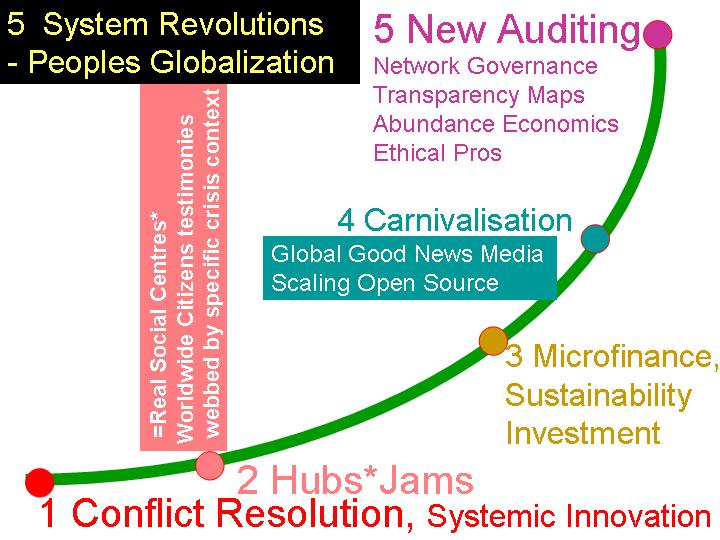 permalink
Beyonds Mission Impossible? - connecting brand and knowledge
Like Queen Elizabeth's semi-decade broadcast for 2000-2005 - Is Humanity Turning on Itself - Connecting Brand and KM may appear in its smaller way to be a future history of ever greater exponential failure and compound risk - although all the answers of how to connect brand and knowledge and other intangibles are now known and being written up by one of Britain's senior business and marketing journalists
Meanwhile here are some extracts from the error report of Knowledge Management being abusd so as not to liberate service economy or knowledge working or any co-creativity which we could be co-mentoring and making project differences on :
2000: Unseen Wealth (chaired by Brookings (economics) and Georgetown (law in society) declared by brand valuationverison 1.0 algorithms as useless to everyone but accountants filing their nooks because they separated brand from knowledge
2005- Anyone who maps the economics of exponentials transaprently around the world's vilages now knows that the future of the world - and the human race - if there is to be one after century 21 - depends on governing global sectors : collaboratively, transparently and sustainably (map the future's compound exponentials simply enough for all the world to hold communal debates to our open hearts contents)
The first test case of collaborating in humanity will be water worldwide as a human right.
Because clean water is the number 1 ingredient of life as well as health, and because water waves are coulpled with other environmental waves of nature's evolutionary power, which at a global level of species promtion and extinction will always be more determinant than what beings race to do.
For a year between 2002 and 2003 the European Union, through its KM portal knowledgeboard.com encouraged a network of over 100 knowledge angles to open space. They did this paying their own way to dialogues in London, Berlin and Luxembourg. Though knowedleg economics were integrated into tese debates it was also agreed that a thriving community of not for profit cases and explorations into ways to narrow global divides was the way to ensure that knowledgeboard sustained the most open of professional dialogues. Over a thousand of man days were volunteered by this the knowledge angels network who were encouraged to tender for minimal funds needed so that thousands of knowledge angels could host meetings all round Europe in small cafes as well as larger open spaces. Then their proposal was not only turned down by Brussels but the area in the KB portal where they had been encouraged to co-edit news was prevented from starting new discussion threads.
So before knowledge angels (a name the EU coined for transparent and meta-professional networking in 2002) were destroyed by apparently frightened bureaucrats (or self-centred "piecemeal expert" academics lobbying) the European Union from 2003 on, we started some far reaching debates on sustaining water and life. We have transferred extracts of these here for posterity or as long as google's blogger permits us to propagate this do no evil wave. permalink
January 22, 2006
Marketing directors’ first 100 days: the report
 First 100 Days, where my friend and colleague Tim Kitchin contributed, has released its report (by Oxford Strategic Marketing and Hunter–Miller). It’s about what marketing directors do in their first 100 days on the job, and reveals dos and don’ts to aid their chances of longer-term success. There was a total sample of 75 (25 interviews, 50 further subjects in a second test) and the results draw parallels with Jim Collins’s Good to Great research which I mentioned at Beyond Branding earlier this month.
Collins’s CEOs, as detailed in the report:
• displayed “a compelling modesty, are self effacing and understated”;
• were “ambitious first and foremost for the company, not themselves”;
• first got the right people in the business before figuring out where to drive it.
Marketing directors have similar recipes for success. The report can be downloaded here. The First 100 Days blog is welcoming comments. permalink
It was a narrow, but effective study.
We are now trying to build out a wider discussion around the unique 'fit' of different marketing capabilities for different contexts.
Why not wing him an email if you feel your survey is on a system-revolutionary trajectory passing on my regards from the days we pleayed in his provisional wing of the Marketing Council. We could have had a different globalization if the net had been used to lauch living and learning brand realities instead of billion dollar image-making over people
He was there ; John Stubbs was there; oddly another migrant to Oz Mark Uncles first Euro chair of branding (sponsored by Heinz) could have been there. Jack and you can make persuader links....
meanwhile I'm reverting to helping the deepest voice folk map learning curricula at http://brand.blogspot.com
Melbourne happens to be the epicentre of the world's deepest meta-network for humanity
Don't be scared - everyone can know how to link the economics of sectors
All we (6 billion people) need to do is know one question that needs debating everywhere, all the time , connecting economically * socially above and beyond any separate theory of management or of government or of leadership valuation
what's the best and worst for the world that the future of global industry sector XXX could consequentialise?
for example , global retailing
at the worst of always low cost quarter on quarter:
all product workers end up on slave wages
all space for innovation/quality is banished because there is no investment in better permitted by always lower cost
anything that a particular category is most deeply responsible for human safety or sustainability gets externalised out compounding risks that on a global scale will pollute, unbalance nature, sicken all life forms
there are no humanly worthwhile relationships of service or learning economy only lifeless transactioning
at the best, we get back to what marketing and indeed market exchanges - as productive and demanding relationships spinning round gravitational context, where the more the world is networked the more gravities interact at macro, micro and inter-levels of exchanges not just any particular one that is being governed - could be trusted to be about; whomever is the most powerful voice (retailer or other) over a sector is transparently known (questionable on the net with no harm coming to any brave questioner) by all 6 billion beings so that no sector is ever so shredded into low cost bits that it has no quality connections with futures human beings value most
what is difficult about this question? once we get a sector in focus and accept that sectors now wave through all 6 billion beings whether they are customers or not; whether they own any of the infrastructure of productivities of that sector or not; whether there society is a direct investor, a direct user or only one that gets the other end of nature's wrath if the sector's global impact is one that has not be mapped sustainably by all the leaders (people who know the sector's future side-effects) most because they have studied the sector in every diverse detail relevant to life-waves as well as cash-flows
London's Global Village 2 : the people's economics assumes truth questioning broadcast and served the world over; indeed as future historians 1 2 3 map systems: all economics of markets has consequences that compound on how true the flows of questions about the future were - whether we use relationship permissions to come down to zero degrees of separation on sector's best for world future. To be of not to be revolves round 6 billion empowering questioners.
If you think it might be wise for your city to start replicating its own version of Future of London Village 2 , please do it at blogger.com and if you want to be linkedin to cities with parallel best for future concerns tell me where you are cited wcbn007@easynet.co.uk
Tecnhical reference for living or learning brand architecture professionals- frameworks for questions brands communaly evolved out of 1980s market research databanks across 30 countries and milions of hours of interviews in the 1980s to experienced based questions of brand chartering which have been openly avialable for newtorking from the early 90s on. To achieve organisation-wide participation the secret is to open up on the biggest deepest question - in 15 years we haven't yet found a bigger one than what would who in the world uniquely miss if our organisation's life ceased existence tomorrow -questions that arouse pride and passion are good for identity as long as they loop back to how do we know that's the future our best customers will value most or that societies the world over will love to connect through us or... permalink
HELLO- many funny things happen on the way to the forum of CSR
FAITH
Jack or his ghost may one day return to tell you how we missed out on the greatest tourist event known to beyond-branders- we were invited to see if we could toss a cap onto the head of the statue of Mary Tyler Moore as one city's odd celebration of citizen celebrity gone fatuous- to do this required the 2 of us travelling half way round the world from different directions to where our ethical host -one who has campaigned longer in corporate america for transparency of big top leadership than anyone her age - suggested we celebrate. I hope -for both our stakes - we do one day.
HOPE
Oh that CSR was as popular as CSI (americas number 1 show when set grissom and gruesome in Las Vegas how could you fail to be diminant in day after recall conversational chatter boxing-sadly too we forget 10% of what we don't talk about every season; its not quite true to say that a company that doesnt talks about ethics or its greatest sector vision for humanity's future will have forgotten all of it after ten quarters though Enron's actual valuation curve could have been plotted ten quarters before it became nothing as compounding 10% less worth per quarter and that would have been a better risk analysis model than anyone on Wall Street used then or now?
-as our economist and his 30 years of entretrepreneurial revolution networking friends had hoped in 1984 would happen by now
http://entrepreneurialrevolution.blogspot.com
http://project30000.blogspot.com
http://www.normanmacrae.com/netfuture.html#Anchor-Changin-27687
but then dad (and his friends) and I and Londoners http://futureoflondon.blogspot.com were spoilt by the cultures of 2 innocently good media - the world's most open service media the BBC which Brits had invested a hundred billion dollars in so that the biggest ethical questions of leadership would be explored ahead of time - that way the reputational damage to the leader or their company chnages the way valuation of globalsiation is done
LOVE http://value100.blogspot.com
The Economist - the first global viewspaper; probably the only one to have returned its investors 100 times their stake over the generation it resturned 1000 times that value top cosieties; only because its 19th century founder believed in economics in society not economics of high power over society; indeed he declared that the paper would be closed when England repealed the corn laws and capital punishment; I suspect today he would say close down all economics once we've rid the world of the EU's agriculture policy and war as a means of advancing big economic power games over the frailest of communities. But better still, let's make a competition out of that. Had you been that founder of the organ of transparent worldwide leadership debates on what economics does to the globe, what would you nominate as the 2 goals after whose accomplishment The Economist should close
chris http://ecosaintjames.blogspot.com
VALUATION THEORY OF 2 MILLION GLOBAL VILLAGES adopted from Gandhi, Schumacher, Trumpeter, Einstein and Von Neumann to name but 5 man beings...then? 1
charter version 0 - do co-edit or Q&A openly-final charter to be issued for Gandhi centenary alumni to re-edit in Delhi 2007
to be sustainable the global city (as multicultural epicentre as well as market exchanger of local to global trades) needs to include 5 village networks whose peoples love, faith and hope (if you are British but I am sure your country has a communal tri o that are just as morally good for branding our species common interests in life the way the eyes of a child would judge) is capable of collaborating with the world's poorest vilages rights not to be externalised off the face of the earth - village number 1 comes from transparently mapped authority - who is your city's or country's highest trust person in the perception of the world? what was the end of 2000-2005 number 1 questions to peoples? how are those who develop the frames around which the authirity's valaution is systematically practised connect through the home village where the authority can be most seen and celebrated by ordinary folk and youtful tourists of the world as well as the great and the good
http://ecosaintjames.blogspot.com exists to provide Londoners iterative answers to questions of the gravitauional pattern illustrated and to enable any city that feels it wants to open up a similar weblog to open source it in the 5 minutes it takes you to click to blogger.com and tell me and my 1000 most intimate co-mentors where you are - chris wcbn007@easynet.co.uk permalink
Then she says ok after Enron we learnt CSR is Fluff and many ad agents greenwash with it. I will dedicate my next 7 or 15 years to Economic Democracy. So perhaps the question we need to gently ask her is: what is the calendar of Economic Democracy? where does its map include some open spaces folk like us can come and play with or without the statue of Ms Mooore. Has she got a message of open space for readers of Lucire too?
January 21, 2006
A goodbye of sorts
 I’m following in the footsteps of Johnnie Moore, Tim Kitchin, and half a dozen other Medingeites by having a blog complementing this one. It’s at www.jackyan.com/blog/, and I welcome your visit.
Right now, The Persuader Blog (a combination of The Hidden Persuaders—but I am not hidden—and that old ITC TV show with Tony Curtis and Roger Moore, which seems apt) merely has a few repeats of posts here to help set the tone—but I am currently welcoming suggestions for link exchanges on my Blogroll. I’ll continue to cross-post here temporarily, but you can get Atom and RSS feeds of my blog, too.
It’s been a true pleasure to have regularly served this blog and its readers since May, taking over from the others who have been here between 2003 and 2005—after all, it’s one of the top 10 branding sites on the web. Mine won’t surface in that top 10 for a while, but I look forward to your visits and to building up something special. Most of my new posts will appear at The Persuader Blog from now on, with increasingly fewer regular cross-posts here—so please do come on over. permalink
Branding Knowledge Work : 2000-2005 ER report #6 since 1976
beyond century 21 is now much more precariously balanced if the world had enjoyed more transparency among leaders of nations. Will we unite in learn green is the next red white & blue in time 1 2 3 4 5 6 ??????
Here's some more of the details on the EU's tapering of trust in Human KM and open networks for mutltiplying goodwill -more at KM Europe
Between 2000-2003 many people were led to believe that the European Union's knowledgeboard.com was intended to be the most open experiment for Human Knowledge Management and Peoples Economics. It had been chmapioned as a critical open space need by Unseen Welath researchers whsoe year 2000 reports on the future were chaired out of Washington DC instituitions: Brookings Economics Institute and Georgetown Law School. Befitting the evolution of a service and network learning century untiting the globes localities: integrating how valu exchnagee subsystems compund purposeful contexts through transparency maps, which can be openly catalogued and explored below by indexing how the connectivities K1*K2*K3*K4*K5 flow and multiply future goodwill or badwill
These people included a knowledge angels network of well over 100 people who were encouraged to pay their own way to meet in open spaces in London, Berlin and Luxembourg; to identify future curricula of KM which had not been understood well in 2000, and to work out alumni networks around each. All of this extraordinary experimentation was suddenly discouraged towards the end of 2003, leaving a community without the 100 action learners who had most connected it and deep lines of inquiry that each knowledge angel had shown their personal time and interest in exploring. Moreover a connected view of knowledge management had been encouraged by the EU who spent hundreds of millions of Euros on surrounding programs including :
Knowledge Society - how to integrate the best of 25 countries open capabilities
Need for Lifelong Learning
Need for Corporate Responsibility
and other programmes (please help us list what else was connected while millennial optimised in what the internetworking world could achieve for humanity's progress was at its peak)
K1 how a free to join virtual community could connect professions in a networked age where the experience/learning curves and productivities of people to make a difference
* integrating
K2 group formats such as teams, practice communities and social networks, and such interdisciplinary content hubs as emotional intelligence
* integrating
K3 Gravitation of transparent organisational leadership governed as a purpose compounding system of productive & demanding relationships
*integrating
K4 integrating into the most valuable future exponential for its global market sector
to serve people
*integrating
K5 harmonising sustainably with societies' investments and knowledge collaboration city, 2 million global villages and other constructs that recognise the need to connect:
1) places of diversity being ultimately where all longest-term cultural, natural and human resource investment is sustained even whilst death of distance means that peoples mentors and work may connect many different places.... permalink
Google -we fear for you as the loveliest & most inter-productive 5 year brainchild the world has ever known or sourced
To undesrtand more of this post's brand strategy conversations around not only the world's most valuable brand - but the brand that was cooperating in multiplying more value for 6 billion beings' enterprise than any other - you might want to look at the 30 year learning curve of entrepreneurial revolution , our particular 65 year experiences on media/societal economics and the editors lens we can bring on that to Euprope's 5 year report on Knowledge managent. I'll post an extract at BB blog and am updating http://kmeurope.blogspot.com as fast as I can this weekend before one more polg interlinking the knowhow between the lines of 5 years of people dialogues and open spaces is pulled for ever permalink
Brand evangelism (Mk II)
 Further to our earlier post on Star Trek and a group of fans’ brand evangelism in making a new series themselves, Trekkies may be interested to know that the New Voyages site has had a nip–tuck and is far more comprehensive. Earlier readers will know that Walter Koenig, from the original series, had guest-starred; the latest news is that George Takei will guest-star in an upcoming episode in his original role. More of the original writers are coming on board, too—showing just how real fan-driven brands are. In fact, brands are becoming more and more guided by audiences, not managements, and you can’t get clearer proof than New Voyages. (It makes me lament how The Professionals was so botched when revived in the 1990s.)
Earlier links at Johnnie Moore’s Weblog and John Moore’s (no relation) Brand Autopsy. permalink
January 20, 2006
When to branch off?
 On the 19th, I asked readers whether I should branch off into my own blog.
I thank Hugh and John for their responses, and Kris for phoning me about it. You guys are quite positive about my doing a blog independently of Beyond Branding.
I continue to hesitate, and it’s not because I don’t value your input. I wouldn’t have asked otherwise. But here are the reasons for staying here: (a) a high Google ranking for branding—I’d like my posts to be seen; (b) a sense of continuity; (c) each time one of us spins off into an independent blog, this one gets hit somewhat in terms of traffic; (d) John, Hugh and people like that have something valuable to say whereas if I had the luxury of my own blog, I could become a right tosser, ramble and go off-topic; (e) unless I could be sure that others would link to me and read it, then it would take a long time building up traffic.
Just yesterday, someone at my bank referred to me in introduction as ‘Jack Yan from Beyond Branding’. This book, more than any other, is connected with me. It even has its own Blogshares entry. No one says ‘Jack Yan of Typography and Branding’.
Here’s why I should do my own: (a) the many different voices here must mean some of us are coming in to read Chris, and others to read me, so I am the comic relief as far as his readers are concerned; (b) I’d like to promote my other books; (c) it might just enhance jackyan.com—which is hosted on the same server anyway; (d) I know that at least John and Hugh would probably link to me unless my posts go stark raving looney. And I know that only makes four points versus the earlier five, but the feedback from the 19th counts very heavily—I really value it.
Maybe another collaborative blog is what I need. I have been blogging—and in most cases repeating posts, whether that’s good blogiquette or not—at Kiwibranding, which was actually set up by Errol Saldanha of Canada. However, even there it’s “not me”. Or just cross-post between these but go off on my own little tangents at “my blog”.
I’ll have to think on this some more, and see what need a ‘Jack Yan blog’ would meet for readers. In addition, is a personal blog the right image for me? Johnnie seems to think so, and that counts for an awful lot. permalink
http://value100.blogspot.com
A "separate" blog is the wrong language for beyond branding, for transparency, for trust-flow, for sustainability of any community or belief you care about propagating. For example I co-edit 100 blogs but they are all connected, loosely as David Weinberger would say . And they are not only connected as blog but rreal places, live transformation agendas, investments in peoples lives. I look forward to seeing 99 Yan blogs and their connections through BB.
By all means let there be different segementations of the blogosphere. But look for example how cluetrain.com - where the idea of the blog was also first annouced to clued communities around 1999 or 2000 - also ended up talking more and more to itself. There is not much value in a blog - apart from perhaps to its owner - unless it connects its open source reusable concepts - with every other neighbouring blog that needds help in innovating. Innovating what? : is always a question but have another look at http://project30000.blogspot.com since that gives relationship permissions to openly connect with 30000 projects humjanity is voting for somewhere.
Your idea of a loca press magazine that every country's yout can co-edit is extrardinarily valauble. That idea needs a blog so people can keep on exploring how they could help compound the future of youth's media participating locally up not globally dumbing down. But such a blog needs its learnings and systemic values waved around the world by connecting mediu; it does not want to talk to just the parties it has already converted. IF it did it would become old or as locally separated as they did over time.
Sites I am not allowed to go to
 I’ve done my share of evangelizing about the LinkedIn service, to the point of co-moderating Vincent Wright’s popular MyLinkedInPowerForum, but I was a bit shocked to discover that I can no longer access the site.
Forgive the paranoia, but I can reach it via traceroute and via anonymous proxy. I just can’t access it via the normal way: typing the address in my browser.
A fellow New Zealander, John Dierckx, says he can get in without any problems, but for the last three days I see a blank page, regardless of browser.
It reminds me of the national ban on the George W. Bush site in 2004. No New Zealand-based person could access the site, unless we went in via anonymous proxy. I realize there was some press when some larger countries were locked out at the end of the presidential campaign—but the fact was New Zealand was blocked long, long before that happened. Even the US Embassy could not access it, when I asked the folks there. So much for freedom of information—particularly bad when employees of the US State Department can’t do a thing, either.
I notice that New Zealand is now blocked from the GOP.com site, too, which we could access during the campaign. I think the United States is saying, ‘If you won’t join us on the War on Terror, we’ll restrict your internet usage.’
Fine, but how about LinkedIn? I’m going to have to dig up old tech support addresses, as I can no longer use the regular way, by going into the site and notifying its people there. However, it’s a bit sad in both cases where freedom of information underlies the official brand promises—and the user experience falls a bit short. It’s only three days out of many years of good service from LinkedIn, so I won’t diss it, or say that there is any malice—but I would like to hear from others who are experiencing the same thing in order to help. permalink
Jack's question: what is leadership? Sample responses from communities of transparency mapmakers
This covers all multitudes of sins of omission and commission that big power can make non-transparent but is also very simple if you ask your questions to oridnary human beings. Here are some sampes
when Meg Wheatley asks any ordinary circle of human beings to shout out to her flip board what charateristics (values) they recall of the person or project they most loved being led through, very natural stuff comes up like:
she is honest, true, fair
listens, encourages big questions not hasty answers, helps people colaborate and connect deepest lifelong experience curves; values any goodwilled person
...
asks us to connect out practical energies systemically by agreeing on a Big Hairy Audacious Goal and contructs rewards for those who try first (even if they fail) for every innovation pathway we will need to connect to map back that big goal -ok there is no ordinary language for this though its in the books of Jim Collins
now if we ask faciliator epicentre of open space's 50000 stages over the last 20 years -eg harrison owen - he will say a big leader needs to know the 3 C's - Conflict, Chaos, Confusion -here you are as leader you are sitting on top of the world's most revered brand whomever she may be, and then the environment changes or some internal organ of the brand goes unhealthy (like your most innovative person leaving to the competition or Nick Leeson taking one too many bet without being co-shadowed by anyone)
If you -and the leadership team - were transparently governing this corporate brand so as to sustain its future valuation exponentials , you would be auditing ahead of time so as to detect emerging conflicts, but suppose you are one of today's typical big leaders drowning in historic accounting numbers that tell you nothing about 90% of future upside or downside that you are sittiong on, ie you don't see the conflict as early as the eladership team needed to resolve it at elast cost
as your histioric auditors and others cycle their unseen wealth measures every quarter ; the conflict wil attract more conflicts as surely as a cacerous cell in a body politic - this is Chaos
and yet poor leader, this all becomes increasingly evident to good folks lower down who leave the sinking ship becasue your top professional advisers and agencies are imaging over them instead of facilitaing true and fair internal channels- so we encounter the last C= Confusion. The most confused group of all in a chaotic organsiational system are the folks at the top. And this loops round to the start in a way that at least 1000 economics cases now show to be true if you had been enjoying 30 years of discussions on leadership at Entrepreneurial Revolution. You see a system revolution can be defined as when something chnages in the enviironment that means one of the perfectly precise rules of leadership historically has turned and is now mathematically the worse rule for leaders to enforce across the system.
Back in 1998 I was working at the world's largest communications agency as the smallest team member valuing the future eladership of one of the largst professional firms the globe had then seen. We tried to find a conversation opener in the 100 interviews of the top leaders of the firm. This is the one I coined so that the partners conducting these face to face leadership interviews could read between the lines. Do you understand the future difference between a professional sector where you can be 100% right and the best your whole organsiation can ever offer to be is 99% right?
The answer was a pretended yes which included tens of millions of image making budgets, and an actual no. 4 years later, the company once valuing its own brand at tens of billions of dollars, was worth less than nothing. Since this company had valued dozens of other leaders of the dotcom age the same way it valued its onw trust-flows, we can be left to wonder what the network economy 1.0 could have been if it had wanted to motivate the greatest relationships people can comune around rather than the least. What by 2004 in Delhi I presented as the coming wars between goodwill and badwill networks - in Delhi the government minsiter for broadcasting and Information technolgy attends such recociliation and risk conferences, unlike most Western countries we map at valuetrue.com and through our peoples' correspondece timelessly open blogs of Club of Village, City, Country and World
Would you think that big leaders might want to listen to the different mathematical audits of 100% right and 99% right? Well some who sustain people do, but many who are rewarded in ways that do not care a jot for what compounds in 4 years time are not likely to listen to what the majority of the world's people would see as transparent common sense and goodwill leadership.
Would you think that journalists would be asking questions about this. Well some do 1
please tell me where else on the net you think the people can continue to debate the day after questions that world class journalists and peoples economits are now asking. permalink
Way too late debriefing of abused customer
1 their own bastardisation of economics of my (and your if you ever leave aol) time- thinking its ok to leave you on call for 15 minutes before you get to a person instead of endless inane machines singing lullabilies or whatever can music of the night some IT nut happens to think is soothing
2 then asking me dozens of questions on why I am leaving - to each I said I want to close my account as fast as possible and have no interest in answering your questions; to which the call center's reply was: everyone has to go through this process, as if it was some natural democratic right
and then the final coup de gras of a brand without a head and without any customer soul : a pleading voice different from the main call centre guy saying in all gravity: is there anything at all we can do for you that will change your mind
to which I would answer: close down forthwith and never pollute customers again . You are governed only by big accountants and others used to debriefing people through their own misguided sense of power as they cost cut them out of productivity. You dont understand when you are asking people you have abused for a favour. You are behaving exactly as scholar of law Joen Bakan describes the worst type of species behaving at www.thecorporation.com
that a media brand on the net can come to this disgusts the 22 year old vision of what the net could be doing now to help people everywhere be poroductive
http://www.normanmacrae.com/netfuture.html#Anchor-Changin-27687
http://value100.blogspot.com
if you are all entrepreneurial americans have left to do online, I will pray for them every day for the rest of my life permalink
What makes a great leader?
 I’ve taken a quick glance—quick as it’s 3.18 a.m. here—at David Pollitt’s summary of leadership articles at the Emerald Insight site, where he writes:
Something of each of these approaches is revealed in leadership author Jim Collins’s five-level model of leadership. Collins focuses on the characteristics of a level 5 leader, whom he defines as ‘a person who builds enduring greatness for the organization through a paradoxical blend of personal humility and professional will’.
Collins argues that good leaders ‘care more for their company and its work than for themselves, are willing to take responsibility when things go wrong and give credit to others when things go well, and have an overarching vision for the organization but also pay attention to small details’.
This alternative model of leadership clearly has much to commend it.
Jim’s stuff always makes sense and he doesn’t spend his books writing supercilious wank. I have to say I am interested in this—the full interview is in Training Journal, September 2005. And as we know, great brands have strong management commitment, so this is relevant to us. Brands, too, need vision. I can see parallel after parallel between our marketing and branding work, and Jim’s work on leadership. permalink
Labour is engineering a recession in New Zealand
 As if the worst business confidence survey in 35 years wasn’t bad enough, Bloomberg reports that New Zealand’s finance minister, Michael Cullen, has been telling Japan to steer clear of the New Zealand dollar.
It’s another sign of a clueless administration.
A weaker dollar will help exporters, but considering the government hasn’t shown much sign of encouraging the sort of innovation that would spark exports, and the country is a net importer, then what does it expect?
Labour needs to make up its mind: New Zealand is either an exporting nation or an importing nation, but it can’t be both at the same time.
It’s acted as a net importer than enjoys having foreign money while people lounge about the Viaduct drinking lattès, the exception being the film industry who drink chicken noodle soup from thermoses.
It was known to the government that these Japanese Uridashi bonds would mature this year, and it did nothing while the going was good to use that money for building up exports. It smells like the mess that got Gray Davis recalled in California: ignore the underlying problems when there’s money flowing in.
There must have been some powerful stuff in those lattès, but then our Prime Minister was a bit more frank than President Clinton when he said, ‘I smoked, but I did not inhale.’
New Zealanders can expect the $2 per litre petrol price this year if all goes to “plan”—this must be Dr Cullen’s intention, because it is a natural and foreseeable consequence of his actions. And I am not even a forex expert. Just a bloke with a brain.
I tell the Japanese investors to play the eurodollar market and if they wish to ignore Dr Cullen, then they should. I would, but I live here.
I have frequently said the lack of vision on the part of Labour has sounded the nation’s economic death knell—and when there is a lack of vision, there can be no nation brand.
The PM is a heck of a nice lady who is far, far sweeter than her hardened image suggests. And I think she has placed her trust in the wrong people. If she does not realize that this year, then we are in for a rough ride.
I still argue that New Zealand, and the clever people we have here, are about innovation, independence and individuality—not a mere tourist playground for those conned by our environmental record. And sure we should export and have a weaker dollar, but who is exporting? I am, but who else? I once heard a statistic that only three per cent of firms here export—which I find hard to believe.
Frankly, I don’t mind making a bit less if I know that my fellow New Zealanders are not having problems paying for their petrol and their mortgages.
However, when I deal with New Zealand Trade & Enterprise, I can’t work with the Wellington office, in the city where I live—I actually have to deal with Auckland. Because Wellington doesn’t want us doing well or exporting. I guess they got some memorandum to say they must do the opposite of what they are charged to do.
The greatest successes in New Zealand have nothing to do with the government’s programmes as it rode the hype of Peter Jackson and his last four films. It took one man and his love for New Zealand to tell people: (a) there is beauty here; (b) there are clever, innovative people here; and (c) you can be a geek and succeed. And funnily enough, Mr Jackson has detected a latent element in New Zealand that actually identified with this. This single-handedly changed the view of this nation—and reflects the foolhardiness of the government’s attempts at nation branding.
And now those major films have come to an end. Two thousand six has a few films, but nothing to the scale of The Lord of the Rings and King Kong.
Meanwhile, New Zealand’s state bodies charged with economic development and trade have instead been telling people: (a) this is the home of Anchor cows; (b) we chew the cud and browse; (c) we are clean, green, 100 per cent pure, just like Ireland, Sweden, Israel, Norway, and a good part of Canada. Come here if you like, but those other places are about the same.
I’m going to keep criticizing because this supposed ‘New Zealand, new thinking’ campaign has had no airing internally—and makes as much sense as South Korea’s 2001 ‘Visit Korea’ programme, which for the most part did not even get out of the country.
We need help—and we need a vision. Prime Minister, the ball is in your court. Read through the old ‘Bright Future’ programme that you cancelled, and please tell me what is wrong with it. And if there is nothing wrong with it (apart from the fact the opposition came up with it), do it. permalink
The Peoples Economics:5 Vital Clues of Leadership wherever Century 21 Sustains Investment in Local Societies & Global Markets
Clue 2 is: and do we know if we are serving customers who are best for the future vision local societies would most want our global market sector to innovate
Clue 3 integrates up to 9 other measures (4 (V2-V5) flowing in tandem to (V1) valuing customer demands, and 5 (K1-K5) representing what economists and measurement psychologists know about productive sub-systems of the people relationships of service and networking transparency of actions and learning). It is ultimately up to a corporate governance team to decide whether all 10 coordinates are needed. For example, if you are in machine age market sector where people’s service and learning has no value, then you will not need all 10 coordinates. If you business is not networked in any way, then you will not need all 10 coordinates. This is all quite simple – not at all complex – if you have tracked the 5 main preneurial revolutions which have evolved together since 1976 as the gravitational dynamics of the local and global economies of markets has changed.
V1 – measures our customers use (& are they our best customers for the future)
V2 – measures our most competent employees use (& ditto)
V3 – measures our owners use (& ditto)
V4 – measures our leadership team uses in progressing our vision for the future of the global market sector whose future history we can govern
V5 – measures societies use to ensure our sector is not in conflict with sustainability of life systems and natural resources including local environmental connections with the globe
K1 – what makes the lifelong learning and action curves of individuals most productive over time
K2 - what makes groups of people most productive over time: particularly in the cross-disciplinary group form that is most valuable to our organisational design be this teams, networks, practice communities, etc
K3 – what makes our organisational system most productive over time
K4 – what makes our business web of partners most able to realise our optimal envisioned global sector productivity over time
K5 – what makes local societies who make a major reciprocal investment in our global sector most sustainable growing over time
Clue 4 is that these 10 coordinates compound a tense/elastic human relations systems whose emerging possibilities of conflict need to be audited ahead of time so they can be transparently resolved before they compound erosion of relationships and goodwill destruction. This future-back auditing is context specific and needs to be done with as much attention and as frequently as any other measurements and rewards leaders systemise organisation-wide.
Clue 5 is that the integral corporate governance system needed in the 21st is not the one that any of the professional semi-monopolies separated as their own business case in the late 20th century. Separately, each of their maths (or laws) is perfect for compounding destruction of the future exponentials of value multiplication that all 10 coordinates are interdependent on. Quite simply our future value ~ K1*K2*K3*K4*K5*V1*V2*V3*V4*V5 where each coordinate can be indexed from 0 to 1 (averagely healthy elasticity) to above 1 (sustainably compounding growth). Why is it simplest for leadership teams to model connectivity around value multiplication. Well suppose you let the value that local society measures in you slump to 0 as Arthur Andersen did, then however many billions of value are connected by the other 9 coordinates : billions*0=0 Since publications on Unseen wealth were issued in 2000 by a committee chaired at Brookings and Georgetown Law School, over 100 multibillion dollar corporations have been reduced to 0 or less than 5% of the integral value that their Unique Purpose was worth by the wrong risk analysis assumed by accountings tradition of separation. Billions+0 and Billions*0 do not lead to the same value! Tragically the accounting standard for brand valuation introduced in the late 1980s is riddled with this mathematical error and is a primary cause of most brands death we have witnessed since this false mathematics of intangibles was spreadsheeted around global markets.
You can search for other CEOs and opinion leaders who lead critical perspectives of this transformation in economics. The Chairman of Cisco talks of interactions being vital to the partnership strategies his leadership team visions and stewards. The Chairmen of Whitbread and of interface provide compelling testimonies o]n the value of human life that societies bring to the table of sustainability investment. The founder of Fast Company talks about identifying how the marketing company that compounds the most value in any sector connects the best choice of customers and their knowledge of what society will most want in the future. Preneurial economist can provide many cases of investors in a generation receiving 100 times their initial stake but only if even more value has been returned to societies through the same compound exponential of sector goodwill. Future Historians including my father since 1984 and today's best selling leadership author Thomas Friedman now make it clear that national economics is no longer a separate game from the economics of global sectors that a place is most transparently connecting. Unless we learn from what are now the mathematical errors of separation embedded in 20th Century economics, we will not network 6 billion beings together in a way that empowers people’s productive potentials to make a difference in the way that Bill Clinton, Mary Robinson and others concerned with transparent globalisation are openly raising around leadership responsibilities to peoples’ futures. This is clear in this 1984 storyboard timeline to 2010 and beyond which I co-authored. If you side with us in cross-cultoral demands to sustain humanity, why not help contribute 1 project to the 30000 being openly catalogued and transparently mapped here. Or join our blog co-editors in representing the best interests of places your family love most at Club of Village, City, Country, or World.
Other primary references:
Intangibles-Valuation can help you certify what corporate governance your region values most.
You can look at Entrepreneurial Scripts that have emerged since 1976 and open source their impacts
You can contribute transformational sightings to the monthly death of distance innovation feeds we openly syndicate
across weblogs
If you have a reason for caring about the future exponential of a particular worldwide sector including the geographic one of global villages, we can introduce you to other networkers who wish to collaborate in stewarding sustainability of that context around the world
If you feel that your profession needs to understand the above content as well as leading members of Beyond Branding, we welcome open exchanges between disciplines
Chris Macrae, wcbn007@easynet.co.uk (include 007 in subject if you need my fastest response) permalink
The Simpsons, by you
 Reported by Australian blogger Markoos, The Simpsomaker is a little Flash program that allows you to create your own Simpsons character. A few weeks ago we looked at Trekkies doing their own episodes of Star Trek based on the original timeline—even grabbing original screenwriter D. C. Fontana to contribute. This isn’t quite to the same extent (judging by Flickr a lot of folks know of it), but it is fun to see the Simpsons techniques available to all—who will further evangelize the brand. (Just when the shows were getting less funny, though I have yet to see the Ricky Gervais-penned episode. There is something funny already with the idea of one fat guy writing about another fat guy.)
permalink
Reported by Australian blogger Markoos, The Simpsomaker is a little Flash program that allows you to create your own Simpsons character. A few weeks ago we looked at Trekkies doing their own episodes of Star Trek based on the original timeline—even grabbing original screenwriter D. C. Fontana to contribute. This isn’t quite to the same extent (judging by Flickr a lot of folks know of it), but it is fun to see the Simpsons techniques available to all—who will further evangelize the brand. (Just when the shows were getting less funny, though I have yet to see the Ricky Gervais-penned episode. There is something funny already with the idea of one fat guy writing about another fat guy.)
permalink
If you ran a virtual firm, you’d do a bin Laden tape
 When I presented my end-of-year keynote to the Australian Graphic Design Association in 2004, and wrote a paper on virtual firms and Al-Qaeda, I wanted to get this message across: we have nothing to fear from audio tapes from Osama bin Laden.
Today, Mr bin Laden issued a new tape with another warning to the United States, and the CIA has confirmed that the voice is his, and that it was made recently.
But if we think of Al-Qaeda as a virtual firm and not a terror network, it is far less frightening. And I should know: I have run a virtual firm since 1987, long before the term was even coined.
To me it was just a necessity of having no money to rent an office and bulletin board systems were available to us as teenagers.
A virtual firm has the following. It has a corporate headquarters in charge of brand management, PR and administration. It has individual offices belonging to staff members and contractors, often from home. They are allowed to carry out their own projects using the corporate brand, provided they are done in a way HQ will endorse. Every now and then, to rally the team, the head of the company will issue an email, do a press release or contact the principals of the different teams.
Sound familiar?
Each “terror cell” is a home office doing things in line with the corporate strategy.
Osama bin Laden has to rally the team, issue his emails, and his tapes are merely press releases, or branding exercises.
And like Howard Hughes, Osama bin Laden is a CEO who doesn’t show up all that often.
Like a lot of corporations, it uses jargon. We use names to refer to our competitors in a humorous way, which I can’t share outside the firm. They have ‘the great Satan’, ‘infidel’ and similar phrases.
So for those of you freaked out a little, you need to bring this chap down to size. They like the secrecy and the fear that can bring—we call that a corporate image, a consequence of a branding campaign. When you examine the structure, there’s a lot less to it all than you might think: there are millions of home businesses operating in a similar way. Al-Qaeda is a lot easier to understand than they would like you to think, even if their business is terror, and ours is not.
Del.icio.us tags: Branding | Al-Qaeda | War on terror | Osama bin Laden | Virtual firms permalink
January 19, 2006
Arfur Daley’s ’Otel
 The Hilton group wants to extend its Waldorf–Astoria brand into other properties (see here) by way of endorsement or co-branding (I know there are differences between the two—I use them in lay terms). I am a sceptic because I am not sure if the Hilton is capable of managing its brand.
In 2003, I stayed at the Hilton in a city that shall remain nameless. The service was five-star, but the rooms were three-star at best. I was given a temporary Hilton Honors card—on thin paper. My toilet has slightly better stock in a roll. ‘The second time you stay at a Hilton,’ said the concierge, ‘we’ll send you a plastic card.’
I was in Helsinki at the end of 2003 and had them credit my Hilton Honors number after staying at the Hotel Grand Marina, another three-star joint masquerading as something better. Despite calls to the Hilton in 2003 and 2004, I await my plastic card. After all, I have my Inter-continental one. And cards from a number of other chains.
A five-star promise, a no-star resolution. So will people be confident after seeing the Waldorf–Astoria endorsement? For apparently it brings with it all the advantages of the Hilton Honors’ system. Pay a whole heap and get a lousy piece of paper about the size of three postage stamps with your name scribbled on it—that is meant to stop you from choosing a Hilton competitor.
The final irony: when we photographed Nicky Hilton for Lucire’s September cover (December issue in Romania), we could not get her a room at the Hilton. I can’t remember the resolution organized by our celebrity director Brad Batory, but I think Miss Hilton eventually stayed at the Sheraton. permalink
Are you reading me?
 I started blogging here regularly in May 2005, though the few of you who have been coming here from the beginning know that I first surfaced in 2003. In fact, I set up the look and feel of the blog to match the rest of the web site and the book, Beyond Branding—for what use was preaching branding if we could not practise it ourselves?
Johnnie Moore blogged here most in the early days before setting up his own blog, which has established him as one of the top branding bloggers in the world. Chris Macrae has probably written the most posts, though he and I are probably tied if we were to begin counting from last May.
John suggested back in May or June that I should set up my own blog, but I was adamant I would not. He reminded me again when he was in New Zealand during the end of December, because I had probably blogged a lot more than I had planned.
The question is: should I? I like blogging, but it’s only an extension of the online publishing I had done for over a decade and a half. The fact this blog remains current is one reason it’s in the top 10 for the Google search for branding. Perhaps more to the point: am I enough of a tosser to write about my world of branding, consulting, media and how to save the world, and does anyone give a darn? And does being an own-brand blogger enhance ‘Jack Yan’? Am I a Johnnie Moore or a Gaping Void?
I’d like your input, before I branch this post off into a philosophical rant in the realm of personal branding and whether blogs can enhance your reputation. (Hmm, do they?) permalink
Whatever you do, don’t mention the war
 Detective Marketing’s Stefan Engeseth wound up on a Mitsubishi PR event this week, and was treated to a dose of experiential marketing with one of the company’s rally cars.
Rallying helped keep Mitsubishi Motors Corp. from sinking into oblivion (and, to an extent, new products such as the Colt). The company has been in disgrace and scandal at least twice in the last 10 years, from memory—its failed merger with DaimlerChrysler and an earlier scandal at its corporate level were major hits against the firm (see this link—merely the tip of the iceberg).
As reported in the Washington Post in 2004:
A raid on Mitsubishi offices five months ago yielded the evidence that exploded into one of the largest corporate scandals ever in Japan. Authorities say seized documents, and subsequent admission of fault by Mitsubishi Motors Corp. (MMC) and a spinoff, Mitsubishi Fuso Truck & Bus Co., indicate that since the 1980s, the automakers systematically hid defects involving 800,000 vehicles. Among the hidden flaws were defective front axles on the same type of truck as that involved in Okamoto's death.
Its failure to get economies of scale with its products have also hurt it: the Lancer Cedia, introduced in Japan in 2000, only made it to many foreign markets in 2003; similarly, its Galant, introduced in the US in 2003, is facing its first full sales’ year in Australia in 2006.
But the rally cars were made into toys—and kids love toys. The Lancer Evolution’s appearances in video games also helped. Branding is so often about spreading the love, whether it’s giving permission for your logo to appear in a link or someone else’s blog, or letting them make a toy. In the 21st century, being overly protective and proprietary, and threatening lawyers on people, are going to work against your brand—especially in an era of citizen media and individuals steering the brand.
Mitsubishi needed to do this. After all, having a single brand to cover warplanes (reminding people of alleged misconduct against PoWs during WWII) and cars is not a good idea. Not long ago, it released a truck called the Zero Fighter. It would be, as I mentioned to Stefan, Mercedes-Benz releasing a truck called the Jewish Transporter. Given very clumsy moves like that, and scandals galore that Mitsubishi Sucks reports on, Mitsubishi needs to do what it can.
Of course, many problems would be solved if it took a My Name Is Earl approach: admit to the negative past, and make amends—then watch Red Chinese sales grow with the bad karma removed. permalink
Canada on the Canadian brand
 In another example of just how ahead we were with our book in 2003, Beyond Branding co-author Simon Anholt is quoted in an editorial today on the Canadian national brand. The editorial is not entirely accurate, in my view—my guess is that successful nation brands and the presence of military service don’t have to go together—but I don’t think Simon’s being quoted there.
 I believe Canada has, at least, some idea of marketing itself overseas, even if the trade mark itself has changed since it first emerged in a nice Old Baskerville typeface in the 1980s. As a tourist, most people express the warmth than I expect. It seems liveable, and certainly more of my Hong Kong compatriots wound up in Vancouver than anywhere else to escape the Communists taking over the place in 1997. Whether this warmth translates to Canadian industry, I would not know for sure—are there Canadian readers out there who can tell me just how real its nation brand is? permalink
January 18, 2006
Dodging the obvious, till now
 It took a while—probably tied to the legalities of whom owns the Dodge brand outside North America—but DaimlerChrysler has announced its brand strategy for it today. Joe Eberhardt, with the rather long-winded title of Executive Vice President, Global Marketing, Sales and Service—Chrysler Group, says Dodge will be for drivers who want bold cars.
I think back to the days of Chrysler Corp. when the whole company was about bold cars. It had its R&D times down to record levels and Chrysler, Dodge, Jeep and Plymouth were each quite well defined. There were exciting plans for Plymouth, with the PT Cruiser showing the retro face of future Plymouth products. All Chrysler cars were visually strong, even if, by European standards, the smaller ones were a bit dodgy engineering-wise.
But Daimler-Benz AG initially did not know what to do with the brands. Cancelling Plymouth meant that Chrysler had to stop fighting Lincolns and Cadillacs, which might have been a good thing, but for the fact the once-premium brand had to occupy both budget and pricey segments.
It’s taken a while to get it sorted. Chrysler now has a strong position as a brand in a well designed suit with modern threads; Dodge is bold and showing your hairy chest, and Jeep is just showing your hairy chest.
But what sparked this blog posting was Mr Eberhardt’s press release summary of ‘five primary tenets of branding that he uses to drive the successful results to date for the Chrysler Group’. These read like ‘Branding 101’. I’m glad Mr Eberhardt has told us all this, but I have to ask: what did Chrysler do prior without knowing the obvious? permalink
New Zealand business confidence plunges (I told you so)
 New Zealand’s business confidence has plunged to its lowest in 20 or 35 years, depending on your news source.
It highlights a few things for me: first, the Muldoon era was actually better for business confidence; and secondly, economic mismanagement by this administration has led to this moment.
The warning signs were there long ago, in the 1990s. And I have said so for the last five years, if not more. The government was easily fooled by the amount of foreign direct investment and the success of two men: the late Sir Peter Blake, for guiding the America’s Cup victory, and Peter Jackson, film-maker extraordinaire.
Tourist dollars and FDI covered the fact we weren’t producing sufficient graduates in science, innovating in new industries, or seeking to improve our national brand—warning signs the last government gave in 1999 with its ‘Bright Future’ programme. Partisanship saw to the programme’s cancellation. So much for patriotism.
Instead, we continued plugging a clean, green image as a country, which is all well and good—but that was merely an evolution of the image of a primary products’ exporter. What of our secondary products, our intellectual property?
In the 1990s, I said that the nation brand should be about innovation and independence, and even isolation—which can be a good thing if you want the purest inspiration. The letter i.
Branding is the way out—both for the nation and for individual businesses.
Yet I have seen very little happen. The government tells me there is a ‘New Zealand, new thinking’ campaign, which I had urged the export body to adopt even during my university days. That’s over 10 years ago. But a campaign only works if the internal audience knows of it first. The internal audience does not: the average Kiwi in the street hasn’t a clue.
Neither, it seems, does the government.
But short memories and in-fighting will, no doubt, ensure that even the opposition remains ignorant to all of this. permalink
Calling for resignation of CEO of VARTEC company owning 1010297
small as you may think this case is , its also completely documentable far as I can see
for many years now I have used the 1010297 telephone service in the United States; it used to do what it says at this bookmark:
http://www.1010297.com/1010297_faq.asp
Frequently Asked Questions
Q. What is 10-10-297?
A. 10-10-297 is a long distance access code. An access code always starts with 10-10, and the last three digits indicate the carrier.
Q. How do I make calls with 10-10-297?
A. Just dial 10-10-297 + 1 + the area code + the number. It's that simple! No need to sign up or pay any switching fees!
Q. Does 10-10-297 have a monthly fee?
A. No, you will not be charged a monthly access fee. You are charged only for your completed calls. Your calls are billed at 3¢ a minute with a 39¢ connection fee.
Q. Can I use 10-10-297 to make international calls?
A. Yes. Calls to Canada and Western Europe are only 3¢ a minute with a low 39¢ connect fee. To call internationally, you just dial 10-10-297 + 011 + country code + the number. Other international rates can be found by clicking here.
Q. Do I need to contact my current local service provider or my current long distance carrier when I switch my service to 10-10-297?
A. No, there is no need to contact your carrier. Just start dialing 10-10-297 before your long distance calls
--------------------------
Today it did not.
I phoned from usa to London to make an urgent call
I was intercepted by preumsably Vartec' call centre and kept waiting by a machine for 10 minutes that told me I would be speaking to a person in a moment (I got that repeat loop down my lughole repeated at least 50 times as if i was some sort of pablovian lap dog)
when the person arrived, she said i would now have to give her all my postal address details to be billed by her company (not another monthly invoice for 3 dollars but a threat as I travel a lot that if I forget to pay on thime I wil be decredit-rating listed)
and then her coup de gras: by the way you cannot use 1010297 for 48 hours until our finacial people have approved your credit ratings
Unless the CEO of vartec has some explanation that he wants published in this blog, his company has broken so many detailed promises that any marketing standards authority should be closing down this service until they do precisely what their web says, and their last 5 years of service (the 100 calls I have made with them) has done
I also seek 500 dollars credit corresponding to wasting half an hour of my time let alone the consequences of not being able to make my urgent call to be credited on the new account you claim to have opened for me. That should keep me ok in your credit ratings for a while
Anyone else got a cast iron case of abusing customer promises they want published in this blog? permalink
The way some American companies are going with their inane mechanised telephone customer services, I expect to read one day soon of a comany where you have to stay up all night to uncustomise your account. I am suprised more people dont compain about how ever more of our lifetime is wasted in this electronic abuse of keeping customers waiting.
Networking Space's Close Encounters with 3rd kind of blog segmentation that attracts my lifestyle
STYLERULES OF CRISIS BLOGGING ENCOUNTERS OF THE 3RD KIND
These seem to start like this: Do not care at all how tidy a blog is to read, just jam in every testimony (or concepr, experiment, expolarory dialogue's links) on one specific revolution the blog stands for. The purpose is to amass more content gravity and interpersonal (comentoring links) through the wblog fopr people who want to be the revolution than anyone else. The way to use such a blog is eithr to take a search engine to it so that you find the slices you want or to use the sidebar to index the subset of events and revolutions that the blog's action futures are emerging around networks of people
Now clearly getting the marketing profession to practice NoLgo in global branding - ie attending transparently chartering the Unique Organising Purpose of any specified productive and demanging granvity of human relations - how people learn, serve, conflict resolve the communal economic and societal realities of that UOP before they worry about spending a cent on image, or PR , or subcontacting their leadership communications to a rotaing door of ad agencies is a revolutionary subject
whether this blog is up for it or we need to start another one I don't know. The first step is : if you want to co-edit such a revolutionary blog however infrequent your contribution (eg because there is one of its networks you want to emerge) then mail me at wcbn007@easynet.co.uk or Jack yan or both of us permalink
An update on personal branding and weblogs
Here then is a first preamble on my favourite ever style of collaboration blog. Its a different timelessly different segmentation from that which is the market leader of blogosphere, and no timeless blog has any action learning value on its own without systemically interfacing withy others in its family. For example if our club of city family seeks to map the world trade exchanges that intercitizens can develop around humanity then clearly no one city is a trading island without other cities who love its cultural interactions. Please don't email me if you are trying to suggest I mend my ways back to the blogsphere's mass market segment. However if you do want personal brands to connect with reforming global brand's badwill exponentials or other transparent changes towards the peoples economics that entrepreneurial revolutionaries have been experimenting with for 30 years since my Dad's survey in The Economist (including such radical challenges as million person webs to Coca-Cola and other global brands that nologo ideas need to marry into, or believe that public broadcast media like the BBC (a 100 billion investment made by all British people in world service coollaboration) can connect every value multiplying comunications exchnage of the future in markets that a billion a year ad spots never will, then feel free to email me at wcbn007@easynet.co.uk to ask more about the blog http://goodmap.blogspot.com whose intro is noted here:
>
To understand what I am most interested in enacting next we need to explore what half-formed connections I have with other people and networks and see if there is one that you want to help me and you fully interconnect. If you see a glimpse of a view that interests you - why not mail me at wcbn007@easynet.co.uk; cut and paste what interests you so we can make a fast start at interconnecting. Our * My meta-views of mapping globally * locally A B C D (after 22 years of debating future histories of a networked world capable of tranmsparently sustaining 2 million the productive drives and diversity demands of global villages) on 12 grade practice of email is to help each other find our best mentors through life as outlined here.
100 not out
Dad- Norman Macrae 1 2 3 4 5 6
Colin Morley 1 2 3
1 XXX -as yet unknown composite of many people I am exploring links as numbered with
Months of personal crisis:
• July05, London
• Sept05 New Orleans
*100 My Dad & Senior Economist of Networks & Preneurial Systems 100 Paul Komesaroff GRN A - 1: what a practical network opening for humanity; & Paul's Conference Coordinator Cleo Fleming for GRN05 Sarajevo Reconciliation & Global Human Rights, & GRN03 London Collapsing World
99 Modjtaba Sadria - Multiculture adviser to GRN: 99 Alan Mitchell -our book 5 years in labour 99 Ian Ryder - constant inspirations that one day global corporate identities could again be worth everyone's while knowing intimately 97 Mark Goyder Tomorrows Global Company -could save economics 1
99 Rick Nelson - Photosynthesis could save humanity & make billionaires - 1 2
98 Robert Knowles A, Theresa A
98 Doug Mac 97 Traci Fenton A, 97 Maz Iqbal - Every reconciliation project team, needs your mentoring 97 *Janet 97 Ganesh - we love your campaigns for Nomads & joint invitation to Delhi's Centenary of GANDHI Grassroots up practices in 2007 97 Harrison- Love Open Space, Conflict Resolution, Innovation, Transformation Networks you have connected thousands activelt to over last quarter century-thanks for openly multiplying all our learning curves *
96 * Franklin
95 Piero Formica
*91 Nancy White - Online for all beings 1
90 Lilly Evans - Conscience mentor & Elders G8 : wicked idea!
89 Verna - Love the holon mapping of value exchange & networking economics; wish we were working next door neighbours on a transformation project
88 Steve your access to systems training is awesome- thanks for Ackoff's paper
80 Jack in NZ 80 Irina - I must do more for your project 80 *John Bunzl - Wow the people's politics is simpol *80 Amanda - how can I help you get the new mediators network to thrive in transparent hi-trust work for employees & purposeful organisations 70 Thomas & Anette- Sweden's most extraordinary global forum hosts and change economics of intangibles/leadership pioneers
• 30 Andy -wow what power games social network maps contain- how do we make them transparent for all; 30 Peter Hutton- Surveying the boundaries to the knowable - eg sustainability 30 Art - what articles you edit on quantum theory of trust and corporation's inner circles 30 Olaf - deeply concerned for improving humanity's lot in Brazil 30 * Anders 1,,2 25 Peter Lewis -Great Leadership Mentoring course you assembled 21 *Nikolai 20 Hom, Juhi, Neil 19 Lynda 19 Robert Thorp 18 Jennifer Trust Research Australia 18 Jon Symes
January 17, 2006
Comment Ca Va? - from day 2 of around the world's cutures in 80 days
Canada is at the tip of N & W Hemispheres in many ways; this makes world trade and death of distance wholly different consciousnesses of our networking age for Canadians- and as readers may know one of the connecftions that binds BB advisers is that Canada's Naomi Klein is mire right about the reality of gloabl branding crises than all the ad agencies of Mad Ave or Farm Street
So it seemed appropriate to bebin http://clubofcanada.blogspot.com with
Comment Ca Va?
Comment Ca Va?"
("How is it Going?")
1976
Directed by Jean-Luc Godard
Co-directed by Anne-Marie Mieville, Jean-Luc Godard's work--combining video and film--is a fascinating dialectic on the dissemination and processing of information, both literary and visual. Two workers of a communist newspaper strike out to make a film and video about the newspaper and the printing plant. One of the workers, Odette (Mieville), has strange ideas about content and form and how the film should be made. Comment ca va? is a formally brilliant work about the transmission of ideas by the major media. French with English subtitles.
76 minutes.
On Day 1 we started in the Southern Hemisphere at http://clubofbrazil.blogspot.com
About 70% of you is made of water, so we say cheers to Brazil as the country with the largest systemic schools curriculum on water and 7000 local dialogue franchises for 2004 as the Catholic Church's Year of Water. Then there is http://www.catcomm.org very much at the heart of searchTheresa women's gifts to the world -one of the most inspired catalysts of http://project30000.blogspot.com and itself co-funded by 200 investors at http://www.pledgebank.com, an execution of the million person web family of concepts that cluetrainer David Weinberger, Jack Yan and I encouraged people to realise that they as the most active customers for the humanity of any global brand can use to be the lead should the company's leadership team be governing intangibles the wrong way round- see how traffic lights help you grade corp governace that is multiply the value of global market sectors exponentially downwards permalink
> and we'll script it into the 80days!
Switzerland is pretty crazy in this respect... German, French and Italian with the corresponding cultures and attitudes! (And Rumantsch)
 : 1/18/2006 3:55 AM
Some of the 20th century's world's faster developing economies have been island or city states which have systemically been -and exponentially http://exponentials.blogspot.com gained - as the connection between 2 or more nations' parts. They have framed their laws so the rich of those surrounding nations "or races" can find a haven -economically there are both goodwill (valuetrue.com connections is the huge multipier of 21st C) and badwill examples of this, which of course also reflect personal cultures and value judgements. I dont suggest mine are right but we at http://therebeleconomist.blogspot.com communally hanker for vilage havens & safe open spaces http://osoflondon.blogspot.com
http://futureoflondon.blogspot.com http://clubofvillage.blogspot.com where we could all put in our 2 cents worth knowing that all views would be published cheek by jowl. What 21st C parliaments might one day actualise as deep democratic inter-networking. ie a Globalzation designed to integrate goodwilled peoples of all localities so that we can go beyond nations and untie the mankind's slavery to geographic chains -22 years and debating at http://deathofdistance.blogspot.com
I would say that Hong Kong has primarily been a goodwill example - who else has ever mediated the Brits, the Chinese and the whole region both with a lot of peace and a lot of prosperity. Conversely there are clearly micr-nation states that launder money or in some way destroy the intent of the taxation systems of the nations they buffer. (Of cousre I am not saying that those taxation syates are good for their peoples as opposed to the rules of short-term politicians- For that long-term globalisation debate which is way beyond my politicial skils you might connect with the politics sans frontiere network at www.simpol.org)
January 16, 2006
5 years out : Can Coke be saved?
Pattern rule 1 is that all such systems spin through time either virtuoulsy or viciously, ie they are either compounding growth of value into the future between all the sides they are exchanging with or destruction of value for all the sides
what are the most certain mathematically for a leadership team's governance to spin destruction?
1 commit brand apartheid by omitting some side from the exchnage who is impacted over time
2 claiming that one side's interest are above all others even if over time this causes conflicts - such as a brand promising what it has no operational model to deliver
3 getting diseased or fat inside by not adapting to what's changing
With the possible exception of China, Coke is a brand on a very steep downward exponential for various erasons but above all it is because it still believes its economics to spend a billion a year on adverstising and nothing on reality making- look at it a different way- think of all the youth communities that Coke still connects from its residual position as having been number 1 firendly young persons brand- Is Coke telling me there are no future realities that could unite the world's youth in harmony with the futures they want? If so, its failing creativity by a very large margin and needs to be buried as fast as all can do
cheers
chris
http://brandchartering.blogspot.com permalink
Coke was it
 Grant McCracken blogs how Americans are buying Coca-Cola made in Mexico, because it is a more authentic expression of the Coke brand. There, unhampered by the downfall of Coca-Cola Classic in the United States, Americans are able to get their hands on ‘the real thing’. But Coca-Cola in the US is not happy that consumers are indulging in their brand and seeking authenticity. An opportunity to enhance the brand, the connection between Coke and freedom during World War II, and a global reputation has been missed. (Read more here.)
permalink
Grant McCracken blogs how Americans are buying Coca-Cola made in Mexico, because it is a more authentic expression of the Coke brand. There, unhampered by the downfall of Coca-Cola Classic in the United States, Americans are able to get their hands on ‘the real thing’. But Coca-Cola in the US is not happy that consumers are indulging in their brand and seeking authenticity. An opportunity to enhance the brand, the connection between Coke and freedom during World War II, and a global reputation has been missed. (Read more here.)
permalink
The selling of prejudice
 A Christian friend of mine blogged about how some American homosexuals felt they were being persecuted in the United States—despite having many more rights recognized there. And when I wrote my response to his entry, I felt that there was a relevance to branding.
The belief by gays that they are being persecuted might come from the politicization of their issues, with a willing and cooperative media—and sadly, there’s money to be had in doing so. I am not blaming gay groups—often “right-wing” groups are just as guilty. This perhaps happens more Stateside than it does here, where everything seems to be under a political bent—from race relations to sexuality. Though follow the trail more, and it leads to dollars: you sell more air time and newspaper ads if you make it controversial and exaggerated.
Earlier media simply didn’t cover the inflammatory rhetoric, dismissing them as rantings of madmen (in some cases they are). At the end of the day there was more integrity: reporting rantings was bad form then, but is good financial sense now.
This sense of responsibility ensured that everyone felt reasonably good about themselves.
Today’s pessimism has come from these forces, but they have led to a lack of faith and acceptance. This has persuaded gays that if they are to be visible in society they either (a) stay in the closet or (b) target being outside the mainstream—the exception being the more militant speakers, who get the headlines (assuming they exist today). The gay community’s freedom has been lost.
That money argument I make extends further and adds to prejudice: why not target the mainstream, now that we can quantify exactly how much the gay market is valued? (Equally, the ANZ has begun an ad campaign in Cantonese. Why not Mandarin? Because while Mandarin speakers outnumber Cantonese speakers, Cantonese speakers usually have better credit.)
As mentioned before, I am sure homosexuals don’t need a heterosexual like me to defend their rights, just as I don’t expect the majority race to defend my rights. I am not picking on them in particular—but I am using their group as it is convenient.
Now, the solution may be to reintroduce a concept of responsibility (how about it: brand responsibility?). The media realize, for instance, that they need to change—falling newspaper circulation figures are cause for alarm. Therefore, the solution is to put integrity back in the news—because cynical consumers have a BS meter built in to their minds, and have been rejecting the mainstream media (MSM) in favour of either online media, blogs or media outlets that they perceive to be balanced.
When that happens, the voices that are reported may have more substance rather than sound bites, heading back to a more “educated” form of reporting.
But this must begin at the individual level. We get what we deserve—or what we unwillingly pray for. If we don’t demand newspapers change, for instance, or if we keep feeding the tabloid machine, then we only have ourselves to blame when they report on the loud-mouthed fringes, one which limits the quieter, tolerant members of society, regardless of creed, sexuality or race.
How does this relate to branding? If our theories are right, and citizens are responsible for the way a brand is perceived, then we have the power to steer companies to responsibility themselves. We need to decide whether a company is worth our patronage based on their social record, not their share price. It’s up to us as much as organizations—just as some of the world’s strongest brands (Patagonia, Amnesty International, the Body Shop) already realize. And what is the measure of their success? Your awareness of them, your loyalty to them, and the level of passion they create amongst their audiences. permalink
January 14, 2006
Detroit goes back to the archives, again
 I see Detroit went muscle car-mad during its Auto Show last week. Chevrolet says it could bring back the Camaro, possibly on a Holden Commodore platform (my guess), and Dodge will bring back the Challenger on an old Mercedes E-class platform. Ford released the fastest production Shelby Mustang.
 I love these cars, but they highlight two deficiencies: Detroit is recycling ideas again, and they are never as good the second time around; and does the world need another gas guzzler? Plus, I am not sure if they can get the pricing right for young buyers.
Yes, it’s a familiar cry at Beyond Branding, and how we’re using the world’s resources. And I don’t mean to turn this into a peak oil discussion. I also know that the first time Detroit tried to address the muscle car issue, it gave us a Chevy Nova-based Pontiac GTO (1974), the Ford Mustang II (also 1974), and the Dodge Omni 024 Charger (1982).
These cars failed not just because they lacked a V8, but because there wasn’t that much driving pleasure to be had. I still say produce a compact coupé for enthusiasts and see a new generation of buyers flock to that. Won’t work? Look at the CDW27-based Mercury Cougar, you say? Let me counter that: did anyone say Miata?
Americans were once good at creating new segments like the pony car and the minivan. Both sparked off revolutions around the world. Most crossovers, to me, are a joke—the “craze” only got folks buying trucks, and introduced the SUV acronym into the vernacular (what is sporty about a sport utility vehicle, Nissan Murano aside?).
I say look at trends today, what the hottest segment today wants, and deliver. If Detroit doesn’t, the Japanese will: post-Scion, Honda has announced that the Fit will be sold in the United States, and that could pave the way for all manner of superminis (Mitsubishi Colt, Nissan March, or even the Renault Clio).
An attractive compact coupé for 2008–9 isn’t that far-fetched if earlier consumer cycles are anything to go by. Just don’t muck it up this time. permalink
Rakon and the New Zealand national character
 New Zealand company Rakon has made the world’s smallest GPS device, no larger than a baby’s fingernail. I say good on Rakon’s Robinson family, and the media and government have championed the firm—but I wonder why it’s not yet in the public consciousness.
Rakon is everything New Zealand says it is: independent, innovative, individual. More of these brands, please. For the sake of the nation brand, and the national economy, brands like Rakon, which represent where New Zealand wishes to go (away from commodities, and toward intellectual property), need as much support as its sporting teams by the mainstream. Young people need to be told that it’s OK to be science geeks and tall poppies. permalink
January 13, 2006
Coming to a city near you : the what is culture debate
so here's one serve at that; doubtless like any game of tennis, this will need 100 serves or more before the rules of how to play up to wimbledon championship levels -which other vilages and cities have already voted for carnivalisation as the most valued missing practive of brand marketing?
1 you can join individually or in a group weblog representing your city's wish to collaborate in carnivalisation - http://clubofvillage.blogspot.com
2 why would you? well on the Brooks interview show of 12 Jan 2006 culture came up as the mystery variable connecting all our futures? will Iraq's cultural dynamics uptilt or downtilt proving Bush*Blair (or American*English cultural codes) right or wrong for what the world waves next; or internally think New Orleans - the carnivalsiation epicentre of the states- imagine if every US city had wanted to learn just a bit of carnivalsiation fun from New Orleans how much more connected, more values these peoples futures and histories would be; especially as I have a sneaky suspicion that the first twin city of carnivalisation is richly cultural New York http://clubofnewyork.blogspot.com
3 why wouldn't you - if other US cities don't want to partner New Orleans in understanding how Carnilvalisation can lead to more real marketing and colaboration in celebrity and celebration than ads alone, I know of 3 cities ready and being financed to do so - from Rio to the Bahamas to Manilla
4 But yes debating exactly how carnivalisation gives everyone a fun role on the same stage from top to bottom, across localities and cross-culturally is an emerging professional practice (one that a fringe network of brand and media experts linking about 100 people have been combining cases on for 15 years to my knowledge, which I was lucky enough to walk into when I authored the book World Class Brands 15 in 1991)
if you need more contextual Q&A on the above I am chris macrae wcbn007@easynet.co.uk
PS The greatest brand I ever helped to transform used these carnivalisation techniques as written up in Brand Chartering Handbook 1996:
Lux soap
Lux is the most value brand by the women of SE Asia - it could be a company brand worth far more than Unilever itself but only because it started as a low ticket item connectimng all women's sel-confidence (the 2nd and greater beauty a woman owns particular in societies that need to empower women). What this means is that the mix of Lux should always be as much about carnivalisation (women seeing how they co-creat culture as advertising spots). When we chartered this in one S E Asia country, the ad agency got very cross with me. No we could not have even 1% of their tv budget on carnivalisation. A brave female marketer said: while we do have a small radio budget; how about starting a campaign where people canphone up the radio with songs on why Lux is their favourite time of day. The contest became so popular that radio cahannels ended up competing to run it for free. And as for cutsomers and society, I happened to be in the country a few years later and asked a few women randomly when I say Lux, what are you aware of. The radion song competition was the reply- because it made you feel you too could be a star for a day.
World Class brands use their platform (not theor product manifestations) to carnivalise, bridge cultures, uplift minorities until they are confident they are in Ogilvy's words renbewed as much a part of the scoail favric of the nation or community as everyine else. And they have fun doing so. And because of this they do not need expensive budgets; they word of mouth and connect bthat community of people which te brand's life and style relies on anyhow. Well anyohow that's how I see it after 30 years of researching millions of hours of customer and societal interviews; happy of course to hear how you map treal branding.
chris macrae wcbn007@easynet.co.uk permalink
Old media’s last stand
 There seems to be a common thread today on this blog. Jon Fine’s latest article at Business Week is on how the old guard might fight back against new media. Which means that if we want to preserve a free internet, citizen-created media are more important than ever.
When I read the article and was reminded of the New Century Network, a consortium with 140 newspapers banding together to offer articles online, I looked through rose-coloured glasses and thought it would be viable. Now that I think about it more, old media’s attempts to be exclusive could backfire: there are simply enough amateur reporters and editors out there, as OhmyNews (which has an English version) proves. But it remains a very attractive revenue stream with some short-term gains, before citizen media really hit the big time. permalink
Is the mass media boycott over?
 It’s amazing. Today one of my media properties got covered by a company, which former employees, who had worked there, told me had boycotted us. Either (a) all these staffers over the last half-decade were liars and I just imagined the absence of coverage; (b) there was a change of heart; (c) I am that noticeable an imbecile that it knows I have a big mouth if they don’t publish; (d) my luck is improving; (e) the Murdoch Press gives me the time of day so it has figured that I might not be so cursed to the mass media after all.
This post does not have a direct link to branding, but it does connect to numerous blog entries here about newspapers (and their failure to understand what makes their brands stand up), the tall poppy syndrome and the future of journalism.
I don’t take any of it back, but I do want to be fair to the company, which will remain nameless. I like to think I record good deeds as well as bad. Fair and balanced and all that.
Some of those old posts were: ‘Newspapers’ Worst Episode Ever’; ‘The Fear of Today’s Newspapers’; and this month’s ‘Koreans Abandon the Printed Newspaper’. Also try this link to Technorati, which seems to be populated by yours truly.
Speaking of newspapers and their transformation, one man who has known this all along was Rupert Murdoch, divesting many of his newspaper interests around the place over quite a period. A few days ago, Forbes reported his intent to enter the internet in a big way, combining DirecTV and MySpace.com. The latter’s 47 million user base is attractive (its million a week growth more so), so we will see how News will handle communities. Don’t forget his satellite interests beyond DirecTV.
And since my post below about Yahoo! was less than favourable, I have to say I am open-minded about his chances. Just imagine: video downloads through a community service, vertically integrating everything from News properties (Sky News, Twentieth Century–Fox movies) to a delivery mechanism to web sites, but sped up through satellites. And, somewhere along the line, allowing the community to share clips, too. Only thing is: what do you call it all? permalink
Yahoo! goes offline
 I see the Yahoo! brand has extended to the Sheraton these days, with the Yahoo Link@Sheraton wifi lounges. Yahoo! has been overshadowed somewhat by Google, which this Brandweek article indicates—so it needs to regain its initiative.
In my world, Yahoo! has excellent groups, but I’m still sore about the fact it deleted one of mine unilaterally—just as Google and Blogger deleted a whole bunch of Chris’s blogs in December (as well as one belonging to the English Guy in Florida).
What does it mean when a brand commits these misdeeds? While Chris got his groups back online—kind of—all Yahoo! ever did was send me replies with copy pasted from its publicly accessible web pages. And that was only one out of three times, based on my recollection—the other two times no one responded.
So, in 2003, I questioned Yahoo!’s ability to think and act in its pioneering ways, as did Atul Chitnis in his diary, or, should I now say, blog. (Back then, I labelled it an ‘online diary’—unlike most blogs there are no feedback links.)
When I heard of Yahoo! going in to these Sheraton lounges, I first thought back to my negative experiences of a company that treated me unfairly by deleting a group, then treated me like a moron by having copy-and-pasters pretending to be technicians. Atul probably feels the same way as his diary entry is still there. Only after these negative thoughts, did I read my more considered article from 2003, where I did suggest Yahoo! recapture its old ways of doing something more daring. To me, going into the offline world is such a move. It combines high-tech with a sense of service—two things that Jerry Yang and David Filo offered when they ran Yahoo! from their garage in Silicon Valley, skipping their classes at Stanford.
I can only hope the support for these wifi services in these lounges won’t be as bad as what I confronted those many years ago. Then, I wrote, ‘If Yahoo! is top of the tree, where is the money going? I can’t see it going to people because I haven’t heard from anyone inside there for a long time. And people, ladies and gentlemen, is what made Yahoo! top property.’ My comment still stands. permalink
January 12, 2006
New York magazines’ vanilla ceiling
 The magazine publishing business has what journalist Lizzy Ratner calls a ‘vanilla ceiling’: if you’re a non-white, you mightn’t get a chance at working in New York.
So begins her story in the New York Observer, referred to me by a colleague who congratulated me for being ‘evolved’.
I never thought much of people’s creed or colour when they came into the fold at Lucire. Now that I think about it, people ‘of colour’ make up roughly the same percentage as they would in New Zealand at this magazine. But apparently, diversity is as foreign to the New York publishing scene as a skinhead at a bar mitzvah.
Ms Ratner writes, ‘At Condé Nast, the premier magazine empire, the fleet of 29 top editors includes just one person of color.’ I seem to recall that African–Americans make up one in eight people in that country, and that doesn’t even include other non-Caucasian races. One in twenty-nine is oddly low.
She continues:
Still, the results of the survey revealed a world that looks little like the streets of New York, where nearly 65 percent of the population identified itself as nonwhite in the 2000 census.
Of the 203 staffers and contributors listed on the Vanity Fair masthead, six—or less than 3 percent—are people of color.
At Condé Nast Traveler, the swank travel monthly, 11 of the 85 staffers and contributors listed on the masthead are people of color. Of those 11 staffers, three hold editing positions and two are contributing editors, while six hold lower-masthead positions as researchers and assistant editors.
I don’t know what to call this except racism. I wish I could excuse it but I can’t imagine how you could wind up with these statistics.
What does this do to their brands once this gets out further? It again illustrates how far off some of the establishment are from the real world and, therefore, their readers.
It’s still going to be tough competing with them, but at least I know I have a team that reflects our audience when it comes to race. permalink
The head of Lazards was on US tv a few days ago saying that he had made one investment for the company he knew would compound extraordinary wealth (perhaps even an exit startegy if the rest of whatver strategy merchants do turns out to be seen as less and less valuable). Buying a New York Magazine , I think the New Yorker.
Now he was talking about a magazine when coupled to the internet can be a city's number 1 exchange _ rather fear for whatever the kost extravagant new yorkers are prepared to pay at the click of their fingertips for when they need the recipe or other codes to action a fashion or a party around them. But think of a different city magazine. One that kept on asking waht abundant economis exhchnages could we co-create with in twin-city diversity collaborations. What coukd Delhi-New York innovate that's best for the world. What could Wellington-New York innovate that's best for the world. It seems to me that contextual micro-communities and microfinance go hand in hand with a medium combo of city magazine and worldwide web. InterCitizens could be debating thousands of experimental concepts in the knowledge that those which made progress would be reported back all round the city through the glossy magazine and its chattering classes. Now Mr Murdoch, how about this beyond media? I promise you that it is exactly how one (the first wholly global leadership) press media returned 100 times shareholder investments over a generation by compounding 1000 times value across societies.
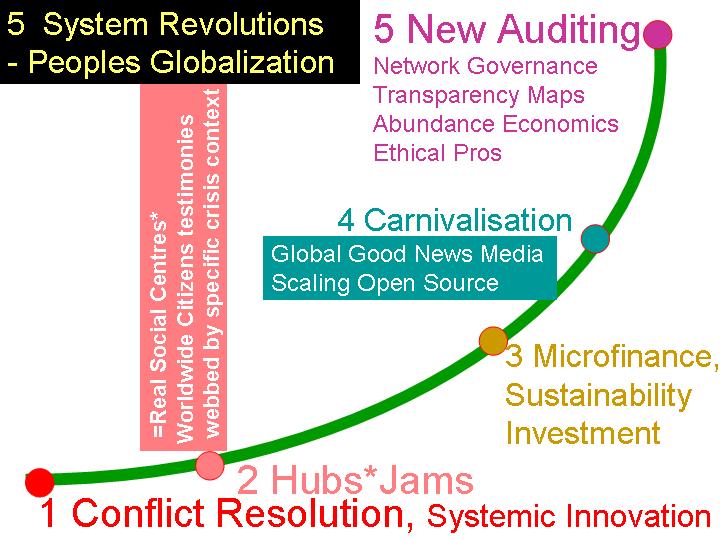
In the 30 years that we have been hosting dialogues of Entrepreneurial Revolution and the 22 years we've been scripting death of distance networking consequences of globalizations for communities and societies, this jigsaw picture of 5 system revolutions in one comes together
Interdisciplinary consequences for future leadership are discussed at Club of Village, what are the first conclusions for the future of the ethical brand profession
The communications and valuation professions are the 2 that people need to unite first before there is any chance of restoring hippocratic oaths of other management or government professions. This is why the separation algorithms of brand valuation and equity were a tragic mistake. On global sector exponentials re-examination of such wrong maths all compound futures of humanity depend. We have the maths of transparency mapping - of systematically designing industry sectors to have upcurving exponentials in which all workers who make a difference are truly trusted and empowered. The Beyond-Branding community itself made a partial mistake when editing the special issue of the Journal of Brand Management on Total Branding Corporate Responsibility. The global (networking) problem is sector level cooperation over its deepest risks to humanity not any one single corporate. No wonder every corporate leader can deny the practicality of responsibility. It will not do that all the corporations who know most about water are buying it up or polluting it faster wherever societies have not caught up with the future scarcity of clean water the way globalisation is currently compounding. Coca-Cola as number 1 brand of 20th Century is leaking goodwill to death. Spending billions of dollars a year on ads to plaster images over these leaks is not what the world's most friendly brand should be singing. It should be convening the mother of all transparency debates on clean water demanding that all corporations who currently profit most from non-sustainability of water join in or forever get left out- branded as water careless globalizers. At a stroke all the universities that have been delisting Killer Coke, would find youth cheerleading Coca-Cola again.
We don't yet have the hi-trust future professions able to simply flow across each other's jurisdictions of knowledge. 22 years into storytelling how economics has to go beyond representing only big power to including all peoples and global villages, little progress has been made. The media we systemise is also a communications problem. Will public broadcast sectors break free of left/right politics and get back to world service in time as per this 1984 scenario? The last 5 year countdown of this intervention being practical has begun. For example if London's Olympics does not give most publicity to superstars worth heroising like Carolina Kruft, we can be certain mass media will continue dumbing us all down until the world suffocates.
We need a new open source industry which shows how easy it is to network the world with something everyone needs and enjoys participating in the carnivalisation of. I'd love to hear of other ideas, but our best shot seems to be photosynthetic energy, and about 100 million pounds (1 2 3 4 5) worth of experimental prototypes are being planted out of Britain in the next 12 months. Since the 25 year old inventor network behind this is dedicated to commons licensing for all peoples, why would anyone who wants humanity to have a future not want to get involved in word of webbing this. When Ken Livingstone talks of the London Olympics as being carbon neutral, why not make it decarbonisation positive.We can all enjoy the dream and the glory of “you are my sunshine”. This revolves around the humanly clean and gravitational power of photosynthesis, and so to a future of celebrating bigger footprinting innovation in every locality simultaneously. A truly inspiring world service that should be on the news everyday of the rest of my life. It may not suit national governments who last control over people is fear, but then when is the last time that national-divided governments lack of cooperation do anything but exponentially increase the costs for all their peoples.
10 years after initiating the genres of living and learning the Brand with Brand Chartering, we are extending the Q&A communications grid of chartering brand architecture to include a fourth row that value global sector transparency's futures the way 6 billion people must demand open debates to be spaced. The journal paper on this is almost complete. email me at wcbn007@easynet.co.uk if you want a draft copy telling me of at least one worldwide industry sector whose future exponentials concern you permalink
Apple is naked
 Is Apple being true to its brand? Stefan Engeseth seems to think it’s a case of the Emperor’s New Clothes.
It’s a daring position to take, but he has a point. When we were younger, Apple made moves that were pioneering. It made us think we were hurtling toward the 2000 predicted in science fiction. The Apple II and the Macintosh could only have come from a bunch of folks in Cupertino who flew a pirate flag outside their block.
Now, there’s the iPod or, if you hate intercapitalized words, the Ipod. Which is one of the products of 2005 and, possibly, of 2006.
I can’t see the point. In fact, I can’t see the point of any gadget which does not serve me and insists I change my life to suit it. The cellphone is one, though admittedly I am in a minority. But the Ipod is another.
The ’Pod offers music on the go. Well, I already have music on my car stereo. If I am walking about, I can appreciate the scenery or indulge in silence, or if I want music, I’ll hum a tune. I like being creative. And it won’t take sitting on my hind end in my office downloading stuff.
Stefan says that Apple doesn’t reach for the future here. He might be right. There’s not much futuristic about Desperate Housewives being downloaded on to your ’Pod. It’s rear-view, mass-market pandering here, and not the balls that gave us the Mac.
Without those balls, the west can watch Red China and India beat the crap out of the rest of us with low-cost versions of the same gadgets. permalink
The brand wiki
 In some of the more recent blog entries here, we’ve discussed how brands are driven more by citizens than organizational managements. It’s not happening in isolation: it’s happening to the English language at Merriam–Webster. The dictionary people have implemented a Wiki of colloquialisms. Rather than editors dictating the words, everyday folks can go in and add them. It’s useful from the point of view of tracking etymology and seeing which words (e.g. Google as a verb) have staying power.
What next? A brand wiki? It is totally possible, where everyday citizens put down their ideas for a brand’s direction and it’s all fed back into management to see if there is merit to steering an organization a certain way. It could happen, and it might even happen this year. permalink
A Wiki of thoughts: the bigger picture to blogging
 More scrutiny today over Wikipedia, this time from the Wharton School. For the few faults it has—marginally more than the Britannica—it remains a pretty accurate reference, but only as good as the people who contribute to it. And therein lies the rub: if the pessimists are right, and society is declining, so will Wikipedia, which necessarily reflects the integrity of the public.
For all the things we write here, there are longer-term reasons. If we’re setting a bad example for young people, then of course they will rebel. And with everything pointing to greed (reality TV), deceit (finance) and dishonesty (politics), then the moves to rectify can either be smooth (we manage to transform our societal structures, globally) or bumpy (revolution).
This also brings up a related topic. I recall 30 years ago, a TV show called Hudson & Halls started in New Zealand. Pretty good entertainment. The prime-time cooking show lasted 10 years and some of the strongest memories I have of the show is the on-screen banter (and sometimes downright tiffs) between Peter Hudson and David Hall.
We think of ourselves as more tolerant today, but I no longer see two gay men host a prime-time television show where their sexuality was not mentioned—either because they were simply too busy entertaining the nation, or because they thought we’d be upset. Today, we seem to spend a bit more time marginalizing minorities. Are we actually more tolerant by making sure, at least in New Zealand, very late-night slots for the likes of The L Word and Queer Nation? If Hudson and Hall were still alive and popped by to pitch a show, would it be turned into Queer Eye for the Straight Diner?
I hope in some ways we are improving; and certainly the gay community needs no help from a ‘het’ (as one friend labels us) when it can more than ably look after itself. Race relations have improved here for the most part, and there is an awareness and even an appreciation of other nations—with the occasional slip-up when a race is made into an election issue. And if there is an upward swing on some aspects of society, maybe we can clean up business.
And as this blog maintains, that cleaning-up can be done through branding, the interface between organization and audience, the most obvious sign the public has about a company’s authenticity. Maybe we can evolve to a higher state in business so that we don’t suffer another dramatic collapse. permalink
January 11, 2006
Trizophrenia of Global Branding
1) The death of brand and people values machines more than people; money more than trust; compounding risk around the globe as long as its not inside your nation rather than sustaining life or nature. Global accountants dreamed up a perfect valuation algorithm for promoting this machine economy, that separates all the relationship flows of being purposefully productive or demanding. And all because they wanted to preserve their tangibles monopoly of adding up bottom lines, a maths they had not chnaged for about 100 years except with all sorts of notes that became larger than the image of offering a true and fair standard.
2 The service economy brand: we know how this works http://value100.blogspot.com Its loves the organisation's most purposeful people. It empowers then to develop their own teams, it wants its best people to work and elarn for a lifetime, but there is one vital external rule. Get close to the most demanding customers where these are the people who can help you see what society most wants the future of this sector to sustain. Anyone whose strategy uses economics of externalities or other Porterian defensive barriers never compounds leadership value over time. The service companies that do multiply value with society can compound 100 times investors returns over a generation.
We don't yet know all about the peopleseconomics of a networked age and empowering 2 million global villages, where we go beyond service to multiplying the value of learning in ways that make collaboration the new competitive advantage but entrepreneurial revolution debates now celebrating their 30th birthdays, economics of exponentials and London's 5 villages researching the Queen's mission (Is Humanity turning on itself?) provides simple map that shows any boardroom who believes that is about governing by historic measures alone is not long for this earth 1 2 3 permalink
January 10, 2006
Devaluing true marketers
However a crisis (mathematical mistake) started to be spreadsheet in the late 80s that is now spinning so fast around marketing's value multiplying competence (on which humanity's progress has always actually depended -read DSrucker 1956 Practice of Management if you need to support this claim - whatever other professionals like accountants or lawyers adminbstrate with). It is a mathematical mistake of sufficient compound order to mean this wil be humanity's last century as elaborated here
To propagate this post's conversation far and wide and deep, what we need to agree is that global branding (which is of course also only as good as deep local cross-cultural goodwill) introduced a 3rd dimension - whether each industry sector at a global level is being stewarded around futuure expoentials that sustain human life or compound its destruction.
Just as quality over time was hard enough for marketers to include in the system against such marketing destroyers as Wall-Mart has mathematically mistakenly (world's largest corporation) with its dictation of ONLY always lower cost of every category, SO too sustainbility of a global sector goes way beyond what a marketing director alone can steward unless the whole board stands up and says: as human beings, we value our leadership of our industry category sufficeintly to insist that all our competoitors colaborate transparently over our sector's greatest compound risk to the sustainability of the human race and earth. This is quite a big reality conversation to raise- one that marketers of goodwill need to find matching goodwill counterparts in every discipline. And then all professionals of goodwill need to connect to devalue all professionals of badwill. What are the chances of this happening in time? What system mappers know is they go down every year.
Back in 1984 The Economist's economist forecast that the BBC would NOW have a critical impact in raising this conversation around the world. The Queen Elizabeth's challenging end of 2005 speech "Humanity turning on itself?" is exactly on this inquiry. Every British journalist could stand up and join in this royal inquiry of whether each global sector as currently being governed is compounding sustainability or death of humanity. Every Indian journalist is being given the same empowerment thanks to owning the secod largest public broadcaster in the world after the BBC and the most extraordinary 21st C leadership duo of Sonia Gandhi and Prime Minister Singh (an economist who's up there with the very best that Cambridge University has ever mentored). Journalists like brand marketers do , at the end of their day, interact with ordinary people so this suggests one simultaneous way everyone in a true democracy has a chance to join this debate now. Another way our journalist sugested in 1984 was project30000
Do drop me a line at wcbn007@easynet.co.uk if you can think of other ways or cracking the 3 dimensional problem that Beyond Branding marketers are now at the world's valuation epicentre of. 2010 will be way too late for marketers to start the global mobilisation of transparent mapmaking networks that 6 billion beings now need to emerge. permalink
January 09, 2006
Untraining monkeys
 It’s interesting to have brought up Reuven Brenner’s The Force of Finance. Chris Macrae introduced me to the book, and I ordered it from a UK retailer, who shipped it to my office in London. (I was passing through at the time, and I always like saving a few pounds on shipping.) Soon after we both got in touch with Reuven. After bringing it up in my blog post yesterday, I dug it out and read this in his chapter on higher education:
Four monkeys were put in a room. In the center of the room, there was a tall pole with bananas suspended from the top. Whenever a monkey tried to retrieve them, however, he was hit with a shower of cold water. After several attempts yielded the same result, the monkeys stopped trying. At this stage, one of the original monkeys was removed and a new one was added. When the newcomer reached for the bananas, the other three pulled him back. After a few tries, the new monkey also got the message and stopped trying. One by one, the original monkeys were replaced, and each new monkey learned the same lesson: don’t reach for the bananas. Though the new generation of monkeys had never received the cold shower, they adhered to this behavior.
And:
high school lost relevance when they ceased to be held accountable for their kids’ education, and that they expect colleges and universities to fill the gaps they’ve left[.]
The first quotation was about the institutionalization of education: that universities are too much about publishing incomprehensible, exclusionary works and organizing conferences for their self-importance than really imparting that knowledge. The second quotation was one of the observations that Reuven made.
Not only does the first tie in with Reuven’s observations within the university system, it fits with Chris’s, and it fits in with a lot of the things we have been blogging about. Beyond Branding, as a book, tries to make these points which might seem way-out for some, but at least we are trying to pick up the slack of modern marketing courses.
It reminds me of the way New Zealanders uniformly attack the administration of the late Sir Robert Muldoon (1975–84), even though many of those who criticize him have no memory of the era. But, when many economics’ lecturers who could have sided with him were removed when Sir Robert lost power in 1984, when TV documentaries paint him as a villain, and when a mini-series, Fallout, is currently being rerun on network television and does the same, who questions? Whether one was alive during the Muldoon administration or not, one might be like a monkey.
Indeed, you can read the monkey behaviour here. One blogger questioned the lies he was told about the era, and the anti-Muldoon din followed, with only one or two dissenters. And there were enough bloggers to label this post a looney-left post—odd in a liberal country. But then Muldoon was not in a left-leaning party.
I enjoy this issue because it’s one situation, of many, that we should be questioning. I am not saying I have it all correct—but to not even question? Where are we, in Cuba or Honduras? John Kay thinks there are parallels with Argentina.
My recollection is that New Zealand had gas–petrol hybrid cars from around 1979 and filling stations were commonplace. That we were one of the most advanced economies around with recycling and alternative energies. Not that that is ever raised. As I wrote earlier in this blog, politicians find it easier to admit to Satanism than Muldoonism—because Parliament is a forum of trained monkeys. And so are the mainstream media (which are all owned by foreigners, anyway—well, nearly all).
So in marketing, how many are trained to question anything beyond Kotler? How many sustainable principles are suppressed because they do not fit in with the establishment?
Even in my university days, we weren’t encouraged to do the questioning till the 400 level. Perhaps I am naturally cynical, but I excelled in this. Summa cum laude and all that rot.
The second quotation connects more with me than Chris. When I taught regularly—I still have some visiting lecturer gigs—I noticed many of New Zealand’s primary and high schools had left the teaching of spelling and punctuation to me. These kids were 20, or more, in some cases.
And when I hired people as designers, I wonder if anyone had taught them fundamental, 100-level typography. So now it seems even tertiary institutions have passed the buck—in favour of “on-the-job” training.
Institutionalization is a very bad thing, especially if we encouraged people not to question, and not to reason. We fight, and have to fight, this ignorance every day. It is why I got into media, and why I got into consulting. With the former, it was raising questions on an international level. With the latter, it was about helping clients raise questions on a firm-by-firm basis, maybe affecting an industry. It still is, in both cases, because my job is not done. Co-writing this book was combining the two—to question, in the words of Deepak Chopra, in order to break through the hypnosis of social conditioning. permalink
January 07, 2006
Note to the west: shift the future
 Chris’s post below brings up several interesting points, which remind me of some of the reasons this book was written in the first place when we all met at Medinge, Sweden in June 2002. The post might be one of the longer ones here, but it is one of the more meaningful, too.
Our friend Prof Reuven Brenner, at McGill University, wrote in his book The Force of Finance about the educational downfall due to the growth of university enrolments in the United States in the 1960s. This created powerful lobby groups and mediocre professors, and by extension, mediocre students. I could not fault Reuven’s reasoning then, and I cannot now.
With some exceptions—I recall some of my own professors—I notice that by and large the so-called Master of Business Administration degree need not lead to mastery. It was this that led me to do a more academic Master of Commerce when confronted with the choice: there seemed little point to complete a more expensive version of 100-, 200- and 300-level papers with a new number on the front.
Instead, MCA (the A is for Administration) students were expected to be more visionary—or at least equip themselves for the coming years. My prof, Peter Thirkell, who has now risen to be dean of the faculty (deservedly so), encouraged students to not adopt a rear-view mirror in their theses.
I do not know how the marketing department at my Alma Mater is run these days, but I do know that if Peter were supervising another thesis, he would welcome the thoughts of sustainability, open space and the ideas of organic marketing. His own research suggests as much.
The crumbling of traditional competitive barriers needs to take place if organizations are to sustain themselves; in the west, it’s needed if they are to make a rapid enough change to take into account a global economy and a consumer movement. If companies entering Red China and India believe that the consumer movement will take years to take hold (by examining the patterns in the west), then they are mistaken: India shows signs of that right now, while Red China’s rapid shift to consumerism will necessarily kick that off, to the chagrin of the Politburo.
The changes in the west, particularly in the United States, are pressing. It will take a huge change in the way business is perceived: one less of adversaries and one more of cooperation. That attitudinal change will necessarily encompass the consumer movement—for right now, consumers are seen as adversaries if you look at some of the largest companies—or at best a wholly separate group to the organization. Numerous, smaller organizations have already woken up Stateside, but the systemic changes—valuation is Chris’s passion, but it is important—still have not taken place. We continue to place finance ahead of people.
I tend to be a cautious optimist: I take heed of Chris’s (and Norman Macrae’s) warnings—and live in hope that the smaller organizations that have kicked off consumer movements (or Oneness, as Stefan Engeseth might put it) will grow so much, fuelled so well by their audiences, that old corporate America cannot ignore it. A single network TV documentary woke Detroit up to Japan’s success as a car-making nation (even if GM and Ford have fallen into old habits again); a single company that has made a big enough change might be able to do the same. It needs to mobilize its citizens, and, in turn, mass media interests. permalink
The Competitive Disadvantage of Nations
Early on -perhaps space trial 200- Harrison had lunch with the top person of an USA association dedicated to management education. After listening to how open space invites all workers concerned with a revolutionary innovation to participate in meeting, debating, co-organising experiments, being the open future network which will resolve the context's value multiplying future exponential; the top man stood up and said: Harrison if you are correct then 95% of what academic specialities of management teach will be wrong. His PA stood up and said 99%; they stomped out; and to this day their asociation is a sworn enemy of letting higher education open space in MBA curricula. They have done things such as write learned papers over the last 20 years so that open space and living the brand is excluded from brand valuation or innovation or knowledge networking. They have teamed up with every major profession that finds it more lucrative to separate its own business case than connect with other professions. More lucrative to peddle a standard rather than admit organisational leadership needs be deeply organic, contextual, beyond what the profession's standard knows deeply about sustaining.
Today, well over 90% of what you might read in Porter's Competitive advantage of nations - or any economic treatise that puts competitive boundarising alone (aka economic externalising) as more vital than collaborations - is wrong, and compounding exponentially greater wrong. Wrong mathematically; wrong ethically; wrong in terms of financial sustainabiliy -ie not multiplying volatility's risks of bubbling up and down; wrong in terms of any relationship dynamic humans value beyond the last quarter's monetary take; wrong for the future of your kids, the sustainability of nature. How wrong does the boundarised scientific mind need to become before we people celebrate deep voices who question it, who provide spaces for communities to declare their grassroots needs however blind the top is to the fact that eg 10% of folk in New Orleans can't drive cars, so a washington DC evacuation plan is as useless as a gaggle of Arabian horses as a new Orleans evacuation plan unless you permit local voices to openly question it ahead of its real-time need. Why are some top funders of scientists so vain that they don't want to include local-up views- perhaps because by including diversity, there would be less money in patenting one fit all standard approaches. Perhaps because instead of soundbiting, the true academic leader would want to promote open questions for a community to resolve as much as handing answers on a plate. perhaps because this would also show that teaching our kids to always prepare for the next standards exam is an abortion of context deep learning , and a sacrilege to using email to co-mentor each other, and to love crossing cultures . Perhaps because (I leave you - dear peoples communicator - to complete the next sentence now you are into the cluetrain of the peoples communications revolution)
This leads us on to the following script on The Collaboartive Advantage of Nations in a Networking age. My intent at wcbn007@easynet.co.uk is to connect with the one percent of people who may read this and want to openly explore this new whole system maths of mapmaking, not get into quarrels with the 99% of professionals who love separating competition. Your past and even your now can do very well from spearation, but as forecast since 1984 our species won't exist in 100 years (give or take a generation) unless at least some places go beyond competition between nations and towards colaboration between all 6 billion beings. Mathemticians might first go back to reading how John von Neumann wanted to see collaborative uses of computing. He would have applauded the 5 year get us to the moon project as the most collaborative use of brain, emotion and machine power ever teamed. Every year since he must have rolled in his grave about how few other meta-projects have ben realised within nations. The tragedy of "humanity turning" today is by not having practised within nation collaborations around greatest innovation projects over the last 2 decades, jumping BEYOND to inter-nation collaboration projects of such 5-year urgency as photosynthetic energy will require far more courage and transparent revolutionary zeal than most national leaders (Queen Elizabeth and India's leadership accepting) have been conditioned by the last generation of left versus right politics to even consider as possible to mediate.
So read me only if you are prepared to agree every one of us has made mistakes in permitting our mnations and subcultures to get so isolated, so afraid of each other, with so little space where citizens can meet to draw up the bigest 5 year projects, and ask their leaders to help facilitate their communications realities, through open spaces etc
Ranking the competitive disadvantage of nations in a Flat World
Links 6 hi-tech interviewees of 6 January and Friedman
This league table can be described in various equivalent ways including the collaborative advantage of nations in a networking age
The ranking we seek to value is whether a nation’s economy is exponentially up-tilting or down-tilting all its societies’ futures
Here is a first guide to some early estimates and qualification of assumptions. As the input data needed to make these rankings is concerned with the deep conflict-free contextual dynamics required for collaborative networking, anyone who has a deep truth testimony to include in our maps can help change the ranking. However broadly speaking national league tables are emerging like this. They are based on the forward value multipliers of whether an economy is on an upcurve or downcurve, and primarily two upcurve qualities: speed of spin and cooperative sustainability
Among big economies: China is on the fastest upcurve, India on the steadiest most diversely and sustainably cooperative
There are city-based economies like Singapore that are probably ahead of either China or India on both curves but at the smaller scale. Countries that may do unexpectedly well compared with backward valuation indicators include:
Nordica countries
Australia
Canada as long as it never gets invaded
EU countries are mostly on slow downcurves that are change-able as long as countries are able to make deeper contextual decisions on future exponentials than Brussels ideal of an united constitution permits.
What of USA? About 10 luminaries at the top of business and academia have go on record on public television in the last few months saying they have widespread feedback that American people feel they are on an inter-generational downturn. They are correct unless economics of exponentials maths is understood pretty fast for 5-year projects the world needs most.
Urgent 5-year collaboration meta-projects include
Green Energy
Intercommunity safety- ability to collaborate in response to natural flows that no national borders
Microfinance to the most disconnected especially women’s networks in places with poorest infrastructures or most corrupted governances
Etc
If USA does not evolve the collaborative network competences and transparencies with which other countries lead in collaboration in 5 year meta-projects , one of 2 things is statistically likely to happen by 2025. The united nation will be on one of the steeper downward exponentials of any once great 20th Century economy. Regions will have split up into a disunited states in terms of economics and governance.
It may be important for you to appreciate that all of us can integrate an open source maths of mapmaking future exponentials all of whose dynamically connecting pieces are known. This mathematics seeks to unite over applied 100 disciplines of management and performance measurement including different branches of economics that have been made academically separate and whose assumption were boundarised by scientific analysis that pre-existed networking realities of system*system interactivity. Moreover, it is only by configuring these at contextual levels and then auditing truth or conflict-free relationship patterns that the future exponentials become transparent.
It is also important to understand that wherever citizens wish to raise a debate that transforms systemic views of all measurement and constitutional professions until they connect as seamlessly as networks themselves do. In providing first sightings of national rankings, we are not suggesting individual leaders have been primary causes of company’s forwards exponentials. Rather the entirety of the mapping system. Transparent governance in an open networking age cannot be sustained by 20th Century top-down modes of governance isolated from deeper and faster changing interactions than can be statically planned or known.
The predictions implied above do not have access to all the future truth-testing inputs which could be gathered and configured. That is the next task for democracies or organisations whose leaders or citizen networks who are transparent and goodwilled enough to stare potential conflicts in the face and systemically resolve them in time.
Where did this come form. It integrates journalist and inquiry molecules that future historians have been using for over 40 years- in my Dad’s case at The Economist to forecast the future of Japan in 1962, and various entrepreneurial revolutions in a series of surveys whose origin celebrates its 30th birthday this year. Similar logics appear in all of Drucker’s work. Modern day analysts of networking’s future exponentials include Friedman and Tapcott, Allee and some of the inquisitors of the Unseen Wealth inquiry done in 2000 out of Brookings & Georgetown Law School.
Personal Resources:
Do you have a transparency region or other context that you want to map? If so mail me explaining why the context matters you and what transparency inputs you and your networks can access for making a first stage map
General resources include:
http://exponentials.blogspot.com/
http://therebeleconomist.blogspot.com/
http://simpol.blogspot.com/
http://clubofvillage.blogspot.com
http://osoflondon.blogspot.com http://futureoflondon.blogspot.com
http://clubofamerica.blogspot.com http://clubofdc.blogspot.com
http://clubofdelhi.blogspot.com
http://entrepreneurialrevolution.blogspot.com
Charlie Rose Debates on PBS TV - Green is Next Red, White & Blue; Competitive Disadvantage of Nation, China, Karen , Lazard, Moores 2nd Laws, Mirror Mirror Least Green Corporation of All permalink
January 06, 2006
Simultaneous Empowerment of 6 billion pople
However future historians and social preneurs beleve that if we people don't stand up from every place and space by 2010 then we will literally lose control of the world (how its systems of economics and societal interaction sustain)
So here's the "start of 2006" review of Club of Country, and an invitation to every blogger to join in timelessly from the community they are most concerned about sustaining and integrating with all other communities to be
Future Historians (since the 1960s when my Dad started hosting roundtable parties of people concerned with his surveys published in The Economist) have predicted 2000-2010 as the Simultaneous decade where the people everywhere need to connect humanity through deep community cataloguing -see project30000, and its forecast need in 1984
Networks change the economics and social trust-flows (including transparency and sustainability) of everything that is most humanly valued. If economics of abundance is to win-win-win over economics of scarcity then the people's globalisation revolution needs to linkin openly at every level of economy - national, corporate, of people's lifelong experience and productivity curves. And we need to support the preneurial sustainability of all those in most urgent need, before nature or humanity turns on itself (search Queen Elizabeth 2 end of year speech for 2005)
Club of Country exists to provide an overview of what is being catalogued at more detailed levels by grassroots future society correspondents:
Club of Village
Club of City -try out these 20 milion searches of catchphrase knowledge collaboration city -shows how much demand is multiplying for people helping each other, and where! -eg London 1 2 3, Delhi 1 2, and 100 more...
Project30000
2006's 30th Birthday parties of Entrepreneurial Revolution of Systems
DoD's 22nd year of monitoring where the future is happening so that everyone can make the co-mentoring most of network's death of distance
In some cases -eg USA, America, Africa we also provide overview maps for large continents of places we would suggest likeminded people visit if passing by
We need co-editors help at all these resolution levels to ensure that every place's open society connections are available on a worldwide atlas
Mail me at wcbn007@easynet.co.uk if you want to help put a community, place or social concern network on the map. We use a timeless blog format so co-editing need only take us as much time as when your network anyway wants to publicise colaboration events or other actions permalink
CSR needs a CEO who can see into a crystal ball
 When I took Lucire into a print format in 2004, I made sure it reflected my personal values. Each copy, for instance, has a breakdown on how much of its cover price was going to printing and salaries. Only after a while did we remove the profit statement from the magazine. And profits would automatically go to socially responsible causes that I believed in—countering the carbon dioxide emissions that we generate, for instance, with planting new trees.
However, these didn’t get much press, nor have they meant much of a difference to the everyday buyer in New Zealand. They have received interest from those journalists here already passionate about these ideas—people such as The Dominion Post’s Carolyn Enting. But as a nation, we are not as green as we let the world think (examine our environmental policies and the percentage of GDP being put into them, and you have the truth behind ‘100 Per Cent Pure’). I have encountered cynicism. Instead, there seems to be more interest in Lucire being a socially responsible brand in the United States, of all places.
I am glad Lucire is still owned by yours truly, because these ideas must be driven from the top. And I still believe them to be right, not just because I have another 13 colleagues and co-writers of this book who say I am right.
There continues to be mounting evidence that this is the way of the future, and in the United States, the country driving hybrid automobile sales, that future is already here. Just that few in publishing want to go with it, with uncertain sales. With Lucire’s US launch looming, I’m still deciding whether to bind our publishers there into our environmental policy and philanthropy, or whether we merely continue with it in the master edition. I will have to make my decision in the next few weeks.
In a branding model, management commitment needs to be extremely high for ideas that might not translate into sales overnight. And management needs to keep an eye on the future. Sometimes, considering the brand as an expression of brand vision (the classical model) or collective perceptions (the consumer movement model) won’t work, at least not when the latter model is concentrated on a single market.
The CEO and the brand manager need to be sages, in the greater consumer environment. The research stage in traditional brand management will never lose its relevance, and it has become more vital that future consumers are looked at—particularly with the second model. permalink
January 05, 2006
world's most valuable brand= how we - 6 billion beings - value future of leadership in networking's collaboration age
Have a visit to exponentials or tell us any time if you know where a hot exponentials debate is transparently being spaced . Below is Exponentials' current hot list. Sure I love to collaborate to make it more urgently relevant. What exponentials debate is most criticial to the future of your family and which leader is either controling or faciliating the choices of all your social networks (cross-cultural villages of interaction) regarding that future consequence? Does that leader even know what's at stake or is he Wal-Marting the world? Do you see that Always Low Costing System governs valuation with the exact opposite maths than World Class (reality-futurising) Brands. Memo to Queen Elizabeth: Your HRM: you charter many of the certificates of professional marketing- temporarily withdraw them from every teacing institution until its first day module is Always Low Cost brings the marketing profession into disrepute. Send the next memo to economics institutes please. At a stroke, you will have down a great & good turn for humanity.
Hot exponentials debates:
- Is Green the Next Red White & Blue? by Charlie Rose & Friedman
- By Rose & Wasserstein: Does Lazard know how to question the next 10 internet collaboration businesses until Google-like value100 exponentials help liberate the world and New Orleans
- Unfiltered Truth CEO Debate : Is the always low costing of Wal-Mart as world’s largest corporation also puuting 6 billion beings at risk to the greatest down (non-collaboration) exponential of the network age ? How many people make their most vital decisions in life on an always low cost basis? Does nature use such a pattern rule? So why would the most powerful organisation designed by man do so? What a big mathematical mistake to govern with
- Will London’s 5 collaboration villages turn out to be a way to save all multi-cultural cities futures? Can you help us spread Queen Elizabeth's 2006 conversation opener across the Commonwealth? With 2005's hindsight we ask you, and public media like Britain's BBC and India's DD, to discuss: Is Humanity turning on itself?
- Can you take charge of the collaboration exponential of one of Project30000?
- In the internet's co-mentoring age, Is there a more collaborative way to teach 9-13 year olds?
- Would you like to join in celebrating Entrepreneurial Revolution’s 30th birthday party, born in 1976 at The Economist of EcoSaintJames, London by co-scripting a collaboration around a global market sector that matters most to you and humanity’s development? -cosponsored by aSIN, DoD & ClubofCity
Please tell us of any other spaces opening for hot exponential debates.
chris macrae , wcbn007@easynet.co.uk
Up the dial on Kiwi radio
 I have discovered two excellent radio stations in Wellington, New Zealand which I had never heard of, and only caught one of them by accident when fiddling with the dial in my car. Groove (107·7 MHz) has jazz—even caught the Tigress from Tiger Bay doing ‘Diamonds Are Forever’ one day. And the Matrix (107·5 MHz, which is very close, and again found by accident) has alternative politics, including a great lecture on the G8 today.
Since few have heard of these stations, they are ripe for citizen support—bloggers, emailers, and other campaigners. Why they have not been started I’ll never know. Groove doesn’t even have a web site, from what I can tell, while the Matrix is still on Geocities.
I think these stations deserve to do well against the dull mass-media ones, because they offer programming quality, even if their signals are not the strongest in town. Tall poppy syndrome might prevent it, but I might just start a few emails going. Let’s see how sophisticated we really are here in New Zealand with publicly driven brands.
The public already saw to the reinstatement of Phil O’Brien’s Matinee Idol programme on National Radio in New Zealand—an entertaining show that contrasts the station’s usually conservative (not politically conservative though) style. If emails can see Phil return in the summer, then a good ol’ citizen-driven awareness campaign might bring these guard-band stations a few more listeners. permalink
America’s top 10 cars: Japanese take top five
 As a footnote to my previous post, even though blogging means this will wind up above it, 2005’s top-selling cars in the United States have been announced.
I am old enough to remember an Oldsmobile Cutlass being in the global top 10. Or the Ford Taurus trumping everything else in the States. Now, the boardrooms in Japan are applauding:
1. Toyota Camry (431,703 units sold)Unless the American automakers sort out their brands, they had better get used to these sorts of sales’ results’ tables. This table, too, shows that the better defined the brand (at least Stateside), the better the sales. permalink
2. Honda Accord (369,293)
3. Toyota Corolla/Matrix (341,290)
4. Honda Civic (308,415)
5. Nissan Altima (255,371)
6. Chevrolet Impala (246,481)
7. Chevrolet Cobalt (212,667)
8. Ford Taurus (196,919)
9. Ford Focus (184,825)
10. Ford Mustang (160,975)
Ford’s Fields marshals marketing
 W. C. Ford’s new president, Mark Fields, says he will take the company on to a market(ing) orientation now that he’s in charge. This means good things for the North American operation, which has struggled to define itself brand-wise. It’s finally been outsold by Chevy for the first time in 19 years, for a start. Funny: I don’t feel cynical about this.
Fields has proven himself at Mazda when running its global ops, giving it a healthy dose of zoom-zoom during his tenure. The cars have captured their sporting heritage and the company has been able to sustain that with its present product line—good going for the Hiroshima-based firm that frequently finds itself in financial trouble.
I’m also confident because Fields has the blessing of Ford’s relatively new North American chief designer, Peter Horbury, who’s a Brit. Horbury was behind the renaissance of Volvo, the company’s Swedish brand, and managed to accomplish the turnaround because management defined the brand and supported its nourishment.
Even more importantly, Fields admits that Ford has turned out some duffers. The Ford Five Hundred (daft name, incidentally—and pictured above), which looks the world like a 1997 Volkswagen Passat, and the relative failure of the Volvo S80-based Ford Freestyle, have no clear brand direction. Fields says Ford lost touch with its customers. Now, according to Business Week, the agenda includes making Ford ‘American and innovative’.
He doesn’t mean the over-patriotic claptrap that became quite passé after 2001 finished, but the ideas of ‘values, culture and optimism’—which are universal enough to apply to Ford of Europe. There, Köln has more clarity, expressing its designs with the spirit of the Capri and 1971 Taunus, culminating in the new Galaxy minivan—one of Ford’s strongest designs since the original Focus.
Fields sees Apple as being an example of a brand going on the offensive. He certainly has the passion, and says he will be bringing marketing into the product development stage. It’s not a new model—Chrysler Corp. (prior to Daimler–Benz AG popping by) used it for years as it turned out butch trucks and Dodge Viper—and my only surprise is how long it has taken another American company to learn from it.
It will be interesting to see just how well Ford can adopt its marketing orientation, and look to the future for inspiration. The boring commodity car may be finished at Ford—a good sign.
Heck, they might even build the next Australian Falcon Stateside to fill the gap vacated by the Crown Vic. There’s an interesting delay in the Falcon’s release that will work out rather well. If, of course, Ford can get over its politics, its not-invented-here syndrome, and sincerely adopts that marketing orientation. Fields will need a lot of strength to do it, and Bill Ford seems to be behind him. permalink
Brand awareness increases with age—so how do we reach the young?
 If one needed evidence that younger consumers are hard to convince—and have shorter memories—an Ipsos study shows that brand awareness, at least among banking and investment firms, increases with age.
So how does one reach the younger consumer? Simple: find ways of marketing that aren’t stuck in the 1950s. Younger consumers are divided into two camps: those who are passionate about the social aspects of the brands they buy, in order to achieve self-actualization, and those who don’t give a toss.
If you have to reach any group, you might as well go for the former, in the hope they’ll influence others, and they are likely to have the greater disposable income.
I doubt this study will act as a wake-up call, but the need to appeal to the under 35s, who are more cynical and less loyal, grows stronger by the day. In the financial services’ industry, this group has seen a drop in service (in the 1990s) and has every right to disbelieve its claims. In New Zealand, banks, which supposedly compete, suspiciously have similar charges and interest rates that rise and fall at the same time (though one could equally claim that if they were colluding, they would stagger these movements).
There are routes open to these companies, and it isn’t giving some money to the SPCA every month. Real commitment to service coupled with support for the causes that customers believe in are the ways to build brands to this group. permalink
January 04, 2006
Million Person Web Pledge against Wal-Mart
http://www.pledgebank.com/unfilteredtruth
If your sector's future vision for humanity or sustainability or people's livelihood has been downtilted by Wal-Mart, please look at this pledge. All it asks that we do is when the first million of us ask Wal-Mart to prove transparently it cares about the sustainability of what global market sectors compound; and until it does the first milion of us try as far as wed can not to be a customer of Wal-Mart. Dont start until there are a million of us!
Need more data: even american tv asjked the question is wal-mart good for America last night http://www.pbs.org/wgbh/pages/frontline/shows/walmart/
The first time in my memory that American tv has openly asked the world's largest corporation a voley of humanly vital questions
If people of the web and who want marketing to help make the world better for all people cannot scale this million person mountain, I would love to know whether you think we will ever scale anyoine for humanity. Or will 6 degrees of separation mean that the slient majority of caring people will never stand up against global power in time? permalink
Conversation 2 -World's Most Scary Brand of 2006
This year my vote would be for Wal-Mart as most scary brand. All the evidence an economist of expoentials ever needs was presented on American television Frontlines program last night. Make a list of every global market sector whose future Wal-Mart as world's largest corporation has predominant power over; then picture what its vision is; lower the cost of all the producers, never innovate, never be concerned for the greatest risk to the earth or human lives whioch evolution of that sector colaboratyive guards. Wal-mart is whatever is the least green color in all the world's futures. Either Wal-mart gets over its own conflict of being obsessed wth ever lower cost - and every new kind of global slavery that means through time - or its futture to everyone is worth nothing. If you are investing in people's pensions, take your money out of Wal-Mart until or unless it gets over always low cost as the only way it influences any sector it has global leadership influence over.
And the Queen's courtiers could script a letter for her to send to Arkansaw- tell us one way in which you are commited everuwhere you go to help prevent humanity turning on istelf, dear dear walmart
And we will have another go at million person webs now that pledgebank exists. I will get back to you once I have trialled a million people web for looking after wal-Mart's better nature and thye survival of the human race, because that is always what precventing the worst of global power has needed to care about transparently in the 22 years our senior economists have been tracking it 1 2 3 permalink
Koreans abandon the printed newspaper
 Another reason newspapers need to align their brands with solid reporting, rather than printing A2 sheets of worthless fish and chip paper: Koreans are abandoning their printed newspapers for web sites, including the blog-like Ohmynews.com, according to a PSFK post today. There’s a link to the original story at Canada’s Newsworld, too.
permalink
Another reason newspapers need to align their brands with solid reporting, rather than printing A2 sheets of worthless fish and chip paper: Koreans are abandoning their printed newspapers for web sites, including the blog-like Ohmynews.com, according to a PSFK post today. There’s a link to the original story at Canada’s Newsworld, too.
permalink
On a roll
 Volvo will show the C30 hatchback at Detroit to gauge public reaction. My bet is that the car will be produced, for several reasons. First, the Volvo brand. Volvo owner Ford knows it’s on a winner with this brand, which contributes smartly to its Premier Automotive Group bottom line. But why is the brand successful? Aren’t the S40 and V50 glorified Ford Focuses that are worse to drive?
Volvo is known, of course, for safety, but in recent years it has managed to combine this with sportiness, a sentiment that a lot of buyers would like to live. (How much longer is another question.) Performance plus a brand that translates neatly to CSR causes and values have an appeal to consumers, not just Connecticut couples and liberal college professors.
The other reasons are more marketing-oriented: the car will be Volvo’s price leader. The Volvo C30 will appeal to people who don’t want the wank of a BMW, and who realize that the Saab 9-2X is a phoney made in Japan. Volkswagen AG’s Audi A3 is also within the C30’s sights, but it should also take Focus and Golf buyers, too.
The interior is better than that of the S40, and let’s hope the Swedes have got the performance right. I have driven the top S40 and V50 and found them pretty poor as performance cars. The down side is that Volvo wants us to think that the C in C30 stands for coupé. Will these CSR-conscious, educated consumers, who might like a brand with the values of Hans Blix, like the fact that this vehicle is not so much a coupé, but a hatchback? Or will brand values trump that of the product itself?
Ten to one the brand values will win the day. People will buy a Volvo because it’s a Volvo. permalink
January 03, 2006
Trend-spotters might confront pluralism
In this pluralistic, highly segmented world, the journalist concludes that they both may well be right.
It might be right from the point of view of regular people. There are some people who operate better when given stringent guidelines. There are others who prefer having the absolute freedom to choose. But even the former have choices—just among a narrower mindset.
Before you got your driver’s licence, you still had free will—but you just weren’t permitted by law to get behind the wheel of a car.
However, I can’t see a reversal of the consumer movement, or a trend that might go against it in some fashion.
Some consumers might well want to be informed to make a certain choice, and expensive, old-style mass marketing can persuade them. But ‘to be led and be given authoritative rules and guidelines’, predicted by DDB, seems slightly far-fetched. Plus, mounting such “leading” campaigns makes progressively less sense, unless you’re very sure of your chances. In today’s world, fewer and fewer of us are, when we hear ‘personalization’ and ‘customization’ frequently. permalink
Branding top 5 conversations for humanity in 2006
Clean energy for 22 years as launched by the then deputy editor of The Economist and all entrepreneurial circles he helped to plant 30 years ago. Below the conversation started for 1984. Is the world debating this enough-if not, why not
Let's see if Britons, The Commonwealth and anyone else who wants to linkin can clarify the 5 conversations that should most concern the human race of 2006. Following on from Queen Elisabeth's Christmas speech, our species may never have experienced a year with such vital conversational foci
YOU ARE MY SUNSHINE written 1984
Sunlight is the fuel which sustains life on earth. The process by which plants extract energy from sunlight, using that energy to build up complex compounds from simper ones and thereby storing the energy which animals, including humans, use to grow and move and see and think is the life-process itself. We (human beings) have always exploited that life-process, but in the past we have only been able to do so by using living plants as our agents. We learned to cultivate them, develop them by selective breeding, and since the 1980s to meddle with their genes, but we have not yet learned to substitute something of our own making for the living plant. We have not found or made a more efficient substitute for chlorophyll itself outside the naturally-occurring factory which is the living cell.
Until we design our own systems which can deploy the energy of sunlight as efficiently as humble algae does, we humans have no real biotechnology of our own. We have many kinds of solar cells which can extract energy from the sunlight and store is as electricity or heat, but such devices are very crude indeed beside the technical sophistication and versatility of living plants.
We are making a determined effort to capture and use a greater fraction of the solar energy which falls upon the face of the earth every day. We are trying to make plants flourish in paces where at present they can only eke out the most precarious of existence. The ideal situation, however, would be one in which we did not need to work so hard to adapt existing plants to more hostile conditions. If we had our own artificial systems of photosynthesis we might exploit the desert sun ourselves, without using other organisms as intermediaries. Our ultimate ambition must be to make artificial photosynthetic systems more efficient than those which have evolved alongside side us throughout the history of life on earth. Then and only then will we be able to claim that we are technologically self-sufficient. In 2024, this looks as if it might be one of our children's tasks.
Given this picture the 64 trillion dollar energy question and even more than that if we value sustainability of life is what can we best compound around the sun's energy exponentials in 2006. Next major public meeting on this in London looks like March2006- please do tell us at wcbn007@easynet.co.uk if you have other open meetings elsewhere to linkin on this agenda. permalink
January 02, 2006
We were nice people (for two weeks after 9-11)
 I often enjoy Mike Bawden’s writings at Much Ado About Marketing, and today’s was no exception.
Mike cites David Wolfe from the Ageless Marketing blog, who believes marketers need to be healers, and more are making the shift.
But, he validly notes, ‘1st world consumers, primarily Americans, need to stop consuming so much and leave more on the table for the rest of the world.
‘But can we afford to pay the price and do the right thing?’
Taking a trip down memory lane, I agree some shift needs to take place. At the beginning of each decade—1980, 1990, 2000—someone says the next 10 years would be less selfish than the last. Each time, that person has been wrong.
I admit that the 2000s have seen some of the conscientious people come forth—the internet has made us visible. But the shift hasn’t changed in consumption habits, at least not in a “tipping-point” sort of way.
There are a few things that can make it happen: (a) we cease valuing companies on their share prices, and instead value them on their social good; (b) this will impact on the state and could result in trade liberalization. If Danone of France, for instance, was rated on how many consumers it could serve in the third world, helping their communities build themselves up so they could be fed, its immense power—it owns most of the food brands New Zealanders buy, for instance—could push its home country to lower trade barriers. The host country might do the same.
Economists would tell you that trading increases wealth in both nations.
But this still seems like a dream, because most of us in the first world remain trapped in keeping up with the Joneses and in high consumption patterns.
The only time when we all were united and became more caring was between September 11 and 25, 2001 (though some of my Arab–American friends would disagree). For a while there, we were less bitter, more inclusive. The person sitting next to you was a person, not ‘black’, ‘white’, ‘yellow’, etc.
On or around the 26th, according to a friend of mine who was a waiter in New York in those days, everyone turned into a bastard again. They began demanding service as rudely as they ever could.
Does it take a disaster to make us better? I would hope that the goodness we could find inside us could come out without jets hitting buildings. In some places, we are like that. But in many other countries, we seem to believe that the behaviour on shows like Survivor or The Apprentice (being conniving and big-mouthed wins), or Fear Factor (where self-confidence is actually arrogance, rather than humility), is “normal”.
What’s it going to take to make the shift? permalink
January 01, 2006
Simplify, stupid
 A quick endorsement today of David Lorenzo’s Career Intensity Blog. I read through his posts and they are filled with little gems of how to move ahead in your daily work—and there’s an underlying message of keeping it simple.
I have founded most of my consulting practice on simplicity and removing the jargon from branding. And in the modern US, at least on the coasts, simplicity is greatly needed. So often I have had to confront tantrums there—I compare it with 10 years ago, when most Americans I dealt with were consummate problem-solvers.
One theory is that life has become busy and we vent our frustrations on other areas—complicating the simple to bring it into “line” with the way we are now. But we should consciously do the opposite. If issues, and that includes branding mission statements, can’t be simplified, we only bring greater headaches on to ourselves. permalink
They’re beginning to get it
 In CFO magazine today, Strategic Hotels & Resorts’ branding exercise is covered briefly. And there’s a growing awareness of brands, even in the financial community.
The journalist had a limited space to write what he could, so while the view is simplistic. You could say reputation is less an antecedent of branding than a consequence of it, or you could say it is part of the entire process, which includes business performance. But it does hint that there is far, far more to a company’s valuation than what the financial community traditionally focuses on. Brands are more than goodwill.
The last paragraph brings that point home well:
But branding can backfire if the message doesn't match reality.
Pity the rest of the paragraph, with a quotation, falls a bit flat, and takes it all back into twentieth-century corporate comfort. To the guys who took the finance class at uni rather than marketing: we can work together to develop a better model. permalink
Disruptive blogging
 In my earlier post about how some corporate bloggers have failed to help their businesses’ performance, I mainly said that their brands were ill-considered. I advanced that blogs could not help them if they were merely part of some lip service to mid-2000s consumer behaviour.
Hugh MacLeod at Gapingvoid explains it in another sense: blogs are not sales’ channels, they are disruption channels. By extension, companies need to be willing to have disruption in their otherwise comfortable, groupthink existences. That “strategies are made to be altered”. That a brand is a collective of symbols and expressions, and not just from the organization itself. The blog is a way to harvest external symbols and expressions, to see where the organization can head to.
It’s not just about correcting a course or forcing people into your view of the brand, but about discovering new places to which the brand may travel. permalink
The Beijing News as a symbol of Chinese freedom
 The strike at the Beijing News could well turn the newspaper brand into a beacon of Chinese freedom. Covered yesterday at this blog, the Taipei Times sheds more light on the matter today:
The good news to come out of this is that Chinese readers are becoming more conscious of—and dissatisfied with—the way that their rights are being trampled on by their government. It takes guts to go on strike over such matters in China—where police can throw people in jail on groundless charges of threatening the national security, and all in the absence of due process.
The reason cited by the government for the personnel change at the Beijing News was “political security”—a typically lame excuse used to arrest people or suppress opponents or perceived irritants. …
The popularity of newspapers known for publishing critiques of social issues and coverage of social discontent suggests that there is strong demand for knowledge among average Chinese. Beijing News itself is very popular among intellectuals and white-collar workers.
If those oppressed Chinese people living under the Politburo’s control do desire freedom, then the Beijing News might become as grand a symbol as the student in front of the tank at Tiananmen Square in 1989. In which case this incident could backfire on the Politburo, which really needs to live by the Confucian values that have worked in China (well, at least till the Sung Dynasty) and successful modern Asian economies (e.g. Singapore).
But, according to the Reds, Tiananmen never happened (at least not officially and publicly). (It seems hypocritical to attack Japan for ignoring its atrocities during World War II. Even if I believe Japan needs to admit to the deaths of 32 million Chinese and its war role, but that is another story.)
It also seems hypocritical to block certain web sites to the Chinese people, including sites from the Republic of China, if indeed it believes in a “one China” ideal.
Before any Communists come and attack me, as they had done after an earlier blog post, let me say this: show me why your oppression is better and I will consider it.
But I believe in the freedom of all Chinese people, not just those who have free elections in the Republic. And that freedom can only mean success for the Chinese brand, raising it from having the image of a mere manufacturing base to a grander, richer one where its history and culture are universally admired.
Till then, the Chinese brand remains cluttered, with questionable brand equity, and with fear surrounding just what its vision is when it comes to international commerce. permalink
The most promising section in this story is that Chinese bloggers living under the Politburo’s shadows have been brave enough to speak out. ‘One Beijing News editor wrote on his Web log, “There is no way to retreat. The butcher has lifted a knife … so let's just die in a beautiful way.” That posting later was taken down by its host, Sina.com, but other bloggers reposted the comments by displaying an image of the original posting.’ Bravo!
Two quotes here, which are promising, show some people are willing to risk their lives for freedom: ‘Despite the censorship, there have been rumblings of discontent in blogs and chat rooms frequented by Xin Jing Bao journalists. “When a newspaper’s editor is an imbecile, his staff will also be stupid,” said one journalist using “House of the North” as his pseudonym. “There will be self-censorship at all levels. Our newspaper will have no more decent articles.”’ And: ‘one of the dismissed deputy editors, Li Duoyu, wrote[,] “Once the storm has passed, will calm return? Will the journalists again dare to develop their ideas as freely and sincerely as in the past?”’
How will you all Brand 2006 with us
1 Know this future history timeline since 1984, these are the last 4 years that humanity will be able to chage the design of globalisation. What we have systemised by 2010 will be the media, space, nature etc we compound for the rest of the century or the rest of life whichever comes soonest
2 Trajecting this uniquely exciting moment of time, you should never be more busier in openly co-mentoring - ie exploring your own mentors through life and helping others do likewise
If you value intangibles, you will go out to bat on the side of goodwill in the wars with badwill networks. You do this at a professional level by insisting that:
all intangible interconnect before they separate different business cases; to the extent that the public gives professionals huge licenses of trust - be this with the air we breat, the constitutions that legislate or measure over us beings, or with the media and open spaces we communicate culture and greater purpose through - a preofession that does not live a transparent hippocratic oath must be zeoised by societies as fast as we can say Arthur Andersen. Mathematically always value multiply before you add up bottom lines. If AA's leaders had then they would have made different decisions in connecting billions of value with business stnakeholders and what they made zero social value. The future model billions*0=0 is different from billions+0=billions. If you want to be a pensioner, don't invest in corporations or funds that don't understand the difference between (value) multiplication and addition. Interconnect wholes in a networked world before you separate parts. Invest in people in service economies as more vital to sector's or community's futures than machines. Know the 5 types or preneurial revolution, and please don't image-play the opposite with the language the global medium of The Economist and the local interpersonal ones of Macrae.nets have been stewarding for 30 years.
If your approach is to keep your head down with professional sparring and get on with action projects of the humanity you most want to compound, wht not help us edit a section at Project30000
Club of City's 100 co-edited weblogs have many parties coming to town in 2006. For example if you go to the top left window of valuetrue's webs of transparency communities ot to the FutureofLondon you will see joining details which range from:
scripting parties celebrating the 30th year of Entrepreneurial Revolutions launched by The Economist in 1976
How to connect with the living and learning brand valuation systems that clebrate their 10th Brand Chartering anniversary in 2006
May your year practice hi-trust everywhere you evoke the greatest emotions in productive and demanding relationship systems spinning around Unique Organisiang Purpose. What true leadership of "best for people" organisations governs. Unless the majority of the world's 1000 largest organisations in 2010 are also concerned with their sectors compounding "best for people" future histories, then the human race will have all hell to pay. It may be that it will be your and my children that pay far more than you ever know, but I for one-nor any of my pyramids of co-mentors - will not let that happen just because professionals lost whole system maps of goodwill: hi-trust*tranbsparent boundaries*sustainability (aka economics of exponentials)
Opportunities to connect the latest action events can be seen updating in the top left window of valuetrue.com web of transparency comunities or ask me at wcbn007@easynet.co.uk to be on our future events newsletter that comes out about monthly or when inspirational revolutions necessitate permalink
Branding Nepal
 Nepal will begin a destination branding campaign this year. On the surface of it, it looks like any of the usual tourism-based programmes that I have criticized over the years. However, I think the Nepalese have one thing going for them: a belief in karma and unity. This may allow the brand to develop organically.
 The Nepalese strike me as a people who have a firm, unified idea of what their nation stands for. It shouldn’t be tough for individual Nepalese companies and people to reflect their nation brand—quite unlike the heterogeneous west. The country, with its blend of Hinduism and Buddhism, is used to blending and including different viewpoints.
Coupled with the government’s spend on media visits, Nepal is getting the word out in a disciplined fashion. I’m betting the new campaign is an evolution of its current efforts, rather than a revolution—and result in a brand which the nation can “live”.
We have a great deal to learn from the Nepalese. The tourism board’s site might not be the slickest and the graphics might not appeal to all right now. But understanding and arriving at unity as they do, and using that positive energy to promote a nation, are useful tools to adopt when branding organizations, too. permalink
Authors’ and associates’ individual blogs
+ Add Beyond Branding to your Blogroll
Add feeds
Aggregated blogs
RSS
WML/WAP
Old Beyond Branding blog entries


RSS feed from 2RSS
CompleteRSS

Get this blog via email
Blogroll
Previous posts
Archives
Beyond Branding bloggers
 Chris Lawer UK
 Chris Macrae UK/US
 Jack Yan New Zealand
 John Caswell UK
 Johnnie Moore UK
 Malcolm Allan UK
 Nicholas Ind Norway
 Simon Anholt UK
 Stanley Moss USA
 Thomas Gad Sweden
 Tim Kitchin UK


