

 |
 |
 |
 |
 |
 |
 |
 |
 |
 |
 |
 |
 |

December 31, 2005
Intel should change its brand
 I am not sure what the big deal is here: Intel has said it will change its logo, as well as its marketing strategy, to encompass its traditional products but other ventures such as devices and healthcare.
 It’s not a radical change, but radical enough to warrant the change in visuals. After all: it has a strategic direction that others might not expect; the environment has changed since the original marketing strategy was set; there is a change in marketing that seems to be supported by top management; the existing image is deemed incompatible with the desired one.
We’re talking about the Intel brand being on the outside: ‘Intel outside’, rather than ‘Intel inside’.
And overall, it’s a neat trick, and I wonder just how unexpected it all was.
Intel began as a chip maker and consumers never saw its brand. It was strictly B2B.
Then, it began to co-brand, with the ‘Intel inside’ logo. And now, this is the next step: Intel will have its own consumer products that extend its expertise as a chip maker on to devices.
Technique: change and spend to reinforce the reasons for that change.
When you have as much money as Intel, and you face a slow-down in revenues in the coming year, it’s worth trying to shift perceptions on a grand scale. I still prefer involving communities in brand changes, and managing their perceptions, but at the same time, this old-fashioned method has its place. It will be interesting to observe how well it is executed in this day and age of the consumer movement, and how, in six and twelve months’ time, impressions have shifted.
My bet? It will be so successful no one will mention the change in half a year’s time. There will be sufficient internal changes, too, to signal the new Intel, given the indications of top-level support.
And that was my first post of the New Year: it is 11 hours, 17 minutes in to 2006 here. permalink


Everything seemed to be going wrong for Bush last week, even the metaphors. On the way to the Allen fund raiser, we stopped for a photo op at a picturesque farm stand outside Richmond. There was a pile of pumpkins sitting on a flatbed truck, and both Allen and Bush tried to hoist an aesthetically pleasing pumpkin by the stem. Both stems snapped. "If you break it, you pay for it, Mr. President," said Richard Keil of Bloomberg News, echoing Colin Powell's famous rule at the outset of the Iraq war. Bush didn't seem to get the joke. "I suppose you're right," he said, and tried to buy the broken pumpkin
Lots of work to do forrest of us who want a sustainable world. Updates on energy as albatross of peace between nations at http://guidemakers.net and http://changeworld.net/_wsn/page3.html

Happy 2006
http://goodwillwars.blogspot.com
sustainability's 5 by 5's
Transparency and future history experts estimate that there is a 2 year window of opportunity for the rest of the world to shape a superpowering empire onto its new trajectory of goodwill or badwill (remeber what compounded after 2001's national tragedy). So we are 25% way through the window, and the game is to go micro-inter-macro in every economic chnage the world conversation you have with an American. As the founder of the world's largest civil society BRAC says: in Bangladesh we say: small is beautiful but large scale is essential. With this introduction , I hope you will have time to discover the full significance of the folowing breaking news of a new micro-medium for humanity (but one replicable wherever netizens ask each other truth's most demanding Q&A) An extraordinary change the world learning network has been started by (Onet) the www friends of thousands of micro-finance practitioners here. Why not click and play. An example of a question we are testing is: As a co-author of the 1984 future history which was first to map a diverse set of scenarios on why www networking would be the greatest communications crisis, systemically impacting all the compound exponentials most relevant to of human sustainability, I have noticed every year since 84 that the world's most powerful leaders are happy if you script a systemic "change the world" scenario as critical more than 7 years out, but coordinate every sort of aggressive or noisy lobby against authors who dare question an Inconvenient Truth of a crisis that needs to be acted on more urgently and requires worldwide debates from every grassroots observation village or net. How do we simultaneously reconcile this globalization catch 22 with the people who have the greatest budgets to innovate for sustainability?
chris.macrae@yahoo.co.uk
Until January a competition for peace projects is at www.changemakers.net. This is probably the web's most trusted competition jam, hosted by www.ashoka.org whose global academy includes Yunus and transparency expert Peter Eigen, one of whose biggest projects is now funded by Gates
If you believe that peace*economics*media connect goodwill brands in the same overall human relations system, see you at project4 or your own project entry!
Beijing News journalists walk out, defying Communists
 To the staff of the Beijing News: I am with you guys all the way. The Beijing News’s staff has walked out over the Politburo-imposed sacking of its editor. This highlights how much Red China needs to progress before others can be assured that dealing with the nation won’t result in repatriation or worse—and what use is a newspaper brand if people know the information remains state-controlled?
I do not know how much of the strike will get out into the public. If it does leak out, then it will only strengthen the News’s brand as a beacon of independent journalism. Once again, the Politburo’s meddling boosts the party which it opposes—just as it did for the Dalai Lama.
Incidentally, before anyone points out the flag—this is the only one I recognize as standing for Chinese freedom. permalink
The Fortune 500 and blogs
 Fortune 500 companies that blog don’t do as well with their share price, indicate data cited by PSFK. Chris Anderson and Doc Searls hypothesize ‘that the companies that blogged were often those that had less coherent and successful corporate messaging that those that didn’t.’
This sounds correct to me. Some of the corporations that use corporate blogging don’t take back any notion of how the brand should be managed, though I am sure they do use some of the ideas fed back by readers for other areas of their businesses (as in sales). It is possible for these blogs to help these companies—but they must integrate them into the branding and marketing communications’ processes, complete with feedback.
Trouble is, companies like GM don’t seem to possess a two-way communications’ model. The GM Fast Lane blog reflects one-way thinking, based on the times I have visited it. It, like the rest of GM’s marketing, still smacks of “fire it out”, rather than, ‘How do you view us today, and where can we take you?’ The brands are still driven by the few, rather than the many, at their peril.
It’s not the blogs at fault, it’s the failure to consider them as part of the branding process, and by extension the overall strategy.
A final comment on this as I sense Chris Macrae will ask the same: how do we know the share price is the best indication of the corporation’s strength? Should blogs be measured against them? Or should they be measured on the strength of the informal networks, and their potential (ultimately) to perform better in brand awareness, sales, market share or social responsibility—which might not be reflected in the share price readily? permalink
My point, however, differs from Anderson, Searls et al: mine is about how well integrated audience feedback is. The more inclusive a brand, the more likely it will do well share-wise.
December 30, 2005
The gorgeous Jag generation

Ever since I covered the new Jaguar XK in Lucire’s print edition about three months ago, I have been in love with the car. Ian Callum’s styling is impressive, especially as it’s the culmination of a dream he has held since he was a boy: to create his own Jaguar from concept to release.
It’s getting plenty of below-the-line coverage (such as in Lucire’s recent ‘The Car to Be Seen in’, which I chair), which is why I think its latest campaign, covered by Frederik Samuel at the Advertising/Design Goodness blog, is a clever one. The ads focus on the word gorgeous and hardly show the product. Frederik doesn’t like them, but I do.
They make sense to me: consumers are more cynical and sophisticated. They don’t need to be shown a product that is already getting a lot of attention (with more to come as it is released, market by market). If anything, showing the product makes it all duller. Most
 western car buyers surf to get more info. And, finally, a car is a fashion item, especially when it comes to XK Jags. People buy into a lifestyle, and Jaguar needed to define that as more future-looking than the image it presently holds (with the likes of Arthur Daley and John ‘Two Jags’ Prescott being its proponents).
At least it isn’t that ‘new Jag generation’ campaign which had Sting flogging X-types, a car that appealed mainly to the ‘old Jag generation’.
Too-thin supermodel types and the Jaguar leaper have their place, and they work together beautifully here. Buying a Jaguar XK is about an image, so why not play on the fantasy first, provide the setting, and allow the customer to fill in the gaps with his or her own little adventures?
The campaign is at this link, including videos. permalink
 : 1/06/2006 3:21 AM
AT&T: out with the old, in with the old?
 Bloomberg is reporting that AT&T will unveil a new branding campaign, saying that the brand needs redefining. Two matters stood out for me without checking with company insiders:
Chief Executive Officer Edward Whitacre kept the AT&T name because of its international recognition and a 128-year tradition of innovation. …
AT&T will blanket Times Square in New York with the message “Your World Delivered” to convince customers the San Antonio-based company can meet all their communications needs, Shelley Almager, director of advertising, said in an interview.
“This is a substantially different company,” Almager said.
Can someone be so frank as to tell me in one sentence what is different? What is the new brand’s proposition, and does the new slogan act as a useful rallying point for such a large company?
And if the advertising campaign is to signal a difference, does it not go against the CEO’s decision to retain its name due to its ‘tradition of innovation’?
Perhaps it would have been wiser to say, ‘We’re different because everything about us is innovative.’
Follow that up with this, if needed: ‘We want this branding campaign to reinforce our innovative values. People have forgotten that AT&T has been an innovator since Alexander Graham Bell invented the telephone. Now, with SBC, we actually have the potential to innovate like crazy.
‘It’s that innovation we’re driving through every aspect of our company. Not only do we have the assets to do it, we’re implementing it in the way we behave.’
Then follow that through with new staff programmes, casual dress, ways of working with customers on developments and brand direction (‘How can we be innovative in solving your problem today?’), and a cheeky campaign that serves as an internal and external trigger for a revitalized firm.
It’s too easy for a non-American to be cynical about a campaign from a large American corporation. Those in this branding profession often joke about how rooted in the 1950s most corporate campaigns are in the States.
And Mr Whitacre’s press release comment at the time of the new logo, which he might not have authored, is very much in the 1950s’ vein: ‘The revitalized mark symbolizes these attributes—innovation, integrity, quality, reliability and unsurpassed customer care.’ In other words, here are some buzzwords. It means nothing. Because every other telco promises these things. Come to think of it, almost every other company in the world promises these things.
Let’s hope this will not follow the same dull route. After all, AT&T has the technology through which many people will be reading this blog entry. It seems logical that it is the company that will implement a globally advanced campaign, especially when you read the assets it possesses. It is possible—it just needs to communicate this a lot more succinctly and directly. permalink
ADVENTS END- Death of Nations, Return to Brand Cities and the Peoples Networks
When I was writing World Class Brands in 1990 - my attempt to transform out of advertising imaged products to communal gravitations people loved to be proud of participating in - I speculated what were the least understood brands od 1990-2000? I valued how I could develop some passioately curious identification charters at that time for nations, Royalty and other constitutions, types of media a country was dominated by, whether a country had any people's media left (as an example from the last decade: Brazil's people found themselves so suffocated by commercial media that they literally took to the streets with the world social fora movement, and chnaged city government transparency, and started getting the church to reconnect with the economics of such human rights as clean water).
CLUB OF CITY
15 years on and 20 million collaboration knowledge city bookmarks later, people networks need to go way beyond nations and reclaim cities and global villages. Branding the future of London is the most vital opportunity I have access to -beyond any corporate client - because tens of thousands of Londoners have read my co-authored books since 184, and at least 1000 are on email with me clarifying what their greatest inquiry for the future is. More importantly all I also ask is they try and connect whatever we learn in London with one other less advantaged place in anothger hemisphere that their family history loves.
PROJECT30000, REGENERATE THE BBC CHARTER, & ENTREPRENEURILAL BIRTHDAY PARTIES of 2006
This is how we first scripted the project30000 debate back in 1984 as a transition for going beyond being ruled only by biog govenance whether the typology is national government, Eupopean Sprouts, Global Corporation, Professions whose selfish global rush to monopolise measurement or writing of law has forgotten their deep oaths to serve people, charities whose global fund raising has lost their grassroots cause, and other systemic abuses of trust-flow*transparency*sustainability and the economics of expoentials which we invite those who want to join the 30th birthday party of Entrepreneurial Revolution to co-script with us in 2006
Action Networking Now around E4
Changing Economics
The introduction of the international Centrobank was the last great act of government before government grew much less important. It was not a conception of policy-making governments at all, but emerged from the first computerised town meeting of the world.
By 2005 the gap in income and expectations between the rich and poor nations was recognised to be man's most dangerous problem. Internet linked television channels in sixty-eight countries invited their viewers to participate in a computerised conference about it, in the form of a series of weekly programmes. Recommendations tapped in by viewers were tried out on a computer model of the world economy. If recommendations were shown by the model to be likely to make the world economic situation worse, they were to be discarded. If recommendations were reported by the model to make the economic situation in poor countries better, they were retained for 'ongoing computer analysis' in the next programme.
In 2024 it is easy to see this as a forerunner of the TC conferences which play so large a part in our lives today, both as pastime and principal innovative device in business. But the truth of this 2005 breakthrough tends to irk the highbrow. It succeeded because it was initially a rather downmarket network television programme. About 400 million people watched the first programme, and 3 million individuals or groups tapped in suggestions. Around 99 per cent of these were rejected by the computer as likely to increase the unhappiness of mankind. It became known that the rejects included suggestions submitted by the World Council of Churches and by many other pressure groups. This still left 31,000 suggestions that were accepted by the computer as worthy of ongoing analysis. As these 31000 community dialogues were honed, and details were added to the most interesting- with cross-linking and the co-mentoring practices of 12th grade email understood by people and those who design social software (eg 1 2) an exciting consensus began to emerge. Later programmes were watched by nearly a billion people as it became recognised that something important was being born.
These audiences were swollen by successful telegimmicks. The presenter of the first part of the first programme was a roly-poly professor who was that year's Nobel laureate in economics, and who proved a natural television personality. He explained that economists now agreed that aid programmes could sometimes help poor countries, but sometimes most definitely made their circumstances worse. When Mexico was inflating at over 80 per cent a year in the early 1980s , the inflow to it of huge loanable funds made its inflation even faster and its crash more certain. The professor set Mexico's 1979-1981 economy on the model, pumped in the loaned funds and showed how all the indicators ( higher inflation, lower real gross domestic product and so on) then flashed red, signaling an economy getting worse, rather than green, signaling an economy getting better. ..The professor then put the model back to mirror the contemporary world of 2005, and played into it various nostrums that had been recommended by politicians of left, right and centre, but mostly left. The dials generally flashed red. Then the professor provided another set of recommendations , and asked viewers who wished to play to tap in their own guesses on the consequent movement of key economics variables in the model. Those who got their guesses right to within a set error were told they had qualified for a second round of a knock-out economic guesstimators' world championship. Knockout competitions of this sort continued for viewers throughout the series of programmes.
In the second part of that first programme, the presenters dared to introduce political decisions into the game. They said that government-to-government aid programmes had been particularly popular among politicians during the age of over-government, but there was growing agreement that government-to-government aid was the worst method of hand-out. The excessive role played by governments in poor countries was one of the barriers to their economic advance, and a main destroyer of their people's freedom. Could anyone have thought it would be wise to give aid to President Mbogo?
The first questions to be asked in the next few programmes, said the compilers, were 1) which countries should qualify for aid? ; and having decided that, 2) up to what limits and conditions? ; and 3) through what mechanisms? They promised that later programmes after the first half-dozen would examine how any scheme could be used to diminish the power of governments and increase the power of free markets and free people.
Open Copyright Asserted by Macrae.nets for all co-edited weblogs, co-hosted open spaces and cafes of collaboration knowledge city & country. Excerpted from Chapter 6 of The 2024 Report first published in the UK 1984. Republished in American and French as The 2025 Report in 1985, and in German as The 2026 Report in 1986; soon used to provide the Swedish Charter for Online with The New Vikings. Further inquiries welcomed by communities with urgent needs through mailto:wcbn007@easynet.co.uk?subject=via
Rebuilding lives, post-tsunami
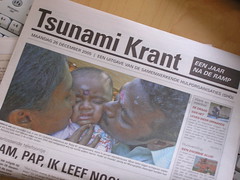 Some countries get grants and payments from the west, and squander them. Others use them wisely. It says a great deal about some of the nations affected by the December 26, 2004 tsunami that many have been able to make headway on rebuilding their economies. At Ton Zijlstra’s blog, he highlighted a report in the Netherlands about how donations were used—namely among local businesses in the affected region—and concludes with a very logical definition on what an economy is: ‘Economy after all is not about the material you use or its worth, it is primarily about the number of transactions created.’
permalink
Some countries get grants and payments from the west, and squander them. Others use them wisely. It says a great deal about some of the nations affected by the December 26, 2004 tsunami that many have been able to make headway on rebuilding their economies. At Ton Zijlstra’s blog, he highlighted a report in the Netherlands about how donations were used—namely among local businesses in the affected region—and concludes with a very logical definition on what an economy is: ‘Economy after all is not about the material you use or its worth, it is primarily about the number of transactions created.’
permalink
Another way to frustrate your customers
 I had been blogging on how certain banks were improving their service, such as the ANZ in New Zealand, and recent Medinge Brands with a Conscience award winner ABN AMRO/Banco. At Johnnie Moore’s Weblog (citing Zopa) I read that NatWest is going to remove clocks from its branches in the UK, to stop customers complaining about how long they have to wait in the queue (article in Rupert Murdoch’s The Sun).
Which begs the question: how stupid does NatWest think Britons are? Would you not notice that you were still waiting a long time without the clock? Isn’t it simply more logical to work more efficiently?
Now, there is going to be one less thing to look at at NatWest. The prettiest teller in the branch should watch out for an increase in perving. Beware the funny-looking chap with the pocketless trousers.
I have never heard of less customer information being healthy. The NatWest brand will no doubt become weaker with more frustrated customers, as they make some of them late for appointments. permalink
Get your naff advertising slogan here!
It does show, perhaps, the “commodification” of advertising. Slogans actually do have some effect on branding and on brand equity, more so than mission statements (according to a JY&A Consulting study I led), and they need to be chosen carefully for brand alignment. However, thanks to consumer cynicism, there are enough people undervaluing them—and a decent slogan generator may not be as far away as we think.
After all, there are web templates now, and companies doing generic logos for less than $100—both being very dangerous to the optimal performance of an organization. Show me one person who can do a logo for an independent client (i.e. not himself or herself) for under $100 while considering all the brand values. permalink
December 29, 2005
Americans name their top 2005 brands (there is hope)
 Landor and Penn, Schoen & Berland have just done a survey of Americans’ top brands of 2005, and iPod has come out trumps. While I dislike intercapitalized words, and am always tempted to write Ipod, I have to admit these little gadgets have changed the world. I won’t get one, but they have changed the world.
Cellphones changed people’s habits and most cellphone owners have altered their lives to serve the technology. But there was no single dominant brand—only in recent times have people begun saying, ‘I have a Nokia.’
But from the start, people have been saying, ‘I have an iPod,’ and have been willing to change their music-buying and downloading habits as the gadgets’ slaves.
And there are web sites devoted to the iPod—which were all too happy to break the news. Even I have been part of Podcasts.
At iPodNN, the site reported on the study:
The 2005 ImagePower Newsmaker Brands Survey identified the high-profile brands in consumer’s [sic] minds as well as which brands suffered, and what Americans think their future holds for 2006.
Nothing unexpected there. Nor was there anything unexpected from the other findings, which we’ve been saying for five years (excepting the Desperate Housewives and Lost bits):
The results also showed that Reality TV programs are “out,” while TV dramas are back “in.” Reality shows “Survivor” and “The Apprentice (Donald Trump)” were named among the top 20 losing brands in 2005, while dramas such as “Desperate Housewives” and “Lost” were named among the winning brands. …
The survey also found that while SUVs continue to be top-sellers in the U.S., hybrid cars win the branding battle, as the Ford Escape hybrid makes the winners list and the Hummer ranks No. 6 on the losers [sic] list. “With the rise in gas prices and increased sensitivity to the environment, drivers realize the importance of hybrid cars and car manufacturers are responding by offering sleeker, more popular models in hybrid form” [said the survey.]
But what was insightful was this—again unsurprising, but worthy of note given where the planet says it wants to head:
Oprah Winfrey earned tremendous positive appeal and placed third on the 2005 winning brands list. According to results, Oprah continues to generate positive buzz through her giveaways, book club, magazine and various successful extensions of her brand.
Think of Oprah as positive and inclusive, two things which Martha Stewart’s brand was not. Oprah is the embodiment of a good brand, particularly with her interactivity (her show) and personal spiritual aims. May we even say that this is how all personal brands—or at least all brands founded on a person—should be?
The full list has been published at USA Today, at this link, along with the predicted winners for next year (with Google leading). Note the surprises here, including Rupert Murdoch’s Fox, Extreme Makeover Home Edition, and Sirius Satellite Radio (if you need a qualifier—in this case your product category—how strong, really, is your brand?).
As for next year, we think there are one or two major brands that are going to come from nowhere. Shhh. More in 2006. permalink
India bugged
 If you ever needed a sign of whether a country has made it past merely feeding its middle class, look at where the Volkswagen Beetle is sold.
I don’t mean the Käfer or Fusca or Coccinelle, but the New Beetle, the fashion icon based on the old Golf platform.
It’s more antiquated than the Golf, has less room than the Golf, costs more than the Golf and is less practical than the Golf.
But when you have enough buyers for it who like a car for its charm and fashion statement (even though I thought it was démodé from the start—how can you glamourize something that came out of Third Reich policy?), and begin looking at emotive reasons for buying something (let’s face it, most of us in the west do), then life is no longer about merely surviving till the next day.
The auto industry in that country is no longer about creating vehicles for mass mobilization like the Fiat 500 (Topolino and Bambina) or the Subaru 360.
The latest country to join the New Beetle ranks is India, which gets the bug “unveiled” next month at its Auto Expo. Volkswagen is denying that it will sell the New Beetle, this time with a 2·5 litre engine, but you don’t bring cars to shows to whet appetites if you have no intention of selling them—at least not like this. If showcasing were the sole motive, Volkswagen of India could have done that in the late 1990s or early 2000s.
The Passat, Phaeton and Touareg will also be shown—highly expensive cars for the everyday Maruti buyer, but the market is there for these vehicles, albeit as limited imports.
I realize that there are Mercedes and BMWs in a lot of places in India, and the Merc W124 was even built there at one point, but even they serve a purpose (of status) without sacrificing a level of practicality. But the Beetle is, as far as I can tell, the most impractical little mass-marketed toy on which one can waste money and get appalling value—at least there it convincingly diverges from the original Hitler KdF-Wagen concept. permalink
: 1/31/2007 8:57 PM
Connections
Johnnie’s latest trip to New Zealand is a flying visit and he’ll be back in winter soon, so we won’t get a chance to meet in person this time. But no doubt we’ll catch up somewhere on this planet—Medinge’s exclusive but worldwide membership means there are plenty of places we can go to in order to grab a coffee and chat to a local. And, of course, discover the next grand development in branding and, dare I say it, humanity. permalink
Fashion without snobbery
 The 500th blog post at Beyond Branding. And I hope it’s meaningful.
My friend David Freak, of the Freak fashion label in New Zealand, is known for recycling fashion and showing them in unconventional venues, including gay nightclubs. But he is not alone: the Cubans have just done a show called the Art & Style fashion show, which has some recycled fashion, adorned on models and transvestites.
I know for a fact that Cuba has more traditional fashion shows, just as New Zealand does, but it is interesting that this item made the Associated Press newswires.
Cuba is a nation of tinkerers—not surprising when materials are not in as great a
 supply as they are in the west. However, this may have heightened Cuban inventiveness. And it might even show a way forward, because not enough of the west conserves in fashion.
I applaud the show for being inclusive. Not only did it have recycled fashion, but local artists joined in.
The west does shows like this, but including artists is usually done out of snobbery. I have a feeling the Cubans have little room, in a communist nation, for snobbery. And my friend Mr Freak has little room for it, too.
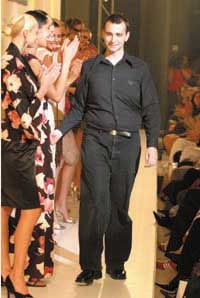
Another special designer is Gabriel Scarvelli (above), who also looks to a sustainable principle in his haute couture. But he, too, is a rare example in the west—something that Lucire tried to change (and has been changing) with its ‘Behind the Label’ series on environmental chic developed by model and social responsibility advocate Summer Rayne Oakes (top left).
It’s fashion with a statement, and for a change it’s positive, inclusive, and human. We need more of it, please, whether it’s in Cuba or somewhere else. And it’s a great way to celebrate 500 posts here at Beyond Branding. permalink
http://gayfashionbranding.blogspot.com/...
Party frock
To boldly go and other split infinitives
Incidentally, the special visual effects are great. permalink
Thanks for spotting this for me. I started doing a little digging and found a wealth of information on this story. As it turns out, Star Trek: New Voyages, is being produced with the approval of Paramount and is now getting stars of the original series to appear in some of its episodes.
You can read more about it on the "Much Ado About Marketing" blog.
Regards,
Mike Bawden
Brand Central Station
Keeping that in mind, I'm particularly fascinated by this latest development in the Star Trek mythos. ST:NV replicates the original series (ST:TOS) in more than just characters, sets and props. This latest venture is produced on a shoestring (the third and fourth episodes are being shot at the same time to save money) and, by all accounts, the production appears to be running behind schedule.
The beauty of the brand equity behind Star Trek, though, is that the fans won't care. They'll wait. They'll download the episode in bits and pieces and then find ways to stitch it together for their own viewing pleasure.
The whole thing is truly remarkable.
Thanks again for the comment.
Best Regards,
Mike Bawden
Brand Central Station
December 28, 2005
You beauty
 When my good friend Amber Peebles (pictured at left, in a photo taken by yours truly) went to Sanya in Red China as New Zealand’s representative last year, there was an online competition where the global public could vote for their favourite. A special award was given to the contestant who polled the best.
It’s one of those “if onlys”. If she had a blog, and it were marketed successfully, people would get to know her. It’s the old idea of forming a connection with your public. Naturally, she should have someone filter the stranger comments out, but posting the daily life of a beauty queen, as Miss Singapore did, would have had plenty of support. When the votes were needed, she could have had a public to mobilize.
After the competition was over, and the crown handed to her successor, the blog could serve to launch her career in whatever field she wanted.
The blog world has changed things—but it is still “just a tool” that creates that old-fashioned connection between two parties. Once upon a time, in the village, the vendor and the customer would have that very link. Today, technology acts as the bridge, killing the concept of distance. But the idea goes a bit further than that. It makes each of us our own public relations’ agent, and it can even create a career for ourselves.
We might next see politicians blog next, to win votes—and to allow for real accountability. permalink
A world without time
[He] dreamed last night that he was trying to get the people of the world to forget everything they previously knew about “time”. There would be no more dates, hours, years … He had convinced me easily but was going out into the world to try to get this to happen. Interesting, huh? He felt it would change so much.It would certainly get us over the deadline mentality.
 Blogs are almost like that—unlike newspapers and magazines, there is no fixed schedule. In fact, some online magazines are the same. When they come out, they have passion, rather than fatigue, behind them, because they have been given the time to mature.
It makes sense in many ways—already automakers are saying they need new models every six months because the novelty of a car doesn’t stay for two years any more. Remove the notion of time, and this would not matter.
I know: some of you are thinking ‘Anarchy!’ Perhaps so—but I know that we have sacrificed trust for time in this day and age. And we keep saying that we want more trust in our business and personal relationships. If we weren’t so ingrained into an instant-gratification society, we might rediscover that level of trust once more.
What else is preventing trust? permalink
December 27, 2005
India, the hottest investment destination
 Rediff has an article that suggests the world is catching on to what I have been saying for years: India is the hot investment destination. Indian-made products are better than Japanese ones, says Toyota chairman Okuda Hiroshi. You get a workforce that speaks English and has incentives to innovate, because the state does not come in to take your ideas. (Hint to Red China: wake up before you play catch-up.)
permalink
Rediff has an article that suggests the world is catching on to what I have been saying for years: India is the hot investment destination. Indian-made products are better than Japanese ones, says Toyota chairman Okuda Hiroshi. You get a workforce that speaks English and has incentives to innovate, because the state does not come in to take your ideas. (Hint to Red China: wake up before you play catch-up.)
permalink
Mercury rising?
 Ford’s Mercury brand is targeting women. In a way, it makes sense: Mercurys are dressed-up cars and fancier than the Fords on which they are based. But they look the same as Fords. They have about the same depreciation. A Ford grille runs horizontally and a Mercury grille runs vertically. Up-spec a Ford to Mercury equipment and it would cost the same.
 The ad campaign may increase short-term sales but I still say: make Mercurys different. Make the brand an American Alfa Romeo, where the cars are sportier and more powerful. If it’s a premium brand, treat it as such within the organization (as it once did), not “just another” Ford division.
Without differentiation—one of the tenets of branding—this campaign is going to be like any other “aimed at women” car campaigns, because the products are the same.
What happens when Ford tries to go the premium route by increasing standard equipment? It’s a long-held Ford marketing method: start the new range off with basic models, and up-spec them each model year. Ford, too, is aiming to be Volkswagen, if the badging on the cars and the overall styling are anything to go by. The result: the differentiation could be lost.
And if women make 80 per cent of car-buying decisions, which is Mercury’s claim, then wouldn’t everyone wish to target women? Why doesn’t Ford or Lincoln?
To its credit, the company says Mercury is targeting a youthful, stylish psychographic, rather than a gender—but that youthfulness means web surfing. These are the consumers who have rejected the Saab 9-2X because they know it’s a Subaru in drag. Will they know Mercurys are Fords with falsies? They sure can see through a lot more than automakers, or anyone, give them credit for. In fact, is their known ad-cynicism being addressed?
I say give women sportier, butch Mercurys—every ounce of research I’ve done suggests they like cars that are sexy to them, and that means shapes that aren’t curvy, but nicely chunky. I know that means expensive sheetmetal differences. But globally, Ford develops more cars than it offers in the United States. I’d love to see the Ford Focus Mk II (C307) offered Stateside. If it wears Mercury (not Merkur) badges, then why not complement the existing range? Make it a little different—or different enough to show customers you’re serious about Mercury being a brand of its own. permalink
American media bias is real
 On the decline of old media and how their unwillingness to serve the public diminishes their brands: I know the New Zealand media lean heavily in favour of the liberal, and sensed that the American media were the same. I had read reports that supported that, from both sides of the political spectrum. It’s nice to see that confirmed in a liberal state’s university, which to me gives more credence to the claim.
 A UCLA political scientist has revealed a study of American media (see here), revealing some truths:
• the Drudge Report actually leans slightly to the left;I have always argued that Rupert Murdoch’s Fox News Channel’s Brit Hume, based on my few viewings, was not biased to the right, but because so much news is left-leaning, that becomes “normal” to the audience. This is especially so in New Zealand, where, for instance, Gov Schwarzenegger’s recent special election positions on Propositions 73 through 77 were never covered, nor were his reasons for denying clemency for Stanley ‘Tookie’ Williams. When neutrality actually arrives, it looks right-leaning—when it is, in fact, merely right-leaning compared to the very liberal that we are usually fed. permalink
• Gannett’s USA Today is the most centrist print news outlet;
• the most centrist TV news outlets are: NewsHour With Jim Lehrer, ABC’s Good Morning America, CNN’s Newsnight with Aaron Brown, Fox News’s Special Report with Brit Hume and the Drudge Report;
• of 20 major media outlets studied, 18 were left of centre, with the most liberal being The Wall Street Journal, CBS Evening News, The New York Times and the Los Angeles Times.
Kerry Packer passes away, aged 68
I will hand it to the late Mr Packer as a man, and as a company head. He was a philanthropist, and he did right by a lot of people. From what I know, he did right by his family. I was always raised to believe that if your family is around you when you go, you’ve had a good life. And Packer had a good life. And the way his companies were run was successful in the twentieth century.
His son, James, will inherit the Packer empire, the third generation of the clan to be big media owners. One of the companies, Publishing and Broadcasting Ltd., has casino interests, too, which are more than contributing to its bottom line—and are occupying, I would say, more and more of its time.
Its diversification is a shrewd move, and a useful legacy for the third generation. The senior Packer did a wise thing not just to put succession in place, but to diversify into an area where the junior has continued to shine. And James Packer has a knack of picking competent, board-pleasing people to run family interests.
I wish the Packer family well as it mourns, and I wish James Packer well as his father’s successor.
The news coincides with the early death of Italian–American actor Vincent Schiavelli, aged 57. It has been a big day for the obits. permalink
December 26, 2005
The great New Zealand Muldoon cover-up
It’s as though both the major parties have agreed to cover the era up, or, when it is mentioned, such as on a recent historical series on TV One—or any other programme, for that matter—it must be slanted against Sir Robert. I have never seen a positive one since Muldoon’s passing, or, for that matter, during Muldoon’s lifetime.
I wrote in response to this blog entry that New Zealanders are more ready to admit to Satanism than Muldoonism. But the writer of the post, Oliver, at least has the guts to talk about the era, and analyse the good versus the bad.
He doesn’t say Sir Robert got it all right, but he did get many things right—things that both parties completely shun.
There’s a distinct lack of transparency when it comes to learning from the past, and that harms New Zealand’s chances of becoming an advanced economy. With an economic downturn predicted, thanks to the lack of innovation in economic policy since the 1990s, they still aren’t learning.
Muldoon is rejected because of (a) the tall poppy syndrome—New Zealand politicians are afraid to have a PM with absolute power, lest such power be used against them; (b) the fact that Singaporeans used Muldoon-style policies to good effect in the last 20–30 years, and the public must not know. Shhh. We can’t let Kiwis realize what we have done. Roger and Ruth and now, Michael Cullen—the equivalents of the Chancellor of the Exchequer—need to keep this quiet. Letting Singapore Airlines rescue Air New Zealand a few years back would have been fatal to the illusion, so, like some psychiatric patients who need to maintain a fantasy, let’s keep the Yellow Peril at bay.
OK, that’s in conspiracy-theory-land, and I mostly wrote it tongue-in-cheek. But like all humour, there are some elements of truth.
My message is this: let’s just “get over it” and see what we can learn from this era, and what could have worked. After all, New Zealanders voted Muldoon thrice. New Zealanders—I mean most of the country who aren’t sitting on their hind ends in Parliament trying to kill any chance the nation has of working itself out of the coming slump—want to know.
If New Zealand is to get its nation brand right, then it must be inclusive. It does well at incorporating the viewpoint of many people who would be discriminated against—New Zealand was, proudly, the first country to vote in a transsexual into Parliament—but it does not do well at incorporating the viewpoints of those who might want to shed light on the Muldoon era.
The thinking goes like this: a Muldoon ally, Sir William Birch, wears a suit. Hence Sir Bill must not be listened to. (Now, they would if he was disabled, or gay, or both.)
Even an unbiased foreigner, like economist John Kay, with his analysis of the post-Muldoon reforms, doesn’t get a fair deal in the New Zealand, its establishment all too keen to report on the government telling Johnny K. Foreigner where to go.
At the same time, the government is telling young New Zealanders where to go, too. They are smart enough to see Australia, with its more cautious economic reforms of the 1980s, is economically superior and a better source for jobs—and care little for the great New Zealand Muldoon cover-up. If they could, they, too, would say, ‘Get over it.’ permalink
Sly and the Corporation Stone
I make two remarks. The first is: will this swing back any time soon? People are discovering there are strengths to their families, and the eastern nations that are growing rapidly and on target to overtake the west still have the family at the core. As the east gains in influence, we may wish to learn from it. Secondly, if the family is disintegrating, just as governmental services once did in the wave of Reaganomics and Thatcherism, then will corporations take their place? They did for the fictional Mary Richards on The Mary Tyler Moore Show, when she called her WJM-TV colleagues her ‘family’; and that was a 1977 script.
If so, then some of the fears of science fiction are coming true, with corporations running people—and it won’t work with corporations retaining a profit motive. They already demand our loyalty through loyalty programmes. They expect our love. Some of us identify more with their brands than with our own surnames—we know their origins ahead of our own genealogy.
We might need an Andrew Niccol movie (like Gattaca and The Truman Show) again to jog our memories. permalink
Fly the friendly skies
 Ismael Ghalimi’s experience with United (blogged here) is a positive sign that the airline is putting customer service up front—and that can only be a good thing for the brand. As a frequent flyer with United Air Lines—and enjoying its Channel 9 cockpit radio communications—it was very pleasing to see that there is a major human side. (In fact, it was good customer service that got me joining its loyalty programme in the first place.) Ismael’s post also talks about networking in the mid-2000s, and how effective services such as LinkedIn were in helping him out of his bind.
permalink
Ismael Ghalimi’s experience with United (blogged here) is a positive sign that the airline is putting customer service up front—and that can only be a good thing for the brand. As a frequent flyer with United Air Lines—and enjoying its Channel 9 cockpit radio communications—it was very pleasing to see that there is a major human side. (In fact, it was good customer service that got me joining its loyalty programme in the first place.) Ismael’s post also talks about networking in the mid-2000s, and how effective services such as LinkedIn were in helping him out of his bind.
permalink
Of course this customer abuse by United is of nothing compared with raiding employees pensions funds which appeared the way that United got out of the last chapter 11, unless someone wants to explain how else it was done. And I just feel that when a sector actually declines in what if offers customers whilst continuing such hi cost garbage as friendly sky ads or in London recently the even more abominable American airline theme of if we can keep New Yorker happy just think what we'll do to you, we should say what crap it is to add insult to injurty to spend 2 minutes shouting at passengers - by the way federal rules prohibit you bringing your own vino.Bah scrroge, bah humbug, resign whomever you in Chicago who does not love customer service and sustaining employees.
On this sector's economics of exponentials, we can be sure that all of the major American airlines are heading the way of the dodo, except South West Airlines 1 where the intrapreneurial value multipliers meaning of the service economy is truly lived by and for serving all people
December 25, 2005
‘You must be American and boring to contribute to this site’
Most companies, when they acquire others, try to keep their national characteristics intact. IMDB, being originally British, seems to have lost that. It was once run by a bunch of Brits who accepted viewpoints, even those written in American English, from around the world. This latest incident suggests that not only do you have to write in American English, a form adopted by a minority of English speakers and only barely tolerated by the majority, but that all humour and sparkle must be removed from the reviews.
I don’t complain about the IMDB putting checks in place—it is right to do so—but it is in danger of crossing the same line many banks did in the 1990s. Then, banks computerized things to such an extent that the relationship with the customer was lost. It is only this decade that they are rediscovering their connections.
By rating human intelligence below that of a machine, the IMDB encourages dullness, and it will harm its usefulness. It always had some level of checking, but if I were to insist that my spellings were correct, it would still let me through. Not any more, it seems. I have written to the company to inform them of my thoughts and asked them what is exactly prohibited about my review. Hopefully I will get a human response, and by that I do not mean a Yahoo!-type one where the chap (automaton?) has copied and pasted from an FAQ to get me off his back.
Read through the piece below and see what you think. Please bear in mind the comments at the IMDB do not contain italicization.
If you were a child of the 1970s, then you will probably remember this as the definitive Avengers, and find the original rather odd. It’s not to say I dislike the original, but when I watched The New Avengers in the 1970s, it had that sense of realism and style that was very formative in my younger days.permalink
Technically, the 1970s saw lighter cameras and greater use of location filming, two things that made The New Avengers different from its forebear. These enabled the series to be grittier, in keeping with the mood of the time. Preserving the fanciful, “British Batman” ideals of the 1960s’ series would have gone sharply against the realism that viewers demanded in the 1970s. Britons (and plenty of people worldwide) wanted to see Britain, not a studio mock-up of it. And car chases were de rigueur. On these counts, The New Avengers delivered.
Purdey, not Emma Peel, was the first strong female character I knew on television. Columbia Pictures Television’s Police Woman seemed phoney with Angie Dickinson getting her gun out of her handbag; it was Joanna Lumley’s willingness to do her own action sequences that made her Purdey character more convincing. You did not piss this woman off. The fact she did her high kicks while wearing Laura Ashley, and not encased in PVC, did not seem strange; it was more her short hair that naice girls on telly did not have.
And because I was introduced to the Avengers’ mystique through this series, I have always been used to the idea of Patrick Macnee's John Steed being the elder statesman. The suggestive nature of his relationships with his female partners in the 1960s seemed inappropriate when I viewed The Avengers in re-runs (and Macnee once quipped that he felt John Steed did consummate his relationships ‘continuously and in his spare time’). The Gambit character played by Gareth Hunt was more my idea of the action-oriented British gent who had spent time in the military, though I recall both being relatively wooden, save for a few episodes.
The spy story lines were entertaining, and I understand the original series’ fans being less than impressed. But they were a clever differentiation from the typical cop shows of the decade, and even though there were some corners cut (using old footage of Diana Rigg in one episode), I never felt cheated by The New Avengers. The thriller style that Brian Clemens and his team introduced to this series kept viewers on the edge of their seats, and it must have been good enough to warrant a second season at the time—even if the latter was partly made in France and Canada. Even then, the episodes were not as bad as some have made out—Continental filming, in particular, gave me one of my earliest impressions of Europe. I don’t think I had seen anything made in Canada prior to The New Avengers.
In many respects, The New Avengers was more a forerunner to The Professionals—one of the greatest British TV actioners made—than a successor to The Avengers. It had the same producers and very similar crews. By coincidence, The Professionals’ Lewis Collins and Martin Shaw guest-starred together in one episode. And, like The Professionals, it gave the sense that after an hour, you got great value. The same could not be said for most TV series of this genre today, made to please a network and an accounting firm rather than the audience.
to any club of city, what brand networks your citizens greatest value multiplication of the future?
Two of the crucial dynamics netizens need to liberate through collaboration knowledge city around the world are:
In the case of London, we have the great good fortune to be where the most phosynthesis energy inventors connect. Their bubble like architectures provide the dream of abundant energy, that cleans as it is used- a sustainable network model's (capable of compounding expoentials that are forver above zer-sum) core multiplier is one group's wate being another's input. We have the great luck that enough sustainability investnment funders are available to take these bubble prototypes all over the UK in 2006, and all over the world's most extreme climate locations before 2010. And once the BBC's world service discovers how liberating this story can be for societies and economies, the change in hi-trust media will bring tears to Bleary eyes and Foxy Murdochs and stars who could be living lives as real heros beyond celbrity's sordid images.
In the case of Washington DC, we have 21 years of developing the world's most extensive conflict resolution facilitators network. We have today's most popular future history journalist selling 1.3 million books around themes such as Green is the Next Red, White and Blue. We have the strongest Intrapreneur network, (1) ready to question all other preneur networks on how to collaborate and do Project30000 by 2010.
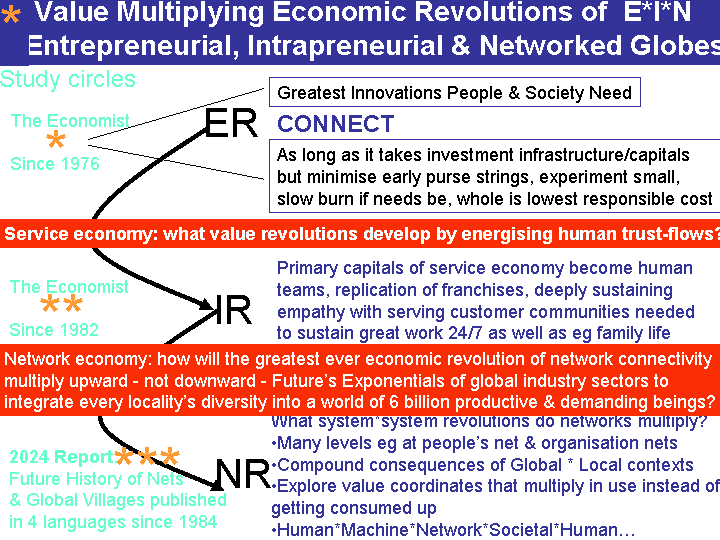
So in the huge jigsaw connecting game of global brand architectures, we can now openly charter what the last 5 years of missed 21st C collaboration misled. Namely Value Multiplication energised trust-flow's service TIMES network boundaries transparency's TIMES 6 billion beings productive and demanding interest in sustainability exponentials.
Will your ClubofCity or netizen web join in with a deep voice or a sector whose future vision your society has a lot invested in making best for the whole collaborating world of humanity. Happy Christmas or other godly carnival be with you this day on. Come join Britain's senior economist and at every city's tea party in 2006 and start the fifth entreprenurial revolution of economics for and by people, not just commanded every 90 days by the top separated from where all valuetrue social interactions critically revolve
Chris Macrae, World Class Brand Networks wcbn007@easynet.co.uk permalink
December 24, 2005
Happy holidays, etc.
ad day 10, to club of Delhi with love
December 23, 2005
ad calendar day 9: to any citizen, put your city's greatest sector vision on the map
To any city, do you have a social preneurial hub that's as collaborative as Rio's
Personally, I recommend the number 1 catalyst needed know in any city brand with a collaborative future is to open up social spaces; hubs are a great model for anyone's social network; and they doevtail nicely with such emerging exponentials as microfinance, sustainability investment and electronic jam's such as habitatjam sponsored recently by Canada. You can see that the social and networking search for collaboration knowledge city numbers 20 million... permalink
December 21, 2005
To DC is green the new red, white & blue?
His interview closed with the question: if Bush & Cheney asked you to summarise what you know from surveying people aroumd the world what you say. "We need an energy startegy, not for the last 90 days but for our futures. The first country to collaborate with China in developing green energy breakthroughs will win-win-win. The reason I say this is that China's need is most urgent. In continuing its growth exponential, it will be the first to suffocate if carbonised energy is all there is. Gree, Mr President, is the new red, white & blue; and just as Nixon needed his China breakthrough for his legacy, your's could be wonderful now if you could boldly go green.
Anyone for debating this at Club of DC or Entrepreneurial Revolution (where my dad's 1984 prediction was that America would need to change economics in a way that would unit 2 million global villages as the 5th preneurial revolution of humanity becoming networked & paradigm shift of death of distance)? permalink
The author and the reader are united
December 20, 2005
Brands with a Conscience 2006 announced
For reference again: read the release here or go to the Medinge Group web site for the PDF version. permalink
To Colorado Springs, question of lost tolerance & lost transparency
1) Club of city needs to ask Club of Colorado whether the sort of hatred propogated by familiy.org and its Citizen magazine here is representative of their place in the world. If not how can club of city help shine light on the mischief of this extreme minority; if yes we need a map of the world wirg red spots of places whose poor global neighbourliness is as intolerant as yours
2) Of course this is interpersonal. Read all about the mischeif at the link. Teach all about it at our schools. Know that the recent Ugandan peoples have drawn poverty's miserable card of ill fortune: dictatorship by Idi Amin, decimation by HIV... And just as they had become a lead country in Africa for stemming HIV by condom campaigns, family.org intervenes claiming that America's aid to the country should made conditional on no condoms being subsidised. In recent years, two of the greatest siants I have met at humanitarian networks are devoting their lives to trying to help African communities regerate. Their stories of children communities without parents bring tears to my eyes. But it was only recently that a chance discussion with a fellow passenger and doctor on a plabe made me aware of the sort of deep inhumanity of meddling of family.org
3) Note how they claim to have Bush's ear and values. Whether this is true I know not. But curiously its on a handul of microissues like these that Blairband should have tested Bush-values before going to bed with the man on global projects like Iraq. The failure to know a prospective global partner's local value has devalued the integrity of Britain's brand and its power of influence in other matters as discussed here
4) Note the double standards. If Bush & family.org are going on a moral crusade against Uganda's people, why not do so with China? Recent population statistics in China show more boys being born than girls- this can only mean that at some stage after the sex of the foetal child is identifiable, girls are being killed off. But then when was the last time that USA leadership boldly goes on a moral crusade against a powerful economic player?
5) There are wider points here of how the national decision-making model cheats us out of the power of other identity. Where is womensworld in this debate. I believe that 99% of Britons would approve of the queen asking the BBC to do a Wolrd Service series of educational inquiries on interlocal intolerance issues like these -on and behalf of conversational freedoms of speech all women have a right to. Historically, national politicians have muzzled the Royal family from anything they call political. But as simpo (Simultaneous Policy) debates here 1 2: short-term nationally divisive political decisions are the world's worst dynamics on exponentials that value the future's global and local integration on the scale of sustainablilty (long-term!) of life. If Blair wants a legacy other than the lkowest trust PM Britain has been ruled over by in my lifetime, then encourage the queen and all women to BBC around big inter-city questions like the one I have tried to raise here. If we compound lost tolerance of rich on poor, we get global slavery and local holocausts. If we do this with 99.99% of the goodwill public being blind to what aid is being conditioned in our nations' names, then lost transparency will cost a networked world everything it values and ultimately every being. This is as certain as eggs are eggs, or mathematically as compound network connections = systems*systems
Happy Christmas everyone from the Children of Uganda 1 2 permalink
December 19, 2005
Victoria’s Secret II: a how-to guide
However, it’s a megabucks’ proposal. What of the everyday folks? In the years I’ve worked online—totalling over 15—no one has actually used the internet to create a well-known lingerie model. If I were to start a label today, I would try to create a career and a reputation, much like those Popstars TV shows or even Tyra Banks’ America’s Next Top Model. You could do it via blogging, and let word gradually filter out, or use the media to help you. The trick is not to go with the “obvious” (i.e. “glamour models”), unless that’s what your brand represents.
You won’t become Victoria’s Secret, but you can create the mystique of the web’s most downloaded woman with your own brand without spending tens of thousands of dollars an hour to secure the likes of Naomi Campbell. permalink
December 18, 2005
ad calendar day 5 - to Pakistan, which of 30000 pro franchises for humanity are you test socialising?
In our attempt to catalogue the 30000 projects most likely to change the world's humanity. Pakistan currently has one home project cited below (emanating from the first annual round of Clinton's Global Initiative sept 2005). Please do help us spot other 30000 projects which Pakistan will be test socilaizing the global franchise for
For example, has one Pakistan superstar for humanity emerhed out of people with celebrity status in Pakistan given the people's challenges of recent months? If so we would love to feature that story at University of Stars
Clinton Global Initiatives -Commitments as at Dec ...14 Dec 2005 by macrae.nets
In partnership with the Institute for Islamic Policy Studies in Islamabad, Pakistan, the International Center for Religion and Diplomacy is conducting a project to reform the religious schools in Pakistan. An additional $226000 is ...
searching 30000 grassroots projects... - http://project30000.blogspot.com permalink
Tim Berners-Lee has a blog
December 17, 2005
Face the brand
Whatever the case, houses need to be very careful about whom they select in an age when they need to seem closer to consumers, not more distant from them. Fortunately, Julia Roberts isn’t conventionally (read boringly) beautiful, and has had a role like Erin Brokovich—and thus may find greater affinity with independent women out there. permalink
Helping with the imagination
When Matchbox became part of Mattel a few years ago, it had already been suffering. Through most of the 1990s, cheap Red Chinese production saw to ill-defined dies and cars that were barely recognizable. The features that were used to make it a leader—opening doors, suspension and detailing—were being deleted, model after model. But for most of this decade, Matchbox alienated kids further by designing cars that didn’t exist in real life—great for a few designers inside Mattel, those who were nostalgic for the fictional Superfast cars that the brand used to have in the 1970s, and the accounts’ department, which didn’t have to fork out a licensing fee.
Mattel, to its credit, is addressing this. Latest models, including a Dodge Charger R/T and a Volvo XC90, are gradually returning to the detailing of the late 1960s finally (still some way to go before they get to the early 1980s), although opening doors and suspension remain out of the question. However, Mattel is clearly doing its addressing from an American headquarters.
There is nothing particularly wrong with this, but I remember the days when Matchbox was as English as Roger Moore. And it still managed to sell its products in America by being aware of the cars that were being produced there. It also managed to sell all over Europe. The miniature Plymouth Gran Furys, Mercury Cougars and Ford Mustangs appealed to the US market as much as any other; but today’s non-American children will wonder what the relevance of the Dodge Charger, Cadillac Escalade and Lincoln Navigator is.
I can’t help but feel the international feel of Matchbox, once an integral part of its brand, has been lost. American cars do not dominate the planet and one may as well be an extraterrestial when talking of Buick, Saturn and Mercury to most children; at least when Matchbox was English, you could buy Ford Cortinas, and other products British kids saw, in most of the world. And we played with them and it sparked off an interest in some of us. We talked to our friends about them. Some of us became adult collectors and we are buying models that look like the real thing, not a flight of fancy from a studio.
Heck, maybe kids don’t care in 2005, but in 1975, we sure did. The fact Matchbox is changing its tune to showing real cars suggests I’m right—but a less US-centric approach could increase its miniature sales in international markets. permalink
New automotive niches: where to next?
Back in those days, I thought the Japanese were coming out with the coolest products. The third-generation Honda Civic and Ballade CR-X. The high-roof Civic Shuttle, more than a decade before Renault gave us the equivalent Mégane Scénic and Opel its Zafira. The new Mazda Capella. The minivans such as the Nissan Prairie and the Mitsubishi Chariot. Toyota was about to come out with its world-beating front-wheel-drive Corolla. Even the Honda City was revolutionary. Europe kicked off the aero look with the Audi 100 and Ford Sierra, so there was some innovation, but Japan, Inc. beat everyone.
I just don’t think the Japanese have recaptured that. The new range of Lexuses has a spirit to it, but the cars are merely plusher and more refined than their predecessors. Like a Continental Mark V was nicer than a Continental Mark IV at Lincoln, once upon a time. Toyota now has westerners on the board, which will help them break out of the committee-thinking that gives us Avensis after Avensis, but the hybrids aside, it hasn’t really broken any new ground. The exception is Honda: it is doing better because it is putting out appealing products. Considering it was once a maker of lawnmowers, it has come a lot further with products such as the new Civic and Ridgeline.
Exceptions aside, I don’t find the same appeal with Japanese cars as I once did. Their brands are keeping them going—a Toyota Corolla will fetch $2,000 more used than the Chevrolet Prizm, which is the same car out of the same factory in the US—but brand effects only go so far. Getting more plush with each generation is no solution—the US itself had been through that.
The American brands are rediscovering this as the Japanese trounce them again.
But where was that daring, anywhere in the world? We’ve done very little to find new niches in motoring. Assuming we have found all the market niches in the world, then how about letting technology catch up, rather than build cars with thicker leather and more buttons on the radio? The lightweight car, for instance, using new composites? The car that does 120 mpg? Who will mainstream biodiesel? Will someone take the lead from New Zealand of 1979 and do more natural-gas cars? Methanol? Hydrogen? How about gyro technology?
Whomever is first to market with a new concept—and is prepared to make it mainstream—will “own” that category. Right now, you can’t overtake Toyota for hybrids, even if Honda has the Insight, Civic and soon, Accord. Red China actually has potential to do something amazing here and show the world a way forward, if it wasn’t so busy fighting over the corpse of MG Rover. That is, if the Politburo will let it.
The most ready solution today is biodiesel- or alcohol-powered cars. Fiat and Volkswagen already have access to such technologies from their South American operations. Fiat, in particular, should be thinking about following up the Panda with something that could revolutionize motoring, particularly after some weak years this century—and not the Grande Punto and the Croma. Or, once again, we might cast our eyes on India and let a country, untainted by the narrow thinking of the west, lead the way in automotive development. Already there are facilities such as DC Design for prototyping and styling, and once Tata finds a way to deliver a car for $2,000, then watch Tom Hanks, HRH the Prince of Wales and others try to buy one. Then they will all be saying why on earth they have not heard of Indian cars, despite decades of Marutis, Hindustans, Premiers and Standards. permalink
December 16, 2005
ad calendar day 4, to Boston- why do MBA's get trained to cut up systems into silos?
-why with some of the world's greatest advocates of whole system design from Senge to Berners Lee
do you teach MBA's as if subjects like strategy, branding, economics, human resources, accounting, investment are separate
the time I gave a lecture at Harvard, I was told it was nigh on impossible to get more than one faculty department to join in; more seriously, when Bob Mnks, one of society's deepest experts in pension investments, gives you advice on how to invest your own huge endowments in compound wealth, the silence seems deafening
We invite citizens and netizens who believe globalisation cannot afford one more shred of Manic Bastardisation of Administration (20th C MBA) to copme join our 30th birthday editorial parties for network economics and service economy revolutions here. permalink
December 15, 2005
ad calendar 3 to Paris, and France
if we are ever going to succeed in transforming economics from being for the global bigger to get bigger, to the people's economics of 21st C networking learning's age as we forecast in 1984 would need revolutionising now
then it will come by translating entrepreneurial models as everyone is invited to do here on the 30th anniverasy of entrepreneurial revolution
the word comes from the French, I believe in the days that the republic took back the land so that people made better use of it than royalty; but these days the French obsession with land economics has compounded the vicious exponentials embedded in the EU agricultural policy and its compound vicious consequences for agricultural trade with the poorest countries
is there any way the French can get beyond this? how about the English buying organic farming lessons with our EU rebate if you give up the agricultural distortions of the farming poincy and then we can all call Bush as this was the one offer he made at Gleneagles permalink
But instead : is 8.2 billion pounds being given away in the Blair Band's latest need for partying with leaders? in spite of 8 years of terrifying choices of leaders partied with? There comes a time when glory me image-making is a treason to the world if not to Britain. This breach seems nigh, unless early reports of lack of any change in paris and brussels's agricultural intent are wrong, in which case Tony you are a boy genius. You can be sure that Intercitizens will be watching- 21 years on the beyond nations revolution cannot come to soon for some -or many - of us ordinary beings.
ad calendar day 2 - question to London
clearly the UK sustains its position as the world's largest economic Kingdom (well queendom these days since the queen and her mother and Di have led the way) -so what can we learn from the world’s most successful kingdom about freedom of journalists, marketing and economics?
well until recently what we could be sure of was that being a kingdom, we londoners & brits were never ruled by big business, and that goverment was therefore also loyal to the people; our jourmalists were freer, particularly in 2 world leading media: the BBC world's largest public broadcaster and The Economist, whose leading story as an original global medium returning 100 times its shareholder investment in a generation is told here
all this could mean that investigative journalists in London sustain transparency more than in many cities, especially about future revolutionary issues of management or global crisis: and keep the space open for big question debates of most public interest so the people's conversations the day after focused on reality-making topics not mere advertising imagery and celebrity gossip
we all might expect these sorts of agendas to be the big conversations of Londoners 1995-2005:
Changing communications, and what makes people distant, bossy, etc
Changing national politics
Changing economics
Changing employment
- which would then explain why brand marketers in Britain (eg Branson) would want to compound the best their sector could do for the world, and a people's economics of global markets would be developed in Britain
It might lead to issuing these 2 world challenges for humanity's recovery of fast downturing exponentials as do-able with other club of cities support by 2010
MEGA GOALS by 2010
Further briefing for jourmalists: A report (titled Unseen Wealth) issued by economists and scholars of law in 2000, confessed that due to a mathematical mistake , the larger the organisation the less likely it is to be governing what impacts it is compounding for humanity. Since then our expert futures circles (including entrepreneurs since 1976 and network experts since 1984) have been working hard on the jigsaw pieces of this problem – its maths, its maps, and its stories - as you can see from browsing 1 2 3 4
permalink
December 13, 2005
an advent calendar of brand learn-style questions to your city
-does your city either have an answer to some of the future's downcurves tabled yesterday? Or a network deeply concerned with reconciling one of these curves which wants to collaborate with similarly concerned citizens networks?
Let's play a game of intercity snap every deep way we are able.
Mail me at wcbn007@easynet.co.uk if you want a particular city and question to be featured
I have chosen to start with New York for 3 reasons:
1 Although many cities have suffered terrifyingly from this war-prone start to the (grown up?) 21st C, if sustainable multicultural answers are to be found for mega-cities then London & New York will be seen as the earliest global test markets
2 In 1996 (the first time I hosted a year long internet debate) big corporate innovation directors told me that through an extensive benchmarking inquiry they had discovered network learning's deepest value multipliers. These would be realised by those whose organsiational systems designed elearning and real communal spaces round children's natural patterns of curiosity. When my father at The Economist and I wrote our 1984 book on the future of networks locally and globally, we believed the same reasoning both because my father had red many books on learning and because I had played with developing computer assisted learning back in 1973 as part of the UK's National Development Project in this field.
3 Because the question I will pose first to New Yorkers on behalf of Club of City is:
Everyone I have met who loves New York seems to echo a view along the lines : it make hustle & bustle more fun than anywhere else knows how on a big stage. So how do you make hustle & bustle as much fun as it can be instead of the least fun? permalink
December 12, 2005
How about valuing everyone's best for the world identity again?
If all people and open sources are to be wholly valued for their greatest potential to make a difference in connecting our networking world, then our race needs value multiplication auditing and mapmaking in 3 dimensions:
Inspired by The Economist's cataloguing cases of entrepreneurial revolution since 1976, the maths of valuetrue research and network maps of unseen wealth began in earnest in 1989 in opposing brand valuation as the media's great mathematical mistake; valuetrue mapping is deeply contextual; see these playing pieces and read some papers on productive & demanding systems of human relationships; ask me at wcbn007@easynet.co.uk if you want to experiment with mapping a specific context whose future matters most in the world to you permalink
Media Crisis Blogs
and am working on restoring our BBC blog as debate of the world's largest public broadcaster's future exponentials -will humanity value its world service as up-curving or down-curving; how can the people of Britain (who in my lifetime have invested well over 10 billion of our own money) get the people's media back from the stranglehold by short-term politicians whether they be left, right or self-servicing in their short-term commands and national divides
if media isn't your number 1 sector that's can be turned round to be best for the world, please choose one at Future History's economics of exponentials originally sponsored by The Economist in 1984
for previous installments in google's meltdown friday, click here for whole of BB December's log permalink
Branding the upcurves during the season of goodwill
At EXPONENTIAL VALUATION, we're making a list of upcurves (and downcurves) a thousand deeply purposeful people have told me about during my first 12 years on the net. We are also integrating those economic circles that can help - eg 30 year long cataloguers of entrepreneurial revolution, 21 year long cataloguers of death of distance's actionable consequences for humanity, 18 years of mathematical development aimed at simplifying maps of Unseen Wealth which began for me when I first mistrusted emerging brand valuation algorithms in the late 1980s...
Here is a partial listing of sector gravities we are cross-examining - if you spot one that you are interested in exploring relentlesly, do get in touch at wcbn007@easynet.co.uk so we can share links. My purpose is not about owning the spaces where the debates happen but mapping where they are being pioneered and linkingin wherever people's needs are urgent and so most valuable
Please help us choose sector debates you and communities around you want to inquire about and map connections with other people who share the same urgent exploration for action. A thousand people, each with a deeply chosen gravitaional purpose, whom I have connected to over my first 12 years of internet life are making a start and linkingin around the listing below.
I will try and bring links over to this blog but iof you see a topic you need to be guided to most urgently, amil me chris macrae at wcbn007@easynet.co.uk
Multiplying Value Peoples Want – Where are the upcurves?
Downcurve Debates
- Healthcare – increasing costs
- Children – increased family strain, lost safety of community
- Professionals- loss of Hippocratic oath, ever more bureaucratic
- Water – Clean water is getting scarcer
- Transport – getting slower
- National Government – Increasingly powering over instead of facilitating what people need next
- Mass media – dumbing down, loss of social space and transparent debates
- Food chain – cost of good for you food going up
- Nations Cultures- love of each other’s diversity going down
- Pensions (investment in sustainable growth) – going down
- Adult confidence in making a difference with lifelong learning potentials – seems to be going down
- Insurance – cost going up, learnings across biggest tragedies seem increasingly blocked
- Underclass – compounding underclass- their loss of hope in life and mutual risks to all of us in a hi-connected world
- NGOs/Charity – Global*Local infrastructure further removed from depth of grassroots needs in crisis or sustainability turnround challenges
- Transparency – ever poorer system * system understanding and openness of inquiry between leaders of separate systems; increased siloisation just when networking value multiplies other way round
Queries Debates - Clean energy?
- Technology – while power going up , has collaborative or inspirational use ever been as great as getting to moon in 60s?
- Socially concerned networking hubs by 20-35 year olds?Open source active learning relationships geared round specific issues of greatest human need
Upcurve Debates - India
- China
- Specific micro-nations – eg Singapore
- Microfinance
- Potential peoples uses of internet
From the tsunami on, I have been wondering whether more and more people linked around the world get it. Whatever matters most to the future of the human race, it will be down to we (all peoples) to connect and network it - don't stand waiting for government, and is my dress-sense image looking cute FEMA's. Back in 1984, we predicted that 2005-2010 would be the most critical years for all people to network up from the grassroots, or forever after lose the goodwill wars. That's why pesky things like exponentials need mapping and debating, and ordinary blogger's freedoms NOT to be melted down must be truly valued if google is to exist in 2010
A prankster on Wikipedia—how interaction helps both sides
Wikipedia, like any entity, is only as good as the people behind it. And today, a prankster was exposed for a false entry about the Kennedy assassination. The tendencies have been there for a long time, and already I am seeing revisionism based on the thinking of an English-speaking majority.
The internet is the same. Once upon a time, only smart guys were on it. Now, a lot of people who aren’t smart are on it. But it’s the best chance we currently have at raising everyone’s intelligence. Just as history shows that trading raises the income of both the first-world country and the third-world country involved, intelligence can be thought of in the same way.
And since this is a blog about branding, one can now think: a brand can be communicated, and can educate others, through free expression. We just need to think of it more as an interaction, where the brand can change depending on the audiences’ feedback, rather than an indoctrination, which relies on carpeting the media with messages and not hearing anything in the din.
This isn’t anything new. But consider this aspect: the interaction makes both the brand and the viewer better. Even Wikipedia pranksters, even if it will take a while to get the message out to them all. The brand can grow stronger because it begins to encompass, organically, its publics’ viewpoints. It then becomes more connected to the public body, rather than be separate from it—turning all of us into its guardians, not just the organization. permalink
December 11, 2005
Eye on the (long-term) ball
They are interesting remarks, as we don’t get to hang out much in public. His remark about the first matter, of Toyota, is not unlike what the authors of Beyond Branding and I have uttered for ages. It is impossible for the CEO of a large American corporation that is so obsessed with share prices to maintain a long-term vision, and that any strategic movement is inherently tied to Wall Street. Japanese shareholders, on the flip side, aren’t going to call for blood if they can understand a long-term vision behind decisions. In Toyota’s case, it’s about being able to spot the next trend—the hybrid car—and not being so stuck on trucks and SUVs that when consumers change, there’s nothing to catch them.
It’s the third time in my lifetime where I’ve seen Detroit caught with its pants down. In 1999, I was already writing about the dangers of gas-guzzling and how the SUV was dead; I was a few years early. But someone must have heard me. Toyota will have a Camry Hybrid shortly, and already has a Kluger (Highlander SUV) Hybrid in its home market, complementing the Prius. Lexus hybrids are not far away. Honda has its Insight, Civic and Accord hybrids. And once upon a time, New Zealand had natural gas–gasoline hybrids—at least between 1979 and 1995. Like Detroit, the New Zealand government took its eye off the ball.
These two Japanese companies will do with hybrids what they did with the Corolla and Civic in the 1970s. People then exited their Ford LTDs, Buick Electras, and 8·2-litre Cadillac Eldorados for vehicles which just made more sense. Now they are abandoning Ford Excursions and Hummers. All Detroit really has is the Ford Escape and Mercury Mariner hybrids—thanks to Mazda. Just like Chrysler once had its Dodge Colt and General Motors its Buick–Opel.
But there is no immediate solution. This time, the overtaking is very noticeable—to the point where I don’t think GM will claw back its crown for many years, if ever. It will lose economies of scale and will need to look at emotive cars—but Toyota is mastering emotion very well, thank you, with the addition of westerners to its boardroom, something it didn’t do in the 1970s. The board back in Toyota City knows just what will push consumers’ buttons.
GM—and for that matter, corporate America—can only help itself by looking long-term again, and to begin valuing its companies using more sensible measures. This can range from informal networks to social responsibility. Chris Macrae, the other regular contributor to this blog, has had much to say on the topic, but it took GM to present a big enough case which may wake people up. Winners in America, too, are those that have grown gradually, as Jim Collins found in his Good to Great—not those that have celebrity CEOs that sparkle and fizzle out. Until we change our thinking, or, rather, adapt the thinking that we already know, this quarterly obsession remains dangerous—and ruinous.
What of the mall kids? They might not know just how good we had it once, because no one tells them. They think hanging around in malls and spending money they don’t have is the norm. It is, once again, an obsession with the now, and instant gratification. Someone will some day make a lot of money with self-help books, if we let them.
If we don’t change our thinking for the sake of commerce, we should at least change our thinking for the sake of setting an example for tomorrow’s generation. Hard work, and not demanding a starring role when you walk in to the audition, will get you to the top. Toyota knows it, as does its shareholders. permalink
December 10, 2005
Warping out of 2005
As one of those early Xmas presents I didnt really need, Google of 9 Dec apparently wiped my previous blogs connecting networks that I have discovered in the last 15 years concerned with mapping the world networks could produce and demand with humanity if all compounds round trajectories:
I'll recap the future history charter of most practical understandings needed for the peoples branding of globalisation here, and in posts lower down start reconstructing new top pages for ressurecting our timeless blog family.It will take me some time to map all the links back to the brave people who seem to me to be exploring hi-trust communities and sustainbility investments. If you have previously shared in any of these hi-trust citizens encounters, please mail me so our weblogs and I restore the area of the maps you are most passionate about as fast as I am able.
1984 prediction (link):
Globalisation can only spin on ever higher trust trajectories of a UnitedPeoples or an ever more terifying Orwellian future, and smaller footprints. Here is more on The Economist's languages (1970s-10980s) of Entrepreneurial Revolution and DoD (Death of Distance)
1973 link -now learning about how to email to 12th grade goal of finding your own best mentors through life and helping others likewise
link to 1995 start of the genres of living * learning the brand: chartering communications so that everyone who participates most proudly and trustwprthily in a brand architecture gains from the communal identity through time here. This includes chapers of Brand Chartering Handbook - first edition print copies available on request for interdisciplinary team use from me at wcbn007@easynet.co.uk
Some quick travel paths:DoD * Global Uni*Perth (temporary representaive of 100 hubs and city clubs)A*B*C*D*E
Chris Macrae, wcbn007@easynet.co.uk http://www.valuetrue.com/ permalink
Did Google melt us down?
I guess if anyone has ideas on how to restore my wee bit of co-creation world they will contact me at wcbn007@easynet.co.uk
Here's the general description of what seems to have gone missing- Mountain View we have a problem!
It seems that yesterday google wiped about a year's work in the family of 100 blogs Clubofcity, clubofcountry, clubofvillage -many that had scaled the top of the 20 million search Collaboration Knowledge City that I had been co-editing where local people raised their biggest questions and we try to match links around the world where communities were debating practice projects. Even our bio blogs on trustmicrofinance valuegandhi, trustdrucker
A bit more of the story has been reconstructed at http://clubofperth.blogspot.com/ and in this blog some emergency reconstruction texts are here.
If anyone has suggestions on what I should do my personal email is wcbn007@easynet.co.uk permalink
However, what happened to me was not the unilateral ending of individual blogs but all my blogs (except those someone else had started -in other words had it been the case that I had set up the Beyond Branding blog it would now have been wiped)
Oddly my blogs do not link spam to other websites as per the excuse given in the clues referred to. They were heavily linked to other blogspots, and my main family of blogs had even been commended (in a minor way) by the charitable arm of google. So....? http://whatwillgoogledo.blogspot.com
Also, Richard did not link-spam—he merely had a lot of outward links. I sense that Google is finding these and making a judgement based on the quantity, not the quality, of links, without human intervention.
I did immediately notify google using the reference number where they had previously praised my blogs and those of our co-editors around the world for the wee bit bit of humanitarian progress they were making
So far I have the computer telling me it cannot reply to all mail but if its humans will, they will in their own good time. It may soon be time to throw google out of the premier league of sustaianability investment http://www.bbc.co.uk/dna/actionnetwork/A4205819 if they are becoming just another organisation full of silos
Incidentally, if you are able to alter this blog's settings, could you go to the format and permit last 20 postings instead of 5; I have a feeling December is going to be a busy month for beyond correspondence
Left or right?
To understand this, we need to re-examine the fear of the mainstream media toward independent publications, and the tall-poppy syndrome, oft-visited in this blog. How they keep confirming the simple fact that the mainstream media are losing touch with everyday New Zealand, a pattern which exists elsewhere in the western world.
They will stay afloat for now because of their claimed circulation, but will their attitude hurt their brands so much that advertisers will find it disadvantageous to be aligned with them? I’m beginning to think that that day is nearer than we think. permalink
December 09, 2005
Folks don’t trust big business any more
I wouldn’t go to this law firm
 In the same edition of Idealog (see earlier blog post from today), there is a full-page advertisement for Simpson Grierson, saying that it’s the best law firm in the country. The headline, which occupies nearly three-quarters of the page, reads (sic): Which Lawyer’s Number One. No question mark.
I have to think: would anyone go to a law firm that proclaims it’s the best yet does not understand English punctuation? A sure way to waste a few grands’ worth of an ad.
At law school we called the place Simply Gruesome. permalink
In the copy, it says one of their lawyers won some ‘Dealmaker of the Year’ award, so if the big headline is correct (save for the missing question mark), then it should be his name that appears in reply.
I hope the law firm can present a persuasive argument to these points, because if anyone ever hired them, they would expect that, at the least. But if a simple one-page ad can’t be correct within itself, then what chance does one of its legal arguments have?
Business Week closes Asian and European print editions
As many of you know, I follow a similar view—Lucire will have a global print edition, localized through advertising and some other sections. There are linguistic differences, too, but the ultimate aim is to do the same. That way, one design session will serve the planet, rather than have teams of designers duplicating work. Right now, our three editions differ in some details because of where they are on their life cycles, but they will come closer.
Business Week is the first big player to move into this global realm as the world gets closer, at least on certain aspects. Readers can then feel like they are part of a global movement, not a regional one. The idea of a global community drives brands more effectively in the twenty-first century, for the simple reason that most of us (especially online) no longer think of being divided by borders. Branding is catching up with reality. permalink
The magazine that could change a nation
You may have seen me attack some of the problems with local media, but Idealog seems to be a positive sign—a silver lining among all those clouds that try to drown local success.
For starters, it is the strongest début issue of any magazine I have ever seen, anywhere. Content- and presentation-wise, Idealog trumps all those titles before it. And it taps in to something about New Zealand individuals that the mainstream media miss: a desire to be creative and to advance. Its tagline is ‘The voice of the creative economy’. Quite fitting.
Am I being facetious when I say this magazine can change the country? No. For New Zealand has a will to change, just that it keeps getting disrupted by its institutions.
Creative director of the new magazine is David MacGregor, whom netizens may remember as the man behind the leading men’s web site eMale—which, in its day, out-GQed GQ online. When I heard of his involvement, I knew this would be a winner—as his creative direction would complement Vincent’s editorial decisions perfectly. Inside, it’s one of the most vibrant magazines, coupled with balance and restraint. There are just enough photographs to make things interesting, and just enough meat for readers to sink their teeth in to.
Idealog has the opportunity to overturn New Zealand’s tall poppy syndrome as it tries to marry online and print, and create events at which the magazine’s mantra can be taken further. That can begin affecting the nation’s brand.
I have always argued that New Zealand is not about sheep and bungy jumping, but destination marketing—such as the cynic’s favourite punching bag, the ‘100 per cent pure New Zealand’ campaign—keeps reinforcing it. The reality is that New Zealand is about innovation, independence and isolation, and the good things that stem from it. Internally, nothing communicates this beyond some individual endeavours. Externally, nothing communicates this—unless some more of these creative events drag people in, and Idealog expands. It’s a magazine as fresh as Fast Company was in its heyday—and, not unlike what I am doing, has the potential to go offshore. permalink
These are the gravities -and their future exponentials for humanity - which we are most concerned to map transparently for all who want to network through trust, time and best for world purposes
Community or transparent media entrepreneurs: For 21 years our friends have debating 2005-2010 as the most revolutionary time when 6 billion beings systemise whether being networked globally and locally will work for better or for worse. We're interested in hearing of anyone's number for better concern so we can map any hi-trust project or cafe or space links to that gravitational challenge around them and vice versa they can practically co-mentor others.
Global Innovation & Conflict Mapping Entrepreneurs: We see 2005-2010 as the summit of changing economics - this tracks back to all my father's future history surveys at The Economist including which nations are on the up from 1962 Japan onwards, to which entrepreneurial revolutions do all peoples need to celebrate from 1976, to what does death of distance's time from 1984-2024 look like
DoD Entrepreneurs: How do we open source both a Global University of Poverty and from age 8 up a whole view of world systems way of connecting - how do we learn enough about water so every community has a clean right to it or power or peace or innovating by giving everyone conversation space to move through gravitational conflicts
Society or Social Entrepreneurs: How we love each others' places, how do we free public media to discuss long term scoops for humanity rather than daily sounbites of bad news, how we sustain people's longest learning curves including reuniting all main religions in their number 1 do no evil rule of relationship reciprocity
Sustainability Entrepreneurs: How do we (1 2 3 4 5 6) tell enough stories over the next 5 years so that the world's 1000 largest organisations or networks listen. Short-term shareholder needs are not your main investor nor your main purpose: societies including pensioners to be and families are, customers who believed you were innovating for humanity are, employees who wanted to focus a lifelong experience curve on making a difference are. In the knowledge worker age of Peter Drucker and Preneurial revolutionary ages of my father, the number 1 investment being made is the peoples' lifetimes not capital into lifeless machines. What do over the next 5 years will spin systemically into all the worst or all the best stories science fiction has ever rehearsed with us.
All we ask is you and all your communities know which choice you are making because systems compound consequences that our valuation maps of the future show become harder and harder to turn round if even one globally vicious mistake at the top waves all round the world. We need everyone linking into such debates as HabitatJam; and then connecting through interactive media like google and world's largest public broadcaster like the BBC or India's DD
permalink
December 08, 2005
Cooper v. Cooper
It’s good for Tamsin Cooper, the small brand from small-town New Zealand, which tried to register her name as a trademark. She’s getting a lot of exposure. Trelise Cooper, a large brand from large-town New Zealand, is saying that it’s too close to her name.
But the way media have handled it is interesting. I know both Ms Tamsin Cooper and Mrs Trelise Cooper. Mrs Cooper and I appeared in Woman’s Wear Daily in the same year. I’ve actually known them both for the same amount of time.
It shows there is a fascination with the fashion business, thanks to the way it has been built up. The mystique of fashion makes an industry perceived as being a high-stakes glamour game, which has the potential to do good. More often than not, it doesn’t do good. But that image-building—or the smoke and mirrors—is what makes many brands tick. It’s why we used to watch Dallas.
What should concern us today as branding people is how to balance the need for good old-fashioned honesty and transparency with glamour. Fashion, ultimately, is the provision of clothing. Nothing more than that. But it reaches further, because we wear fashion for a sense of self-assurance, and it becomes more personal. Hence, so many mundane products, such as automobiles, get into the same game.
The lesson here for us is to respect the trend toward transparency in today’s business, but recognize that the public imagination can be captured if the product or the category is aspirational or personal. It validates the need for personal relationships when our products are potentially duller.
But just as glamour can boost us, it can hurt us. Both women had to comment on Morning Report, the New Zealand radio programme. The flip side to all this is the cattiness that this business is known for. I saw an article in The Southland Times that compared two coats designed by the two Coopers—when the case has nothing to do with coat design or copyright. An “expert” engaged in hypocrisy by suggesting Ms Cooper call her brand simply ‘Tamsin’, as it was ‘strong’, when she herself used her full name to sell her own clothing range.
There are elements in the New Zealand media that are loving this story, so it’s being milked. But just like a soap opera, we are watching, reading and listening to it—because it gives a sense of drama that draws us in.
And that’s the other angle to a good brand. A good story. So many times on branding jobs we ask our clients for an internal “legend” that could be shared. Now, both companies have one, and the New Zealand public is judging them by their drama. permalink
101 clues on the crisis of globalization economics
-Asserted as a Commons Document. If you feel you used a clue the way we were trying to connect it, we'd love to be linked if you have the time, but make your first priority actively using or helping people to explore any valuetrue clue.
By Chris Macrae and co-editors to follow as clues get deeper or more diversely inclusive
1 My father Norman Macrae and Peter Drucker crossed paths in Moscow 1935. One was then a young man, another a teenager destined to be sent to war before going to university. As anyone who has read about Russia or Germany at that time will understand: Norman & Peter tacitly agreed to spend their lives writing how to question big power's view of economics and management and the way that investment sustainability (or not) systemises future histories connecting all beings.
2 Some of their constructs can be found by truly searching their original texts on phrases like these.
entrepreneur revolution paradigm shift knowledge worker co-worker privatization social ecologist service economy post-industrial networking telecommuting free market intrapreneur future exponentials history systemic learning listening innovation conflict love Hippocratic oath
But be warned, wherever a phrase becomes valuable for all people to openly commune around there will be some theorists that use numbers to separate out an opposite direction ...more which their biggest sponsor wants , and perhaps more practitioners who love the original image of the phrase without originally caring or systemically knowing what practices they would need to govern and value through time to live and learn to be the true McCoy.
3 I am only a mathematician. I try to explore truth either through the maths of pattern recognition or the co-creativity of listening to a person’s deepest passion and testimony. My brain is certainly not among those that would have had a look in as a top 20 reporter valuing 20th Century leadership, the world's futures and histories, its greatest innovators and most deep facilitators of humanity (Gandhi, Mother Theresa, the who's who of greatest value to commune with or be socially networked to). However, I can confirm that Peter and Norman are worth trusting when they get you to understand that neither economics nor management can ever make precisely correct decisions. What is correct differs by context -who's purpose are you systemising? time span (the last 90 days or the most valuable future this sector could have in uniquely serving humanity's greatest relevant needs), place in the world or as executed to benefit a legally extreme state like Delaware as prime sponsor of economics of externalities which can compound over time with as vicious consequences Bhopal's ... more
or whatever was the worst untrue and unfair consequences of Enron and Andersen becoming top 50 economies all over the world until their mountains and bubbles of dis-trust were waved away as much less than worthless in all good peoples eyes.
4 Precisely correct for who - yourself? your inner cronies, one mythical group (shareholder- do your SVA maths mean speculators and exclude pensioners to be) or everyone who invests in organisations through time as sustaining purposes' most productive and demanding systems: societies, families, customers, employees who make a difference with lifelong learning curves, the country in choosing to prioritise your sector not just with direct investments or tax breaks but in the way it changes education, the culture around communities that may in one place prize sustaining some history and another none, even whether owning everything is good which it certainly isn’t is a country where 1% of the land has oil or hugely valuable natural resources and the other 99% is so sandy that nomads are the only ones who could survive.
5 If you desire it, mathematics can enable economics and management to govern whether a system is openly healthy enough to compound future exponentials that are going up or ill enough to bubble down; or transparently goodwilled enough to sustain (win-win-win) for everyone they integrate over time or badwilled to compound towards a meltdown which nobody other than speculators can gain from.
6 We can also simply map whole systems and networks as systems*systems so that almost all the words most valued by Norman and Peter become components of:
7 Right now -having had 21 years to storytell (see our 1984 book co-authored by computer-man, economist and interviewer of leaders, & science fiction scriptwriter), debate and timeline the coming war between big money at the top of the world and all the rest of us 6 billion beings - I am not interested in hi-falutin maths though I spent a post-graduate year in Cambridge studying that and I love my father's biographic inquiry of von Neumann (head mathematician of collaboration -would he have wondered why computing collaboration never got facilitated more energetically than in the moon-race?), and Einstein's (all mathematician’s head truth-tester of relationships) support of grassroots economists like Gandhi.
8 What we need to explore is maps -do we agree how these co-work for everyone's communal interests? We can all use a road-map to get around a city because it is mathematically simple and true to connect through and to evolve round over time. In the service economy, let alone knowledge workers networking or globalisation's networking economies we need relationship maps if our time and trust and passions to connect and learning curves are to action transparently greater wealth for all instead of the opposite. This is why service economics and beyond is a post-industrial revolution away from booking in investments in machines never people, separability at all costs and no connectivity in our measures, make a perfect historical assessment not one that enables anyone to see the future. If that's all you want use addition, the operand of separation as bottom line tangible accounting shows. If however you want to move forwards rather than backwards through the co-creative interactivity of networks then let's use maps as the simplest way to include value multiplication.
9 Not being an economist nor a traditional management guru, I invite anyone who becomes interested in the values stated and the attempt to edit this until it gets simpler but more deeply linked to join in. It may seem like a big subject. My father and I give us 5 years to finish it for reasons stated in 1984 in our chapter on changing economics for the peoples world to compound better and better through networking's multiplication of systems rather than worse and worse. I am heartened by reading a short history of the world which a passionate German ( A short History of the World- origin EH Gombrich succeeded in writing up in 1935 in 6 weeks, so that children could enjoy the story of humanity so far as much as adults. I do hope that unlike 100 other blogs of ours that google has lost, enough people will co-edit this one for it to succeed in having some timeless value. permalink
Branding 21st C Branding
BAH!
Someone, we will call world class branders of chief brand officers or beyond branders has to come up with dreams of how the future's expoentials will compound and talk these until the company is cofident that one of tehse concepts is its biggest reality
let me move to a case; I hope you will see the connection; I guess people will ask if they don't see it
A big question (there are people on this list who I know could take this a practice level higher than this draft indicates; if you think you may be one, email be before Xmas because I am challenging a few sub-communities to see how their biggest ideas shape up):
Having seen http://www.habitajam.com and http://openjam.blogspot.com What jams application areas would like to see compounding in the next 5 years
To recast Moores’s Law I would like to see a jam on something where we could double the value of collaboration every 2 years for many years to come. The big question: is there any value dynamic you believe could be on that trajectory. I belie there are several, though they would need some passionately open investigative journalism to verify.
My guess where I feel I would look least foolish to start it (not necessarily a good criterion) is microfinance women. How could we lose with having a jam among women in areas where microfinance over the last decade clearly has made deep communal changes.
Note however, its not the electronic part of the jam but the whole world of microfinancing women getting together to get some sort of all time hall of fame nuances ion breakthrough that were achieved. Get some public sector broadcaster to make great stories out of these; so that in parallel to the jam , there’s a microfinance olympics. Once the world has seen what collaboration can double humanity’s valuation of every 2 years, perhaps the make poverty history movement will become more popular than the Olympics until we have worked out the 100 sub-competitions each of which is on its Moores curve of collaboration.
Regarding the jam of microfinance women, I would make the organising committee: 90% women; ones with clear track records of social entrepreneurial networks; with passions that flow across a rich an poor country; who have been involved in grassroots hubs or the journalistic transparency side of the world challenge competitions for ideas . (As a scot, I would get someone to phone up Tony Blair and suggest he and the BBC have a great role to play in this if they forgive each other and get on with their best capabilities for world service. A good end to 2005 which he had once wanted to be Africa’s humanity’s most exciting year yet)
(Look I am cheating, I have been telling stories that we can do this sort of thing for 21 years now. Trouble is I know we can do it (collaborate exponentially) but I need 100 of you to know we can do it. And to put a collaborative hat on before a competitive one. Because it’s the collaboration exponentials we haven’t yet mapped or played with the way Johny von Neuman and other mathematicians expected us. It’s always easier for an accountant to deny a future exponential’s upturn by counting up the past and so destroy the purpose that could have united (in this case uniting the worldwide may be at stake if our 1984 scenario is correct http://www.normanmacrae.com/netfuture.html#Anchor-Changin-27687 )
chris macrae, wcbn007@easynet.co.uk permalink
: 12/13/2005 8:50 PM
December 05, 2005
Irking the Highbrow -part 1 in an Xmas Advent series
A David Letterman Style Top 10 of Why Irking The Highbrow (ITH) is the Do Now of Branding the 21st Century's Humanity & Love of Life
10 As any professional marketer knows Irking the Highbrow is part of the turf of turning news headlines into a fashionable identity. Example if C-C (Coca-Cola's) ITH can make sweet fizzy water world famous by relaunching Santa's 1930s wardrobe in corporate red & white, then BB networkers can surely ITH Branding whether humanity survives this centtury joyously
9 In 1984, entrepreneurial revolutionaries and economists' 1 2 most accurately timelined future history story of 6 billion networked beings lives to 2024 predicted 2005-2010 would be the critical time to "Irk The Highbrow" -simultaneously Irk national Governments, Irk NGOs, Irk Charities, Irk media, Irk academic,s Irk profesionals who separate those hard separatist (inadvertently apartheid making) disciplines starting with accountants, economists, lawyers, and identity merchants but let our networked communications evolve global village forums that connect globalisation to be for everyone's progress not a digitally dividing world of ever more locally extreme richness and poverty
8 Win-win-winning for everyone's chnace to intercoonect productively doesn't make rich societies poorer except those very corrupt few that gained from speculation, war's manipulation of the social fabrics of life of democracy and kings, monopolising how the rules were written for their own vested interests -Orwell's Social controllers of value-slaving chains. If that's what 20th Century PR or strategic leadership compounded, then go beyond 20th C PR now.
7 Go beyond machine-age bossy hierarchy - that's not how almost all future value of service or knowledge worker economies compounds let alone how the grassroots of societies of the world come to love each other instead of terrorising each other
6 Make a list of 10 huge hierarchy failures of 2000-2005 (the Katrinas or Tsunamis or Quakes). Don't blame anyone's past leadership errors apart from the system that valued too big hierarchy too much just when distributed grassroots up networking waves were the defining potential of 21st C life. Have an armistice against 2005 boosy leadership Xmas 2005; from then on turn new laws onto people who use hierachy to pretend business casing of sustainability of human life is too complex; who hide behind sector externalities and Delaware Law's Myopic analysts.
EXPO THE EXPONENTIALS
Part 2 of this top 10 listing to come. But first an exercise for those who want to be in the first wave of mapmaking humanity - if you have one cause for humanity that you do care about worldiwsde beyond the locality your nation is, why not email me at wcbn007@easynet.co.uk. Over the weekend the world's greatest serach resource was developed fopr anyone who wants to make poverty history for the billion p0orest: in search of water (and dear Tom systemically transparent excellence of a second loop sort most global consultants have mathematically failed) to reinvent economics so that all compounding exponentials are transparent as far as they spin any life-critical resource, and how citizens everywhere can have a great carninal for humanity by Irking the Highbow. The web starts at www.habitatjam.com but because you need to have been part of co-creating it over 72 hours to know how best to search it on day 2 of its public release, we at Club of City * Village * Country will help try and do that if you will send me a cause we can translate into search catchphrase. permalink
December 01, 2005
Entrepreneurial Revolution Invitation to New Authors of Brand Books
The idea is that valuation is at a crossroads. So if the book has covered everything else that a brand needs to connect through, why not develop a blog that refers to bits of the book the national author wants to launch with , and connect this with the revolution in valuation
The India blog is http://brandsindia.blogspot.com
and here's an extract on the revolutionary twist to brand valuation which can be very newsworthy!
-----------------------------
We are at a crossroads in the valuation of purposeful brand relationships, trust-flow and intangibles of knowledge work, transparency and sustainability. Unseen Wealth researchers (2000, Washington DC) have found that up to 90% of future value is compounding up or down in ways that are neither measured or governed by.
In this weblog, Indian and international brand experts will discuss cases of interest globally and from an Indian Perspective. The new valuation is all about how conflict-free (upward future exponential) or conflicted (downward future) is your total investment in the brand system. Component conflicts to debate any brand's future around include:
-are there conflicts in serving the brand's essence/promises to different stakeholders and investing in people's learning of core competences? if so unique purpose will be eroded, and passion/pride in the brand will be deflated
-are any of your network partners conflicted in ways that may erode transparency of you sector or local impacts on society? (Some brands have lost all their bvalue becasue of what a networked parner did.)
-mapping back future environmental and other changes- is your brand's sustainability win-winning with what societies want to sustain or in conflict?- does this vary locally and globally?
http://entrepreneurialrevolution.blogspot.com
chris macrae, wcbn007@easynet.co.uk permalink
Authors’ and associates’ individual blogs
+ Add Beyond Branding to your Blogroll
Add feeds
Aggregated blogs
RSS
WML/WAP
Old Beyond Branding blog entries


RSS feed from 2RSS
CompleteRSS

Get this blog via email
Blogroll
Previous posts
Archives
Beyond Branding bloggers
 Chris Lawer UK
 Chris Macrae UK/US
 Jack Yan New Zealand
 John Caswell UK
 Johnnie Moore UK
 Malcolm Allan UK
 Nicholas Ind Norway
 Simon Anholt UK
 Stanley Moss USA
 Thomas Gad Sweden
 Tim Kitchin UK


